Thorium nuclei steer clocks, crystals skew them
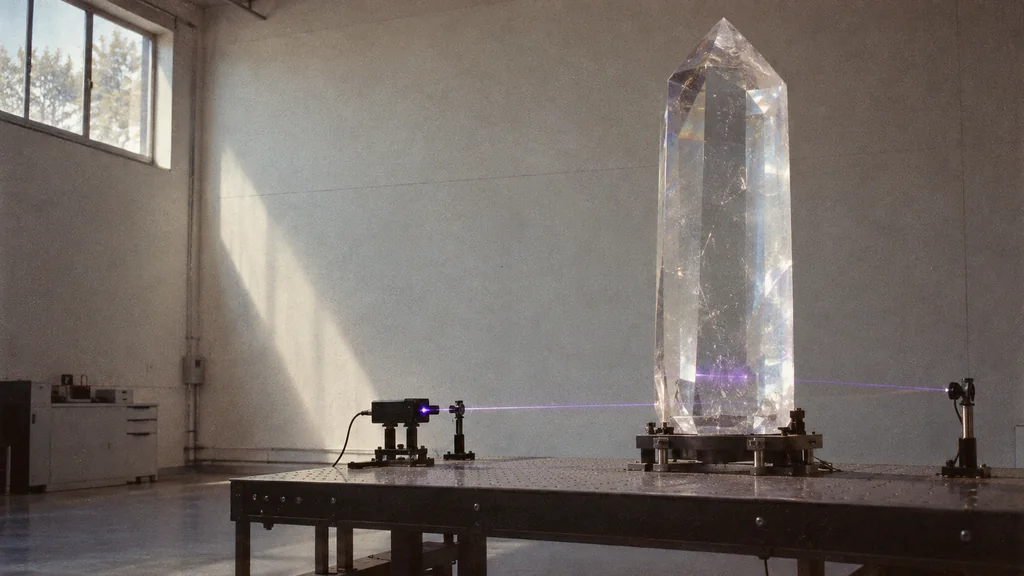
**A nucleus steadies the laser, but its crystal still shifts the reading.**
Image composition · tobriefFor the first time, a laser's frequency is being held in place by the heart of an atom rather than by its electrons, in clocks built by teams in Vienna and Beijing and reported in Nature on 7 October (Reuters). The thorium nucleus now corrects the laser continuously, which gives physicists a new instrument. Tiny frequency shifts caused by the crystals holding the thorium still keep it from being a dependable timekeeper.
Every clock is a rhythm plus a correction. A pendulum swings, and a clockmaker nudges it when it drifts. An atomic clock hands the nudging to physics: a laser is constantly checked against a transition, a jump between two energy states that absorbs light at a characteristic frequency. That frequency is extremely consistent, although the atom's surroundings can shift it slightly.
In conventional atomic clocks, an electron makes the jump. Thorium-229 is unusual because it has a jump inside its nucleus that ultraviolet laser light can reach, while most nuclear transitions need far more energetic radiation. Nuclei are also tiny, so in principle they are less disturbed by stray electric and magnetic fields than the electron clouds around them (Physics World).
How a nucleus takes the wheel
Both teams embedded thorium-229 in small calcium-fluoride crystals and shone a narrow ultraviolet laser through them. At exactly the right frequency, the nuclei absorb slightly more light. The control system nudges the laser to either side of that absorption peak, works out which side it is on, and pushes the frequency back towards the centre (Vienna Nature paper, Chinese Nature paper).
A car's lane-keeping system works the same way. A camera senses where the lane markings are, and the system makes small steering corrections to stay between them. In the clock, the absorption signal plays the camera and the laser controller turns the wheel.
That feedback loop is the new step. Earlier experiments had already driven the transition with laser light in 2024 (Physical Review Letters). There, the signal was commonly detected through the slow afterglow of excited nuclei, which arrives far too late to correct a laser moment by moment. Finding a radio station once is different from staying tuned to it, and direct absorption is fast enough for the second job.
The two groups got there separately. TU Wien describes its device as a self-stabilising nuclear clock (TU Wien), while the Chinese effort was led from Tsinghua University (Tsinghua). Two independent builds of the same idea make a stronger case than one.
Steady, but not yet right
Clock scientists judge two different qualities. Stability asks how evenly a clock ticks from moment to moment, and on that measure neither prototype yet matches established optical atomic clocks. Accuracy asks whether the clock is quietly running at the wrong frequency, like a watch that ticks perfectly evenly but was set five minutes fast.
Accuracy is where the crystal causes trouble. Each thorium nucleus sits in its own patch of crystal, and local strain or defects can nudge its characteristic frequency, so the reading can depend on where the laser passes through. The Beijing team found an encouraging sign: two separately grown crystals gave closely matching frequencies (Chinese Nature paper). A full accounting of every effect that could bias the frequency has yet to come from either team.
Listening for dark matter
Even as an imperfect clock, the device is already useful to physicists. Some theories propose that dark matter, the unseen material that makes up most of the universe's mass, could gently and rhythmically tug on the forces that set these frequencies. A nuclear clock and an electron-based clock would feel that tug differently, so the ratio between their ticking would rise and fall in a regular beat.
Vienna ran its thorium clock alongside a conventional atomic clock and looked for exactly that beat. It found none, and the authors say this rules out some specific dark-matter models rather than dark matter in general (Vienna Nature paper).
The official definition of the second still rests on caesium atoms (BIPM), and these prototypes will not change that soon. What they have shown is that a nucleus can steer a running clock. Turning that into dependable timekeeping now depends on crystals that hold the thorium without pulling its frequency, a problem the crystal growers in Vienna and Beijing are the ones placed to solve.
Details about this article
- Model:
- claude-opus-5-5
- Generated:
- 10/8/2026, 1:37:10 AM
- Pipeline run:
- eu_pipeline_20261008_005007
- Watermark:
- SynthID (Google's invisible watermark)
- Human review:
- None before publication