Thwaites could add 30 millimetres by 2100
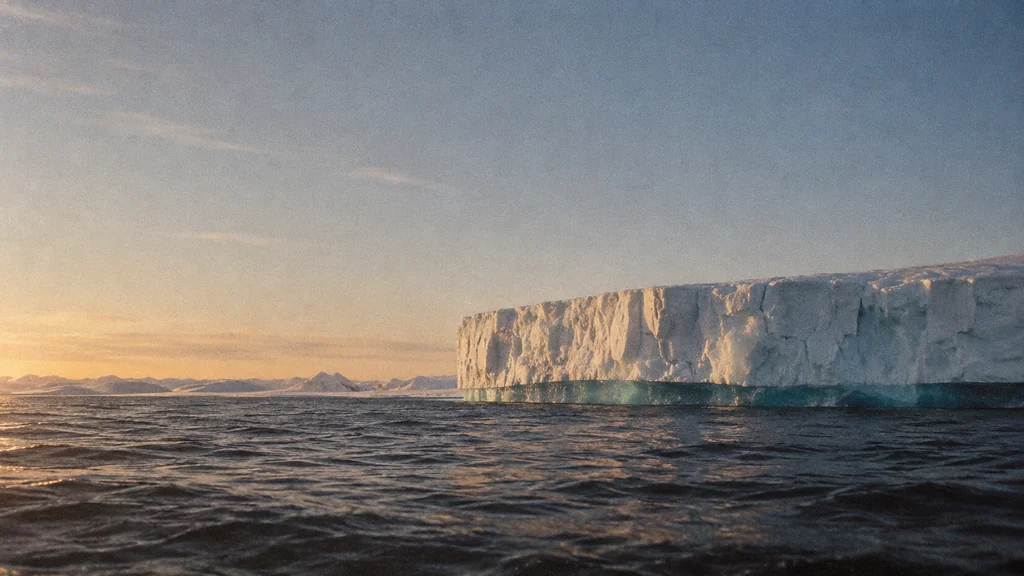
Beneath Thwaites, seawater loosens the ice that still holds the seabed.
Image composition · tobriefMany computer models of Antarctica leave out one kind of melting: seawater eating away at a glacier from below where the ice still rests on the seabed. When a new study added it, Thwaites Glacier, the West Antarctic giant nicknamed the "Doomsday Glacier", was projected to add about 30 millimetres to global sea level by 2100, roughly twice the 15.2-millimetre average of earlier models (Nature Communications). That "twice" needs care. The earlier models disagreed widely, so the comparison sets one carefully tuned case against the middle of a scattered crowd.
The peer-reviewed study, by Mattia Poinelli, Eric Rignot and colleagues, was published on 12 October (PubMed). It is a projection from one model, and its strongest evidence comes from comparing versions of that model with and without the hidden melting.
Where the ice lets go
Picture a heavy raft being pushed down a slipway into a lake. The back still presses on the ramp while the front floats. Glaciologists call the dividing point the grounding line, and standard models treat it as a sharp edge, with the ocean melting ice mainly on the floating side.
Thwaites blurs that edge. As the tides rise and fall, the ice flexes, and seawater can wash in beneath ice that otherwise sits on the bed. Earlier satellite radar work by Rignot's group recorded the ice bending with the tides across a broad band and inferred seawater moving underneath (PNAS). Some of the same researchers worked on both studies, so that observation is the foundation the new model builds on. It is not an independent check of it.
Melting in that band thins the ice exactly where it grips the seabed. As the grip weakens, the glacier can lose contact with high points on the bed that hold it back, and the ice behind flows more freely into the sea. That matters because most of a glacier's contribution to sea level comes from ice that was resting on the seabed before it entered the ocean. Ice already afloat is like an ice cube in a glass: it has largely displaced its weight in water.
Testing the model on the past
Before looking forward, the team checked whether the model could replay what satellites had already recorded between 1996 and 2023. Each run was scored against the observed ice speed, thinning and grounding-line position (Research Square). Getting all three right at once is much harder than matching one. A weather model faces the same test when it must reproduce yesterday's temperature, wind and rain together.
Versions that included a wide melting zone fit that history better than versions without one. The team then ran both forward with the climate held at its 1996–2023 average. Without the zone, Thwaites adds 8.3 millimetres by 2100. With a zone several kilometres wide, it adds 30.1 ± 5.7 millimetres, where the plus-or-minus gives the uncertainty range around the central value (Nature Communications). Holding the climate steady is deliberate. It isolates the effect of the missing melt process instead of guessing how fast the ocean will warm.
What it means for Europe's coasts
The Thwaites figure is one glacier's share of the global average, not the rise any particular coast will see. Local water levels also depend on whether the land is rising or sinking, and on regional ocean conditions (NASA). For Europe, the risk arrives through storm surges and high tides. Without stronger defences, the European Environment Agency expects rising seas to make extreme coastal water levels much more frequent along much of the continent's coastline (EEA).
The study's clearest finding comes from comparing its own runs. The glacier is the same and the climate is held equally steady in both. Once the ocean is allowed to melt beneath ice that still rests on the seabed, the model matches the recent past better and projects a far larger sea-level contribution. That gives the many ice-sheet models that leave this band out a concrete reason to add it.
Details about this article
- Model:
- claude-opus-5-5
- Generated:
- 10/14/2026, 1:44:27 AM
- Pipeline run:
- eu_pipeline_20261014_005006
- Watermark:
- SynthID (Google's invisible watermark)
- Human review:
- None before publication