Thwaites keeps shrinking in zero-melt models
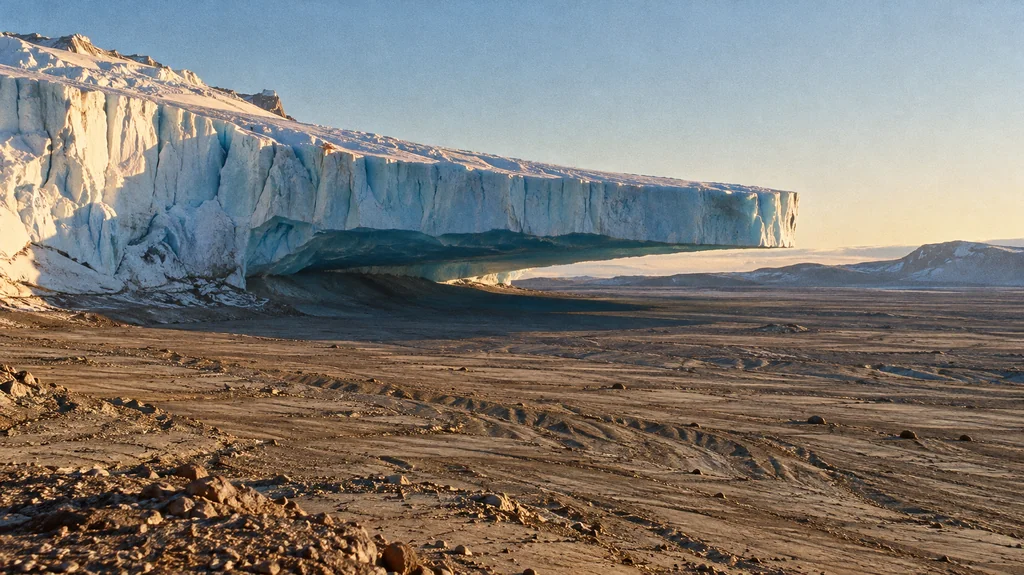
Even with ocean melting removed, Thwaites keeps sending grounded ice seaward.
Image composition · tobriefThwaites Glacier in West Antarctica holds enough ice to raise global seas by about 65 centimetres, according to the British Antarctic Survey, which presents that figure as the glacier's total reserve rather than a forecast. When researchers switched off ocean melting beneath it in three computer models, Thwaites kept losing grounded ice anyway, while its neighbour Pine Island Glacier recovered (Williams et al.). The result suggests part of Thwaites' decline is already built into the glacier's shape, so a cooler ocean alone would not quickly undo it.
Why the ice on the seabed counts
A melting ice cube doesn't overflow a full glass, because floating ice already displaces its own weight. Seas rise when ice resting on land or the seabed slides into the ocean. A glacier is a slow river of that grounded ice, and the point where it lifts off the seabed and starts to float is called the grounding line.
The floating part beyond that line, the ice shelf, still matters. Wedged into its bay and snagged on bumps in the seabed, it resists the ice flowing in behind it, the way a doorstop holds a door someone is leaning on. Warm seawater thins the shelf from below, the grounded ice speeds up, and the grounding line can creep inland. Satellites have tracked Thwaites' line retreating unevenly since 1992, by under 1 kilometre in some places and about 20 kilometres in others (The Cryosphere).
An impossible experiment
The study, led by the British Antarctic Survey, appeared in July and drew wide attention only this month (NERC archive). Its authors set melting under both glaciers' shelves to zero. No real ocean could do that, so the test asks something narrower than a forecast: with the ocean's heat removed, does each glacier settle?
Pine Island did, thickening and pushing its grounding line back toward the sea. Thwaites' main grounding line never substantially readvanced, though its losses slowed over time. All three models agreed on that direction and disagreed considerably on how much ice Thwaites lost (Williams et al.).
Pine Island's recovery shows that switching off melt in these models does not automatically leave a glacier shrinking. Agreement across independently built models strengthens the Thwaites result, although models resting on similar physics can share blind spots.
The authors read Thwaites' continued loss as partly a delayed reaction (Williams et al.). Earlier disturbances, including past ocean-driven retreat, seem to have left it with a shape that keeps sending ice seaward. Picture an undercut sand slope that keeps slumping after you stop digging, because its steepened profile is now the problem. The models cannot say which event started this, or how much was natural rather than human-caused.
Stubborn, but not runaway
Steady loss also differs from collapse. In the zero-melt runs Thwaites' losses tapered off, and independent glaciologist Mathieu Morlighem told New Scientist that they do not produce collapse of the wider West Antarctic Ice Sheet. A 2023 three-model study pointed the same way, finding that today's Antarctic grounding lines could return to their positions after small disturbances, a sign that runaway retreat is not yet locked in (Hill et al.). Williams told the magazine that further ocean warming would still speed Thwaites' losses.
A separate study by Mattia Poinelli and Eric Rignot, which we covered last week (To Brief), adds seawater seeping under grounded ice near Thwaites' edge. Earlier radar surveys had seen the ice there flex with the tides and inferred that seawater was getting underneath (radar study). After checking their model's past against observed speed, thinning and grounding-line position, Poinelli and Rignot projected about 30 millimetres of sea-level rise from Thwaites by 2100 if climate holds at its recent average, against a 15.2-millimetre average from earlier models (Nature Communications). That gap between projections is the reported "doubling"; nobody has measured Thwaites losing ice twice as fast today.
For Europe's coasts, higher average seas make damaging extremes more frequent, while local water levels also depend on land movement and regional ocean conditions (European Environment Agency).
Across the models, Thwaites went on losing grounded ice after its ocean melting was switched off, while Pine Island recovered, and the models disagree only about how much Thwaites lost. Zero melt is a hypothetical test, so none of this forecasts a cooling ocean. What it reveals is a glacier whose decline is no longer driven by the ocean alone.
Details about this article
- Model:
- claude-opus-5-5
- Generated:
- 10/20/2026, 7:05:24 PM
- Pipeline run:
- eu_pipeline_20261020_180759
- Watermark:
- SynthID (Google's invisible watermark)
- Human review:
- None before publication