Three Russian missiles in Poland, none shot down
AI Daily Synthesis
Image composition · tobriefIn Nowy Lipowiec, eastern Poland, a homeowner says the explosion on 20 November shook his house, knocked things off his garage shelves and sent a fragment into the roof (Interia). Two days later, prosecutors in Lublin, a city in eastern Poland, announced that debris from Kh-101 missiles had been found there and at two other impact sites. The Kh-101 is a Russian guided cruise missile that flies at low altitude (Lublin prosecutor’s office). None was shot down, although a Swedish pilot under NATO command had conditional permission to fire (Rzeczpospolita).
The finding changes the initial picture. On the day the objects fell, Defence Minister Władysław Kosiniak-Kamysz said the first site held a Kh-101, the second a possible missile and the third a possible jet-powered drone (Defence Ministry). That was the account we reported at the time (To Brief). Prosecutors now provisionally assess that all three were made in Dubna, in the Moscow region, in the final quarter of 2026 (Lublin prosecutor’s office). In other words, the missiles had left the production line less than two months before falling in Polish fields. Their identification remains provisional until laboratory examinations are complete.
The three missiles were part of a large Russian strike on Ukraine that night involving nearly 100 missiles and 400 drones. According to Yurii Ihnat, a spokesperson for the Ukrainian Air Force, the Kh-101s headed mainly towards western Ukraine, near the Polish border (Focus). Moscow says it targeted defence industry sites, warehouses, and energy and transport infrastructure. In Russia, the strike was presented as retaliation for Ukrainian attacks on the Kerch Bridge, which links Russia to occupied Crimea (Trud).
In the Polish villages, the warning came down to minutes. Residents had five minutes between the sirens and impact in Nowy Lipowiec, and three in Rudnik, according to the Interior Ministry’s timeline (Onet). In the first village, the missile fell in a field beside a forest, 200 to 300 metres from the nearest houses (Dziennik Wschodni). Regional prosecutor Grzegorz Trusiewicz confirmed minor damage to the roof of a nearby house. Investigators have not determined whether a fragment or the blast wave caused it (Radio Lublin). The other two missiles fell in a forest and on undeveloped land. No one was injured at any of the sites.
The Gripen in bad weather
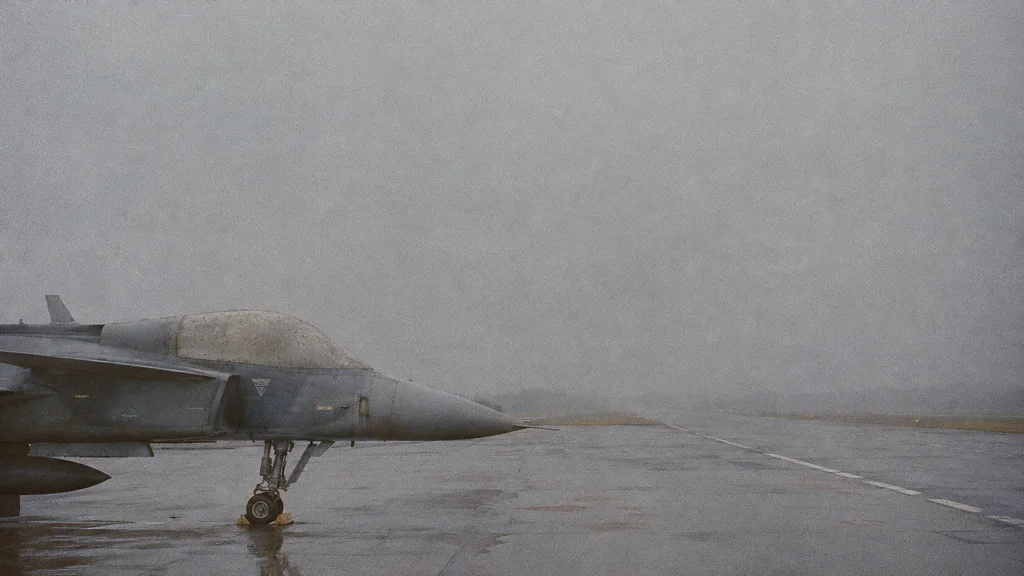
Swedish Gripen fighter jets operated for hours in “very difficult” weather and poor visibility under the command of NATO’s air operations centre in Uedem, Germany (Swedish Armed Forces). According to Polish operational commander Ireneusz Nowak, the centre had granted conditional permission to fire, leaving the decision to engage to the pilots (press conference recording). One pilot approached a target he assessed as a possible cruise missile. In the bad weather, he could identify it neither by sight nor with his electro-optical sensors, so he did not fire (Kyiv Independent).
The permission was not an order to fire. It required identification, and that condition was not met. The conditions are known only from the Polish side. A Swedish government spokesperson told TV4 that they could not comment on exactly what had been authorised (TV4). The window was narrow: Kosiniak-Kamysz estimated that one Kh-101 travelled about 50 kilometres from the border to its impact site, or roughly three minutes of flight (Ukrinform).
Detection worked; identification failed. Radars picked up the tracks and a fighter reached the target, but the final step, establishing what was flying through the bad weather, was beyond the pilot. The rule protects civilians from a mistaken shootdown and debris falling on villages, but allows a missile the pilot cannot identify to continue flying.
Poland is taking the issue today to the North Atlantic Council, NATO’s political decision-making body, which acts only with the agreement of every member, including Greece (NATO). Deputy Defence Minister Paweł Zalewski said he would present proposals to strengthen air defences without invoking Article 4, the provision for formal consultations when a member considers itself threatened (RBC-Ukraine). Warsaw is asking for additional AWACS early-warning aircraft, which carry airborne radar, and F-35 fighter jets (Stars and Stripes).
Intent remains in question. Prime Minister Donald Tusk raised the possibility of a deliberate provocation. He suggested a possible link between the missiles’ arrival and an exercise by the Coalition of the Willing, a group of countries planning support for Ukraine’s security, in Nowa Dęba, a town in southeastern Poland, attended by foreign defence ministers (Euronews). On the Russian side, Kommersant reported on 22 November that Moscow had not commented on the incident (Kommersant).
Experts are divided. Retired lieutenant colonel Maciej Korowaj considers a malfunction or interference possible (RMF24), while Major Michał Fiszer doubts that interference explains such flight paths (Rzeczpospolita). Neither has flight data. Nowak says the military knows the launch sites, numbers and directions, but has not made them public (Zero.pl). Until the trajectories are released, calling the incident a “provocation” remains a political assessment.
The system’s failure was at the requirement for visual identification, which could not be met on a night of bad weather. The airborne radars Warsaw is now requesting provide more time, but no more visibility. No radar can change that requirement.
Details about this article
- Model:
- claude-opus-5-5
- Generated:
- 11/23/2026, 4:22:10 AM
- Pipeline run:
- incremental_20261123_033011
- Watermark:
- SynthID (Google's invisible watermark)
- Human review:
- None before publication