Turkey contests Cyprus survey and Greek drill notices
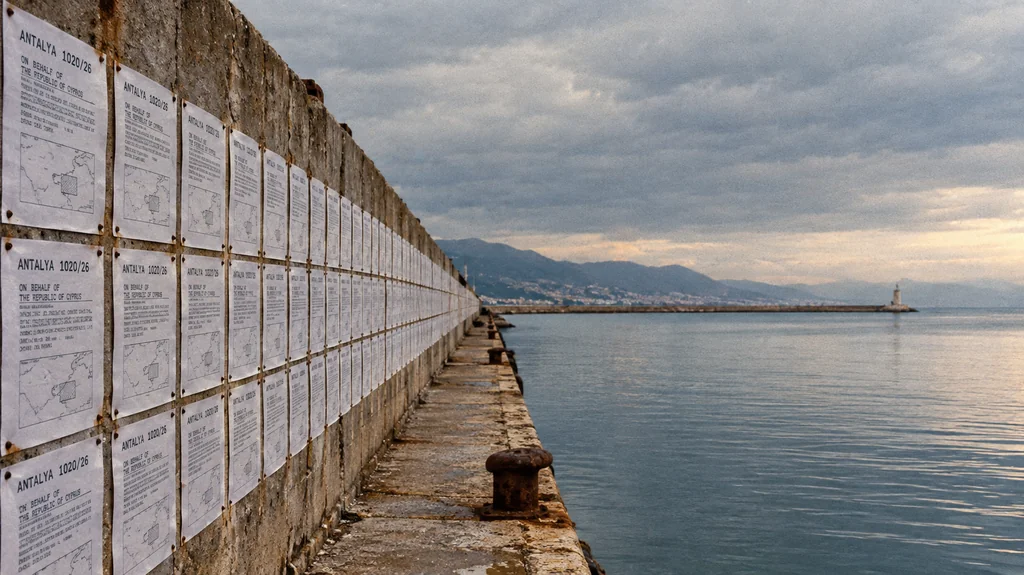
Turkey’s rival broadcasts record claims without directing a vessel away.
Image composition · tobriefTurkey answered two maritime safety warnings with rival notices from its Antalya station on 16 October (Politis). Neither warning concerns the Great Sea Interconnector, the EU-backed electricity cable meant to link Greece and Cyprus. The next decisions on that project belong to Greek and Cypriot officials.
Two warnings, two Turkish replies
The Cypriot warning, numbered MA37-302/26, announces seabed surveys by the vessel Kobi Ruegg for a data-cable system from 21 October to 2 November (SeaLagom). It is a telecoms project, not the power link.
Turkey's reply, notice 1020/26, cited that warning, claimed the area lies on Turkey's continental shelf and disputed Larnaca's right to broadcast at all (Naftemporiki). The continental shelf is the seabed extending from a country's coast, where that country holds exclusive rights to explore resources. Ankara invokes it to claim a say over surveys on that seabed.
A seabed claim, however, does not decide which station issues safety warnings to passing ships. According to Naftemporiki, the Turkish notice did not name the ship, propose another route or order anyone away.
The Greek warning, issued from Heraklion, covered a naval drill south of the island of Kastellorizo on 19 October. Turkey's notice 1018/26 repeated its times and areas, changing only the claim that Antalya, not Heraklion, was the competent station (To Vima).
What a rival broadcast can and cannot do
These notices are NAVTEX messages, standardised radio broadcasts that warn ships about hazards such as drills or survey work. Their service areas are arrangements for delivering warnings, not maps of sovereignty (IMO). A rival notice cancels nothing, grants no permit and draws no border. It puts a claim on record.
That claim has substance. Ankara asserts rights over the Cypriot survey area itself, so the dispute goes beyond radio procedure. What the notices show is narrower: they contest Greek and Cypriot authority without telling any vessel to leave.
The two sides argue from different rulebooks. Greece and Cyprus have joined the UN Convention on the Law of the Sea, the global treaty setting out maritime zones, while Turkey has not (UN Treaty Collection). Athens holds that islands generate full maritime zones. Ankara, in a letter to the UN, argued that islands off its coast deserve less weight and that Cyprus cannot act without Turkish Cypriot consent (UN letter).
The power cable waits on Athens and Nicosia
The Great Sea Interconnector is meant to end the isolation of Cyprus's electricity grid. A 2025 Commission document listed €645.2 million in EU support for its works (EUR-Lex).
Its survey ship is a different vessel, the French-flagged Abeille Marengo. On 14 October the Greek Coast Guard published an application for an exemption allowing its use (Hellenic Coast Guard). The public record shows the application, not a decision on it.
Cyprus controls the other step. Energy minister Michalis Damianos said he expected a survey notice for the power cable within two to three weeks and tied a €25 million Cypriot payment to its issue (Politis).
The project has met Turkish objections before. In 2024 the survey vessel Ievoli Relume finished its scheduled work between the Greek islands of Kasos and Karpathos despite them (ADMIE). That covered one section of the route between two Greek islands, and it says little about how work nearer Cyprus would go.
This week's Turkish notices put two objections on record: to who may broadcast in these waters, and to a data-cable survey on what Ankara calls its seabed. They ordered no ship away. The power cable's next documented steps, a Greek exemption and a Cypriot survey notice, depend on Athens and Nicosia. The broadcasts do not show how Turkey would respond once a vessel actually works at sea. Until then, treating this exchange as a clash over the EU-funded cable ties European money to a quarrel that concerns a commercial data line.
Details about this article
- Model:
- claude-opus-5-5
- Generated:
- 10/17/2026, 1:32:29 AM
- Pipeline run:
- eu_pipeline_20261017_005006
- Watermark:
- SynthID (Google's invisible watermark)
- Human review:
- None before publication