Two countries dominate Atlas Nexus haul
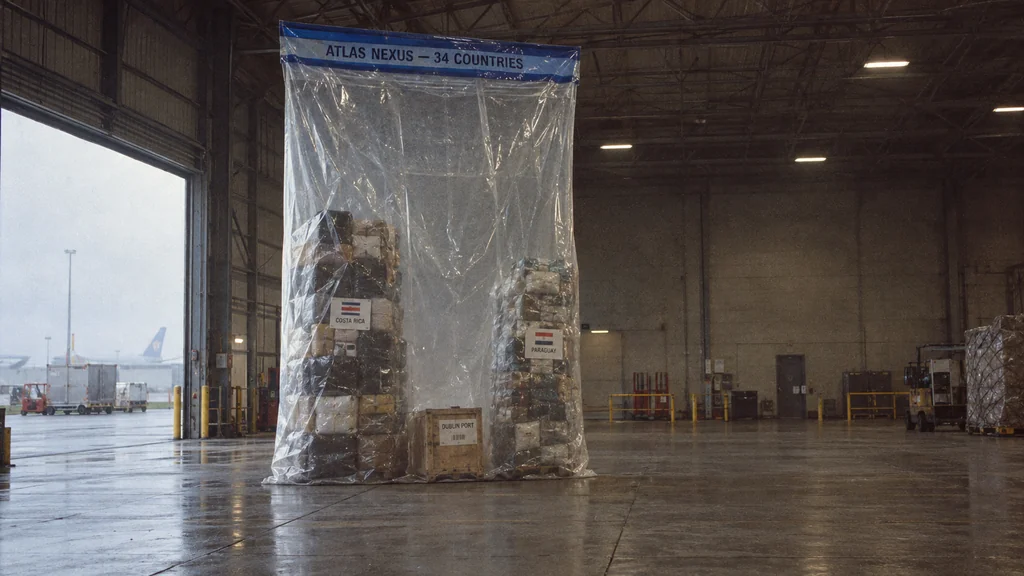
One international total conceals where the arrests and seizures occurred.
Image composition · tobriefBelgium's federal police presented Operation Atlas Nexus on 21 September as a single multinational crackdown: more than 490 arrests and 156.9 tonnes of drugs seized across 34 countries (La Libre, Garda). The operation was real. But it was an umbrella over legally separate national cases, not one coordinated raid against one organisation, and the geographic breakdown shows results concentrated far from Europe.
Most of the Results Came from Two Countries
Costa Rica produced roughly 375 of the 490 arrests, along with more than 27.8 tonnes of drugs, 181 firearms and 169 properties. Costa Rican investigators named a specific network, "Pecho de Rata," and a fugitive tied to a cocaine route running from Colombia through Costa Rica's Caribbean coast toward Europe (La Nación).
Paraguay reportedly contributed another 104.96 tonnes of cannabis and eight arrests (DHnet). Together, these two countries supplied the vast majority of arrests and seized drugs.
Ireland offers the clearest documented European result. In June and July 2026, Irish police and customs targeted cocaine concealed in South American wood imports. Roughly 24 kilograms were found at Dublin Port in a container that had transited Rotterdam (Garda, TheJournal.ie). Irish authorities noted that at least one investigation remained open (Garda). Beyond Ireland, the published European record thins out fast.
Europe's Major Trafficking Countries Are Missing from the Record
The Netherlands, Spain, France, Italy and Portugal all have ports and trafficking routes that make them obvious participants. Yet the reviewed press releases and media accounts attributed no Atlas Nexus arrest or seizure to any of them. Rotterdam appeared as a transit node in the Irish case, not as the site of a Dutch enforcement action (NU.nl). Italian coverage named Italian officials inside the coordination system but reported no Italian police operation (ANSA).
This does not prove those countries did nothing. Intelligence may have been shared confidentially. But the announced totals do not come with a country-by-country account. Belgium's federal police published the aggregate figure; national authorities own the underlying cases. What is missing is a public breakdown showing which government delivered which results.
Coordination Worked. Dismantlement Remains Unproven.
Atlas Nexus ran under EMPACT, the EU Council's framework for coordinating member states against organised crime (Council). Europol, Frontex and Interpol supported the operation. None of these bodies can arrest or prosecute anyone. Every search warrant, detention and trial was a national act under national law.
The Costa Rican results come closest to showing evidence that investigators weakened a network itself: named suspects, an alleged route, identified properties. The rest of the tally looks more like commodity interception, where drugs are seized without proof that the organisations behind them were damaged. As the UN Office on Drugs and Crime has documented, large seizures can coexist with record production and stable supply (UNODC).
The financial picture deepens that doubt. According to NU.nl, authorities reported roughly $135,000 in cash and cryptocurrency. Properties, jewellery and other assets were also seized, but their value was not published. Without a usable account of financial disruption, the claim that trafficking networks were dismantled rests on seizure volume alone.
Belgium's Liège-based federal judicial police played a legitimate role: helping national authorities coordinate across time zones and legal systems (La Libre). That work has value. Calling the result "Belgian-led" becomes misleading only when it obscures where the raids and the work of bringing cases to court actually fell.
The published record establishes cross-border coordination. Any claim of transatlantic network dismantlement awaits linked charges and court-tested cases across those 34 jurisdictions.
Details about this article
- Model:
- claude-opus-4-6
- Generated:
- 9/22/2026, 2:16:36 AM
- Pipeline run:
- eu_pipeline_20260922_005006
- Watermark:
- SynthID (Google's invisible watermark)
- Human review:
- None before publication