Ukraine’s school law opens 17 EU chapters
A school law clears one gate in Ukraine’s EU membership talks.
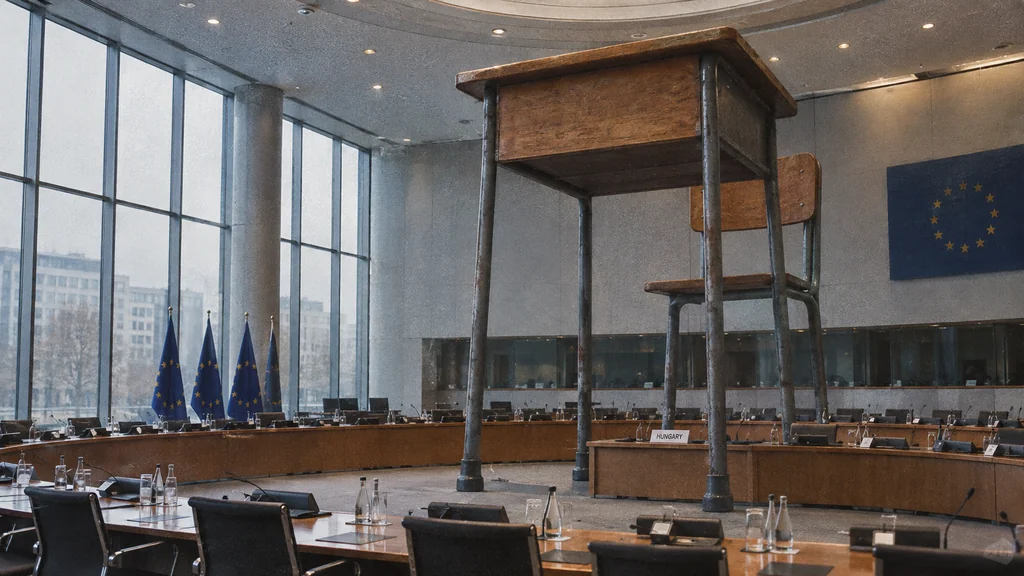
Image composition · tobriefUkraine and Moldova each opened 17 new chapters of their EU membership negotiations on 13 October (Council). The day before, Ukraine's parliament passed the minority-schools law Hungary had demanded, and Hungary's foreign minister then said Budapest could give its consent (Rada, Telex). The sequence shows what one government can extract when every step of enlargement needs all member states to agree.
What actually opened
Opening chapters does not mean joining. The talks are grouped into six clusters of related chapters. This week's two cover the rules of the single market, Europe's shared market for goods, services, workers and capital. Each country now has four of the six clusters open (Council).
Opening a cluster means EU governments have written down the tests a candidate must pass before any chapter in it can close. For Ukraine, one test is enforceable control of state aid. In plain terms, Ukraine needs an authority that can stop public money from propping up favoured companies against competitors elsewhere in the market (Cluster 2 position).
Neither country received a membership date. That comes only with an accession treaty that every member state must approve and ratify (Article 49 TEU).
The price of Hungary's yes
Hungary's grievance dates back to Ukraine's 2017 education changes. The Venice Commission, the Council of Europe's panel of constitutional lawyers, urged Kyiv at the time to rebalance them (Venice Commission). Budapest refused to back this week's step until Ukraine legislated stronger guarantees for minority-language schooling.
The Rada, Ukraine's parliament, passed bill No. 16119 on 12 October with 266 votes (Rada). Foreign minister Anita Orbán then said Hungary could consent. She also promised to monitor implementation together with minority groups in Transcarpathia, the western Ukrainian region where most of Ukraine's Hungarians live (Telex). Member states agreed the EU's written negotiating positions that same day (Cluster 3 position, To Brief).
The same law covers Romanian speakers, and Bucharest is not finished with it. President Nicușor Dan welcomed the new wording, but said Romania would keep working so children can study in Romanian through high school (Aradon).
Moldova moved on the same day
Moldova had no part in the school dispute. It negotiates on its own positions, which in principle means it is judged on its own record. Yet it opened the same clusters on the same day as Ukraine, at a separate conference (Council).
The public record shows the two files moving together. It does not show that anyone held Moldova back to wait for Kyiv. If the pairing continues, though, a veto aimed at Ukraine would stall Moldova too.
The Commission wants to take that single-country brake off the middle of the process. On 6 October it proposed qualified-majority voting for intermediate steps such as opening clusters, while keeping unanimity for final admission (Commission). If adopted, Hungary alone could no longer block a step like this week's. A decision would instead need at least 15 of 27 governments representing 65% of the EU's population (EU Treaty).
A Commission proposal changes nothing by itself. Member governments would have to adopt it, which gives the capitals that hold today's veto a say over giving it up. The proposal played no part in this week's decisions.
Hungary is not alone in using these gates. Greece's foreign minister Giorgos Gerapetritis has tied Albania's further progress to secure property titles for the Greek minority there (Greek MFA).
Budapest named a law, Kyiv's parliament passed it, and the talks advanced the next day. One capital set part of a candidate country's legislative agenda as the price of a procedural step, and it got that price. The caveat is that Hungary's consent covers this step only. Two clusters, including agriculture and cohesion money, remain unopened (Council). Unless governments adopt the Commission's voting change, opening them will again require a yes from every capital, Budapest included.
Details about this article
- Model:
- claude-opus-5-5
- Generated:
- 10/14/2026, 1:38:13 AM
- Pipeline run:
- eu_pipeline_20261014_005006
- Watermark:
- SynthID (Google's invisible watermark)
- Human review:
- None before publication