UNEP’s 1.5°C route needs an 18% cut
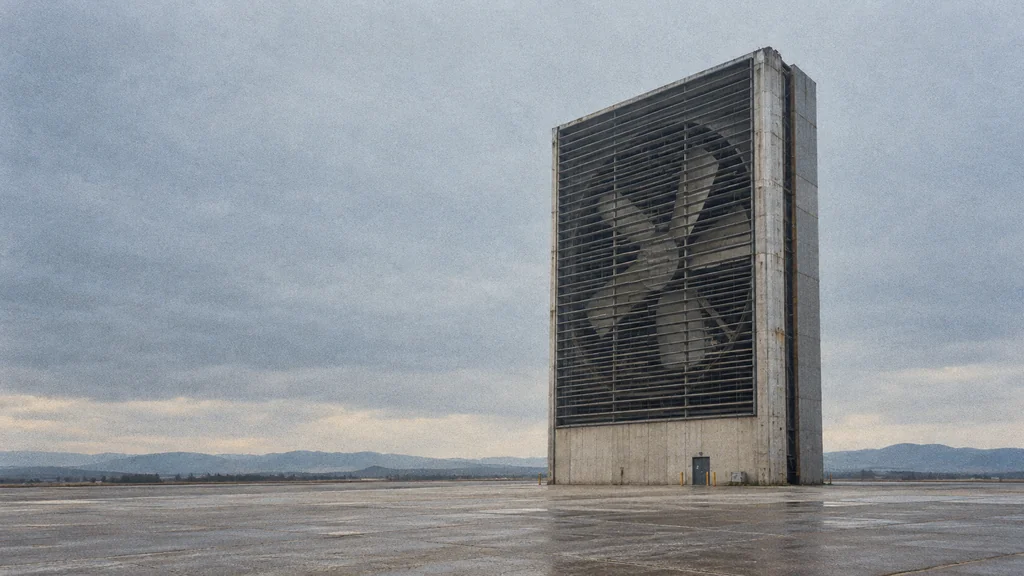
The route back below 1.5°C depends on removal capacity barely built today.
Image composition · tobriefThe world will probably pass the Paris goal of 1.5°C of warming. Getting back below it would take two things: steep emission cuts starting immediately, and decades of pulling carbon dioxide back out of the air. Under the feasibility criteria it uses, the UN Environment Programme (UNEP) judges a path with no or only limited overshoot out of reach, so this year's report maps the lowest and shortest overshoot still possible (Carbon Brief).
The first step is already a stretch. That route needs emissions 18% below 2025 levels by 2030, while national pledges, even if fully delivered, would cut them by 5–8% (UNEP release). Earlier this week we reported that even UNEP's best case overshoots the Paris goal (To Brief). The mechanics behind that best case show why delay costs so much.
A bathtub with almost no drain
A rough way to picture it is a bathtub. Emissions are the tap, and because carbon dioxide lingers in the atmosphere for a long time, the water keeps rising. Cutting emissions turns the tap down, but the tub still fills.
To bring temperatures back down after an overshoot, the IPCC, the UN's climate science panel, finds the world would need net-negative CO₂ emissions: removing more carbon than it still releases, sustained over time (IPCC). In the tub picture, the drain has to run faster than the tap.
On UNEP's lowest-overshoot route, warming peaks around mid-century at roughly 1.7–1.8°C, with about a 50% chance of returning to 1.5°C or below by 2100 (UNEP full report). That coin flip describes how the climate might respond if the world followed the route. It says nothing about whether governments will.
The route also assumes deep cuts began in 2025, years later than older low-overshoot pathways assumed (Carbon Brief). Years of slow action are already built into the plan, which leaves less slack for more.
The drain is barely built. Newer removal methods, meaning techniques such as capturing CO₂ from the air and storing it underground rather than planting forests, delivered about two million tonnes in 2025, according to the independent State of Carbon Dioxide Removal assessment (State of CDR). Against the tens of billions of tonnes the world emits each year, that is a trickle.
How far off course we are
Under current policies, UNEP projects around 2.8°C of warming by 2100, still rising afterwards. Meeting every pledge, including long-term net-zero targets, brings that to about 2.1°C (UNEP release). Even that best case sits well above the lowest-overshoot route.
New promises have not moved the needle much. By September, 124 parties covering about 76% of global emissions had submitted updated pledges, yet UNEP judged their effect on projected warming negligible (UNEP full report).
Clean technology has done better than forecasters expected. In 2025, renewables produced 33.8% of the world's electricity, edging past coal at 33.0% (Eco-Business). Since 2015, solar capacity has grown about seven times faster than projections made then anticipated (UNEP release). The tools for turning down the tap exist and are spreading.
They have not yet bent the global curve. The pathway requires greenhouse-gas emissions to fall by an average of 5.7% a year from 2025 to 2035 (IISD). UNEP cannot even confirm emissions have peaked: its 2025 estimate of 58.4 billion tonnes carries a margin of error of about 5.5 billion either way, larger than the apparent dip from 2024 (UNEP full report).
Why Europe should watch the peak
How high and how long the overshoot runs matters most where warming is fastest. The European Environment Agency found Europe warming roughly twice as fast as the global average, with some risks to health, water and infrastructure already critical (EEA).
Cooling later does not reverse everything. The IPCC finds that overshoot risks grow with both height and duration, and later cooling cannot necessarily restore lost ecosystems or undo ice-sheet melt (IPCC). A possible return to 1.5°C late this century is no reason to delay adapting to the hotter decades in between.
Europe's own delivery is uncertain too. UNEP's review of G20 economies rates the EU's prospects of meeting its unconditional 2030 target as inconclusive (UNEP full report).
Governments meeting in Antalya for the next UN climate conference will show whether the gap between pledges and the route starts to close (IISD). Until it does, each year of delay is paid for twice: in hotter decades, and in carbon that must later be pulled back out of the tub.
Details about this article
- Model:
- claude-opus-5-5
- Generated:
- 10/23/2026, 1:33:23 AM
- Pipeline run:
- eu_pipeline_20261023_005007
- Watermark:
- SynthID (Google's invisible watermark)
- Human review:
- None before publication