US asks about Donbas, but NATO decides
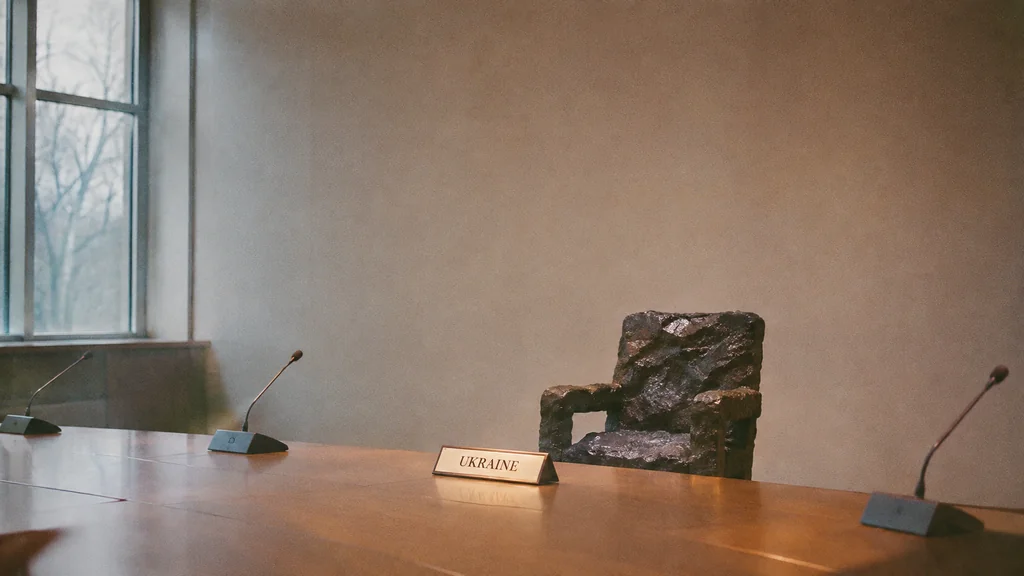
A question about Donbas leaves Ukraine’s place at the table unresolved.
Image composition · tobriefVolodymyr Zelensky says American negotiators asked him, for the first time, whether Ukraine would leave Donbas if it were inside NATO. Donbas is the eastern industrial region Russia partly occupies. He told reporters on Friday 13 November, and the reports carrying his account rest on his words, not on any US source (Interfax-Ukraine, Reuters). The White House has not confirmed raising the issue (Washington Post).
Even as a question, it depends on two decisions no American negotiator controls. Kyiv decides about its land. Every NATO ally decides about who joins.
A question, not an offer
Zelensky did not name the American who asked. He described no map and no terms that Washington, NATO or Kyiv had accepted. The question surfaced while US envoys Steve Witkoff and Jared Kushner work on a wider security framework for ending the war.
Moscow has not responded to the scenario. In December 2021 its foreign ministry published a draft agreement with NATO that sought to block any further enlargement of the alliance (Russian foreign ministry). That document predates the current talks and cannot tell us Moscow's answer today. It does show that keeping Ukraine out of NATO was a goal Russia set out in writing.
What Kyiv says it would need
Zelensky listed conditions for even discussing the idea, and security comes first. He wants specific guarantees from NATO and the EU, plus a Ukrainian army with enough troops, weapons and money for a defined period (Interfax-Ukraine).
He has reason to insist on detail. He says he asked whether American assurances modelled on NATO's would mean US troops in Ukraine, and was told no (NV). Ukraine already holds one American promise of this kind. The 2024 US-Ukraine security agreement commits Washington to consult within 24 hours of an attack, not to send soldiers (White House).
He also wants a recovery plan with identified funding. He says any talks would not mean recognising occupied land as Russian. Reuters reported that he would put a package to a referendum (Reuters). His published quotes promise only an "open dialogue with society," and no referendum has been announced (Financial Times).
Who decides on membership
Membership is not Washington's to trade. Article 10 of the North Atlantic Treaty says allies can invite a new member only by unanimous agreement, and each must then ratify under its own national rules (NATO). A single government that refuses can stop the deal.
Membership would also not settle the defence question by itself. Article 5, the alliance's mutual-defence clause, obliges each ally to take whatever action it deems necessary if another member is attacked. It does not require every ally to send troops (NATO). That leeway helps explain why Zelensky wants specifics before he talks about land.
European governments have not answered the question Zelensky described. The Dublin declaration of 12 November, a statement of European security principles published by the French presidency before he spoke, affirmed Ukraine's internationally recognised borders. It also said peace must be decided with Kyiv (Élysée).
Europe has also not settled who would speak for it. On 13 November, António Costa, who chairs summits of EU leaders as European Council president, proposed a team to carry Europe's position into the talks. It would be made up of France, Germany, Italy, Poland, the UK and the EU institutions (Council of the EU). Security guarantees would go to the "coalition of the willing," the group of countries led by Britain and France that is preparing to back a postwar settlement, working with NATO.
That team has no agreed mandate. Even with one, it could not promise Ukraine a seat in the alliance, because the allies outside the team keep their own votes.
The White House has not said whether it asked the question. If Zelensky's account is accurate, Washington raised a scenario it cannot deliver on its own; Kyiv and every NATO ally would still have to agree.
Details about this article
- Model:
- claude-opus-5-5
- Generated:
- 11/15/2026, 1:47:57 AM
- Pipeline run:
- eu_pipeline_20261115_005007
- Watermark:
- SynthID (Google's invisible watermark)
- Human review:
- None before publication