US blacklists ICC, keeps payments open
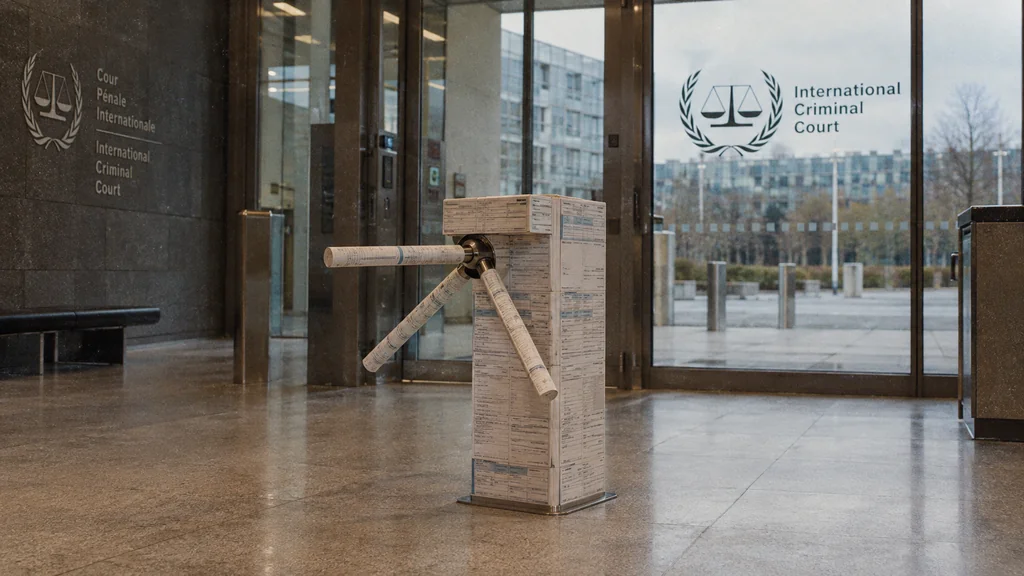
The court’s payments remain permitted, but its suppliers must choose to stay.
Image composition · tobriefWashington put the International Criminal Court on its sanctions blacklist as an institution on 9 October, freezing any court property in the United States or held by Americans (OFAC, ICC). A temporary US permission keeps the court's routine US-linked payments legal until 7 April 2027 (OFAC General License 13). Washington decides whether that permission is extended. The court's European backers have voiced support, but they have not shown publicly who would handle its money if the permission runs out.
The US had already sanctioned individual judges and prosecutors. Last month we reported that a move against the court itself was being prepared (To Brief).
Secretary of State Marco Rubio says the listing aims to stop the court acting against Americans and to restrict its resources (US State Department). The US never joined the Rome Statute, the treaty that created the court. It rejects the court's authority over citizens of countries outside the treaty, such as the US and Israel.
The court answers with geography. Its treaty lets it investigate crimes committed on a member state's territory, whoever commits them. It calls the sanctions an assault on the rule of law and says it will pursue all its cases (ICC).
What the six-month permit covers
On listing day, OFAC (the Treasury office that runs US sanctions) issued four general licences, which are blanket exemptions from the ban (OFAC). They apply only to dealings with a US connection: Americans, US companies, or money that passes through the US.
The broadest, General License 13, covers what keeps the court running. That includes member-state contributions, salaries, health insurance and rent, until 7 April 2027 (OFAC General License 13).
After that date, those payments lose their cover unless Washington renews it. A State Department fact sheet, as republished by Forth, presents the window as time for the court's members to settle US concerns through diplomacy (State Department fact sheet via Forth). The US has set both the ban and the deadline, and it holds the power to move the deadline.
Why a licence does not keep a supplier
A licence makes a service legal. It does not make a supplier willing. Banks, insurers and software firms with US subsidiaries, US assets or correspondent banks (the partner banks that process their cross-border payments) can decide the exposure is not worth it.
The court has already lost one supplier. Its health-insurance contract with the French insurer AXA ended on 1 October by mutual agreement, with both sides fearing wider sanctions (Reuters). That exit came before the institution itself was listed.
Reuters also reported that the court has arranged alternative banking and insurance (Reuters). Those arrangements have not yet been tested by the new listing. Their durability is unproven.
Europe's support, and the limit of its one legal tool
Eight governments rejected the sanctions on 9 October, including two from outside Europe, Canada and Japan (joint statement). Their statement named no shared bank, guarantee or insurer for the court.
The Netherlands hosts the court. Prime Minister Rob Jetten called the six-month window essential room for dialogue and promised to weigh countermeasures with allies (Dutch government). He did not name a bank willing to handle the court's payments.
Belgium wants more. Foreign Minister Maxime Prévot is asking the EU to shield European firms through its Blocking Statute, and he has put the court on EU foreign ministers' agenda for 12 October (Belgian Foreign Ministry).
Ministers can push, but the decision belongs to the European Commission. The Blocking Statute forbids EU companies from complying with the foreign sanctions listed in it. Today those are US measures on Cuba and Iran, and only the Commission can add the ICC sanctions (EUR-Lex).
Even if it does, the law has a hard limit. It cannot protect a company's US assets, and it cannot force a bank to take the court as a client. That is the AXA problem again.
The balance of power is lopsided. Washington controls the permission for the court's US-linked payments and decides whether it survives past 7 April. European governments have backed the court in words, but the statements on record offer no public backstop for the suppliers who would carry the risk if that permission lapses. The Commission now has to decide whether to extend the Blocking Statute. A yes would still leave the court relying on banks and insurers choosing to stay.
Details about this article
- Model:
- claude-opus-5-5
- Generated:
- 10/10/2026, 1:36:23 AM
- Pipeline run:
- eu_pipeline_20261010_005006
- Watermark:
- SynthID (Google's invisible watermark)
- Human review:
- None before publication