Usmanov dispute leaves EU seven days
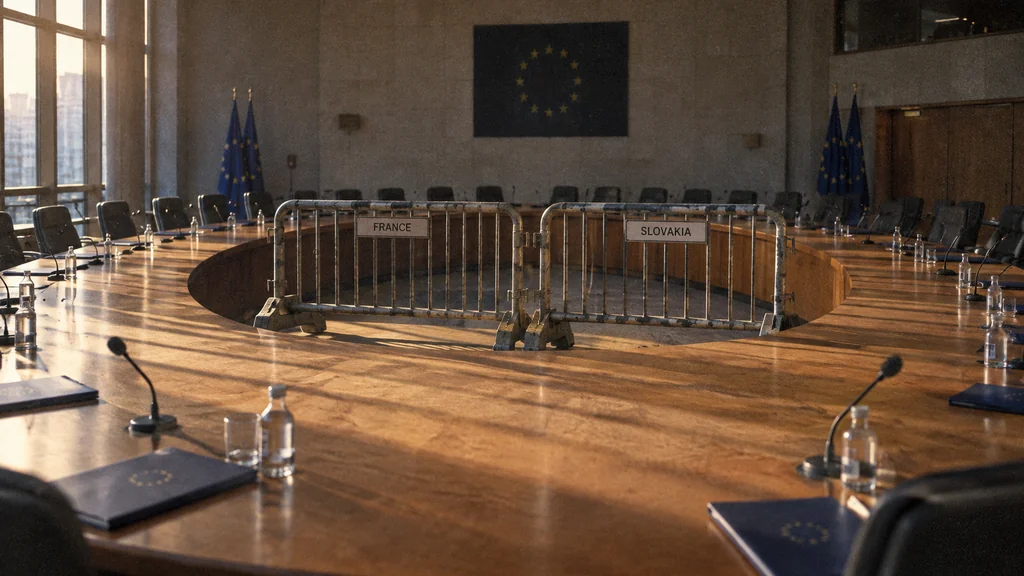
Two national objections barricade Europe’s sanctions renewal once again.
Image composition · tobriefThe EU's blacklist of sanctioned Russian individuals was due to expire at midnight on 15 September. After a morning meeting among EU ambassadors failed, an afternoon session produced political agreement on a seven-day bridge that preserves every listing until 22 September (Interfax-Ukraine, European Pravda). The bridge keeps the names on the list. It does not resolve the dispute behind the delay: diplomats say France and Slovakia are withholding agreement on a standard renewal unless the Council (where member-state governments make binding EU decisions) removes Russian billionaire Alisher Usmanov from the list (Politico).
Ambassadors can settle a text politically, but the Council must still formally adopt it. Ireland, which holds the rotating six-month Council presidency, brokered the compromise but cannot overrule either government (Council of the EU).
Why Two Governments Can Block a Renewal for Everyone
Renewing the sanctions regime requires unanimity, meaning any single government can block it. Slovakia alone already had the legal power to prevent renewal. France's intervention did not change that arithmetic. It made the holdout harder to isolate politically, turning a lone objection into a standoff with a major member state behind it.
France accepted the temporary extension but, according to diplomats, still conditions a longer renewal on Usmanov's removal. Its delegation told other ambassadors: "We face a specific national security issue and wish to respond positively to international partners who have approached us regarding Mr Usmanov," without elaborating. No named French officeholder has publicly claimed the demand. The Foreign Ministry declined to comment (Euronews).
Slovakia wants both Usmanov and fellow oligarch Mikhail Fridman delisted. It also opposes a proposed shift from six-month to twelve-month renewal cycles (Euronews). Slovakia made a similar demand in March before backing down at the last minute (LRT).
The Azerbaijan Lead
The most concrete theory links France's position to Azerbaijan. EUobserver reported that Azerbaijan had lobbied for Usmanov and is holding French citizen Martin Ryan on espionage charges while France seeks his return. Diplomats speculated about a sanctions-for-detainee exchange. That remains a lead, not an established fact. No French, Azerbaijani or EU document confirms a deal.
The EU's General Court dismissed Usmanov's legal challenge in February 2024, upholding his designation as a leading businessperson in sectors generating substantial Russian state revenue (General Court). That ruling gave France no legal requirement to seek his removal. Paris is making a political demand, not responding to a court order.
What Breaks on 22 September
If no agreement comes by the deadline, the consequences divide along a legal seam. The travel ban, anchored in a foreign-policy decision with a built-in expiry date (Decision 2014/145/CFSP), would lapse. The asset freeze operates through a separate regulation (Regulation 269/2014) that has no equivalent sunset clause and remains directly binding law across all member states. The travel ban would expire, but the asset-freeze regulation would remain on the books until the Council repealed it or a court intervened.
Greece used the same tactic in July, withholding consent from the EU's sanctions package until other governments accepted a shipping exemption for Greek-linked operators transporting Russian LNG (Al Jazeera). The pattern is the same: concentrated national interest converted into EU-wide leverage because unanimity hands every government a blocking vote. That leverage has now migrated from sectoral carve-outs into routine renewal of named-person sanctions.
The seven-day bridge proved all member states preferred continuity to disruption. It did not prove the regime is stable. According to diplomats, France is making the blacklist's renewal conditional on Usmanov's removal while refusing publicly to identify the security interest at stake. On 22 September, the same actors return with the same leverage and less time.
Details about this article
- Model:
- claude-opus-4-6
- Generated:
- 9/15/2026, 1:43:01 AM
- Pipeline run:
- eu_pipeline_20260915_005006
- Watermark:
- SynthID (Google's invisible watermark)
- Human review:
- None before publication