Usmanov Dispute Pushes EU Blacklist to Deadline
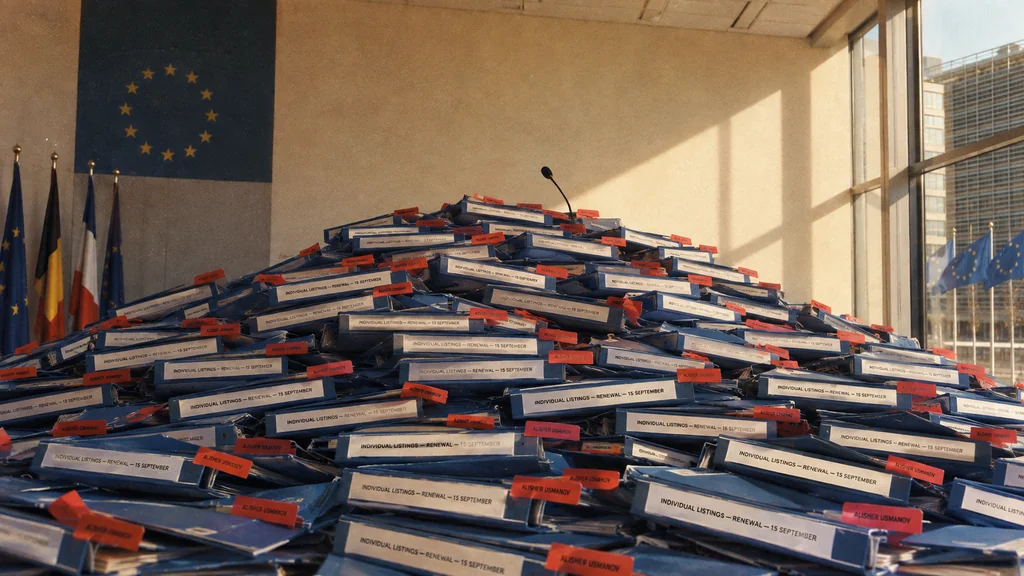
One disputed name buries Europe’s renewal of thousands of sanctions.
Image composition · tobriefThe EU's blacklist of sanctioned Russians expires on Tuesday 15 September. Ambassadors are expected to try again on Monday to renew it, after three failed attempts. The obstacle: France has reportedly joined Slovakia in demanding the removal of oligarch Alisher Usmanov from the list (Euronews, European Pravda).
Renewal requires unanimity in the Council of the EU (where national governments vote on foreign policy), meaning any single capital can stop it. That rule gives France and Slovakia leverage over the entire list because of a dispute about one name.
What France and Slovakia Want
Slovakia wants two oligarchs removed: Usmanov and Mikhail Fridman. It also opposes switching from six-month to twelve-month renewal cycles. According to Euronews, citing four diplomats, France proposed a middle path: delist Usmanov, keep Fridman, and unlock Slovakia's consent. The intervention reportedly caused "huge frustration" among other governments. A spokesperson for France's EU mission told Euronews that Paris supports renewing the sanctions but declined to discuss the negotiation (Euronews). RFE/RL Europe editor Rikard Jozwiak separately reported the Usmanov demand (Čas).
Ambassadors tried and failed on 9 September (Censor.NET) and again on 11 September (European Pravda). No official Council document confirms the French position.
The Evidence Question
The Council can remove a name during renewal, as it has done before (Decision 2025/528, EEAS). But it still needs a defensible legal basis. In February 2024, the EU's court for sanctions challenges upheld Usmanov's listing, finding sufficient grounds to designate him as a leading businessperson in sectors that generate revenue for Moscow (EUR-Lex).
A Frankfurt court ruled separately in June 2026 that German authorities failed to prove Usmanov owned or controlled the superyacht Dilbar (taz, Weser-Kurier). But ownership of one yacht was never the listing criterion. The court-upheld economic-sector ground still stands.
On the public record, neither France nor Slovakia has shown that the legal basis for listing Usmanov has changed. Any evidence discussed privately remains undisclosed.
What Expires and What Doesn't
EU individual sanctions work through two instruments. First, governments adopt a foreign-policy decision imposing travel bans and asset freezes. Then a regulation makes the freezes binding on banks, companies and national authorities. The decision carries a sunset date. The regulation does not.
If Monday fails, the decision authorising travel bans and asset freezes lapses. The regulation enforcing those freezes through the financial system would remain on the books, creating a legal mismatch: the enforcement tool would survive while its foreign-policy foundation disappears (Decision 2014/145, Regulation 269/2014). How courts and compliance departments would handle that gap is untested.
The broader sanctions on Russian oil, finance and technology operate under separate legal acts and are not at risk (Council). Expiry would hit the individual listings, not the entire Russia-sanctions architecture.
The unanimity rule exists to protect smaller states from being overruled on foreign policy. It also means that any single capital can hold an entire list hostage to a demand about one person. France and Slovakia have until Monday to present a legal reason for removing Usmanov that goes beyond the fact that his name is the price of consensus.
Details about this article
- Model:
- claude-opus-4-6
- Generated:
- 9/12/2026, 1:46:20 AM
- Pipeline run:
- eu_pipeline_20260912_005006
- Watermark:
- SynthID (Google's invisible watermark)
- Human review:
- None before publication