Ust-Luga burns; oil exports remain unverified
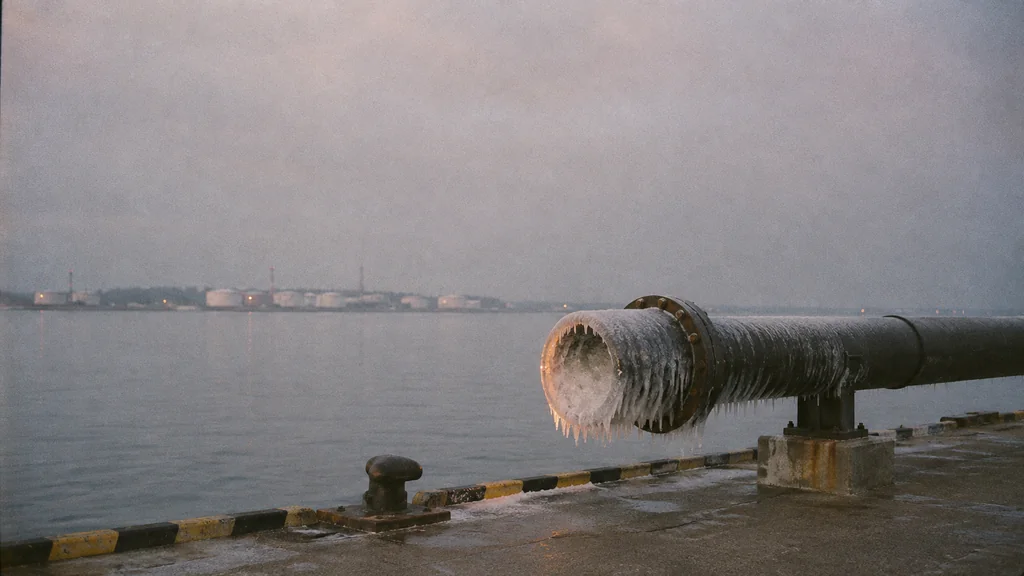
The fire is confirmed; whether Ust-Luga’s oil stopped flowing remains unknown.
Image composition · tobriefUkrainian drones set fire to Ust-Luga, a port that handles a large share of Russia's Baltic oil exports, overnight on 10–11 November. The port is close enough to the EU that Estonian broadcaster ERR filmed the glow from across the border (ERR). Kyiv claims heavy damage, but nobody has yet confirmed that loading stopped or that any tanker was hit (Splash247). The same night, Latvia's armed forces tracked an unidentified drone crossing their country from Lithuania towards Estonia (Latvian National Armed Forces).
What burned, and what Kyiv says burned
Russia's own account is limited. Leningrad regional governor Alexander Drozdenko said drones started a fire in the port area and forced an emergency shutdown of a transformer substation. He reported three injured workers whose lives were not in danger (Reuters, AP).
NASA satellite fire detections also picked up heat in the port area (Liga.net). That independently confirms a fire. It cannot show which tank burned or whether ships stopped loading.
Ukraine's General Staff claims much more. It says five petroleum tanks with a combined capacity of 150,000 cubic metres were damaged, along with a pumping station and a loading pier (Interfax-Ukraina).
The Security Service of Ukraine (SBU) gave a different description. It said the tanks held 30,000 tonnes each and claimed a hit on the missile ship Naro-Fominsk (SBU). Neither agency says how full the tanks were, and no independent image shows damage to the ship.
Did the oil stop flowing?
Ust-Luga is not one facility. It is a cluster of separate terminals, pipelines, rail links and berths. They handle crude, refined fuels and gas condensate, a light oil recovered alongside natural gas. A burning storage tank can choke one product while crude keeps loading at another berth.
The volumes at stake are large. According to Reuters figures cited by News.am, the port shipped about 700,000 barrels of crude a day in 2025 (News.am).
Kyiv says Russia will lose more than $50 million a day (Interfax-Ukraina). Ukraine has not published how it reached that figure. On our reading, a loss of that size only makes sense if most exports stopped. It also counts the value of cargo, which is not the same as money reaching the Russian state.
This gap matters beyond Russia. Ukraine says it wants to cut the oil income that pays for Russia's war, and EU sanctions pursue the same goal. A fire that leaves the loading berths working barely dents that income. So far, no loading data from the port shows whether exports slowed.
Two missed shots over Lithuania
The drone story began further south. Lithuanian officials said a drone entered from Belarus at about 01:20 near Druskininkai, and NATO aircraft fired at it twice without hitting it (LRT).
Latvia tracked four aerial targets that night, three of which entered its airspace. Air-threat warnings covered ten Latvian municipalities until 03:30 (Latvian National Armed Forces). Estonia also issued potential air-threat alerts (ERR). The Lithuanian and Latvian accounts fit a single flight, though neither government has published a full route, and Estonia has not reported the drone entering its airspace.
Lithuania's own officials disagree about where the drone came from. Defence minister Robertas Kaunas judged it probably Ukrainian, pushed off course by Russian electronic jamming. Military chief Giedrius Premeneckas said he could not confirm its origin, and no wreckage has been found (Lrytas).
If Kaunas is right, Baltic air defences are absorbing spillover from a campaign they do not direct. If he is wrong, someone else sent a drone through three countries' air-defence zones, and NATO jets could not stop it.
Ust-Luga burned, and that much is proven. Kyiv's damage figures and its daily loss estimate are unverified claims. The port's terminal operators hold the loading records that would show whether Russian oil kept moving. Lithuania and Latvia owe their publics the drone's origin and flight path before anyone can judge why NATO's two shots missed (LRT).
Details about this article
- Model:
- claude-opus-5-5
- Generated:
- 11/12/2026, 1:59:22 AM
- Pipeline run:
- eu_pipeline_20261112_005010
- Watermark:
- SynthID (Google's invisible watermark)
- Human review:
- None before publication