Vienna’s nuclear clock runs, still wobbles
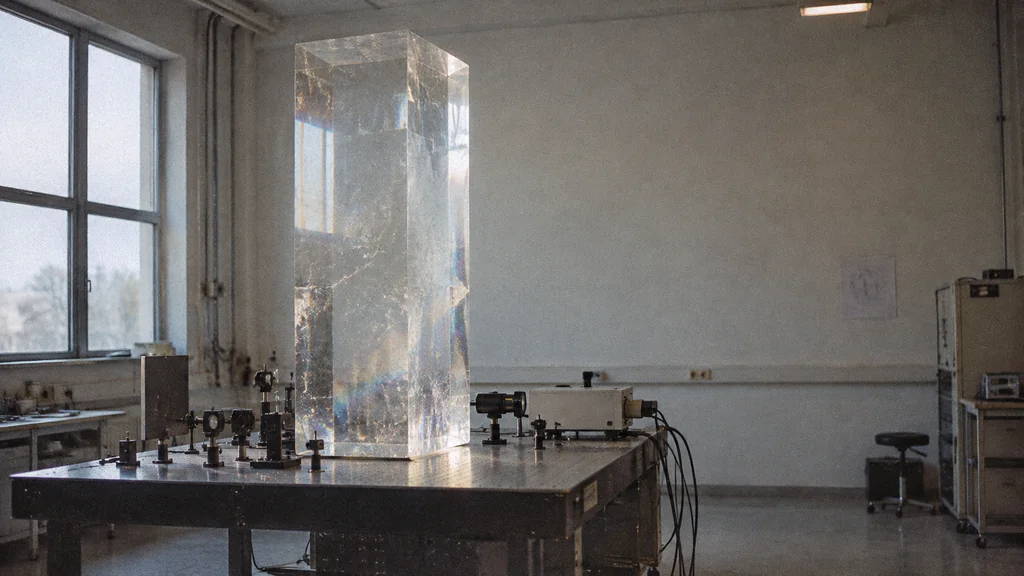
A faint nuclear signal begins to hold a laser steady.
Image composition · tobriefTwo teams reported in Nature on 7 October 2026 that they have built clocks which stay tuned to the nucleus of an atom while they run (Vienna paper, Beijing paper). The Vienna prototype kept going for more than 24 hours with nobody touching it (Vienna full text, Pro-Physik). Both clocks are still far less steady than the best atomic clocks. What they offer is a new kind of reference, one that could reveal whether the basic constants of physics ever change.
Picture a singer holding a note against a tuning fork. When her voice drifts, her ear catches the mismatch and she corrects it. Optical atomic clocks work the same way. A laser keeps the rhythm, and a jump between energy levels of an atom's electrons plays the tuning fork.
Thorium-229 puts the tuning fork inside the nucleus instead. Its nucleus can jump between two states when struck by ultraviolet light near 148 nanometres (PTB notice). Both teams embedded thorium in calcium-fluoride crystals, a transparent material that holds the atoms in place. When the laser sits on exactly the right frequency, the nuclei absorb a little of the light passing through.
That faint dimming becomes the clock's ear. Electronics nudge the laser's frequency slightly back and forth, and a detector checks whether the light dims more on one side or the other. That tells the controller which way to steer the laser back to centre, just as the singer hears whether she is sharp or flat.
Researchers showed in 2024 that a laser could excite this nuclear jump at all (2024 excitation paper). The new step, which we covered on Wednesday (To Brief), is a loop that runs continuously. The nucleus keeps the laser in tune for as long as the clock operates.
Two labs, two ways to steady the beam
Vienna divides the work. An optical cavity, a pair of facing mirrors that traps light and smooths its jitter, keeps the laser calm from moment to moment. The thorium signal then corrects the slow drift the cavity cannot catch on its own (TU Wien). TU Wien grew the crystal, and Germany's metrology institute PTB built the ultraviolet laser with Berlin's Max Born Institute (PTB research group).
The Beijing team, led by Tsinghua University (Tsinghua), reported a lower instability coefficient than Vienna. This number captures how much a clock's ticking rate wobbles over short stretches of averaging, and smaller is better. Beijing's came in at 5 × 10⁻¹³ (Science Media Centre), against Vienna's 3 × 10⁻¹² (Vienna full text).
Beijing also compared two separately grown crystals and found their frequencies differed by only 2.8 × 10⁻¹³ in relative terms (Beijing paper). Two tuning forks cast in different workshops still sang almost the same note. That is an early sign the nuclear reference can be reproduced.
Still far behind atomic clocks
Set against the best electron-based clocks, both prototypes wobble much more. A NIST aluminium-ion clock is steady enough that Vienna's instability is about 8,600 times larger and Beijing's about 1,400 times larger (NIST, NIST aluminium-ion paper).
Vienna also ran into a stubborn material problem. Shifting the laser's path through the crystal moved the measured frequency by up to about 1.7 kilohertz, more than measurement noise can explain, likely because of strain and flaws in the crystal (Vienna full text). Researchers still need to test whether better-grown crystals and tighter control over where the beam passes shrink that shift.
Why persist with a clock that lags so far behind? Comparing two clocks built on different physics turns them into a detector. Vienna ran its clock alongside an ytterbium-ion clock at Austria's metrology office, BEV, which served purely as a yardstick outside the feedback loop. The team frames the nuclear transition as reacting differently from electron-based clocks if the constants of nature were to shift (Vienna paper).
Some dark-matter models predict exactly that kind of shift, as a slow rhythmic wobble. Vienna searched for such wobbles in the comparison, and nothing crossed the detection threshold. The result sets upper limits on how strong those effects can be, not a discovery.
The official second is still defined by caesium atoms, and these prototypes leave that untouched (BIPM). Vienna has shown that a nucleus can hold a laser in tune for a full day, and Beijing that two crystals can agree closely. Turning that into a sharper probe of physical law now falls to the crystal growers and laser builders, who must make the nuclear note sound the same from one sample to the next.
Details about this article
- Model:
- claude-opus-5-5
- Generated:
- 10/9/2026, 1:30:02 AM
- Pipeline run:
- eu_pipeline_20261009_005006
- Watermark:
- SynthID (Google's invisible watermark)
- Human review:
- None before publication