Vision trial: Six gain light sensitivity, four improve consistently
Detecting light is one step; finding an object is another.
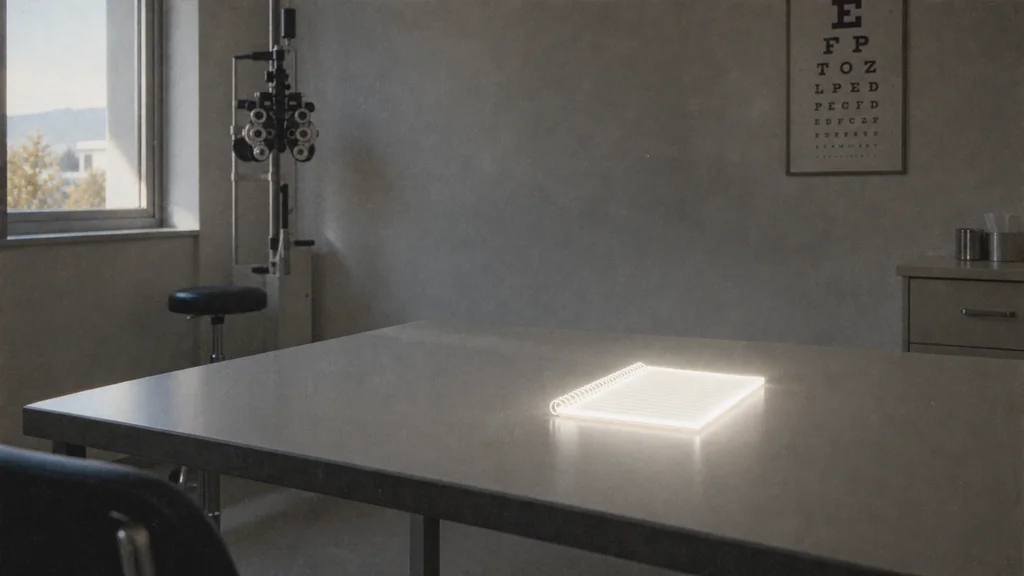
Image composition · tobriefWith camera goggles switched on, five of eight treated participants located and touched a notebook more accurately than with the goggles off (Physics World). They were among ten adults blinded by advanced retinitis pigmentosa, an inherited disease that gradually erodes sight, who received an optogenetic gene therapy in a trial now published in the New England Journal of Medicine (NEJM paper). Optogenetics is the broad technique of using genes to make cells respond to light. In this trial, people who see almost nothing reached for an ordinary object and found it more reliably, but only with the device on.
Different tasks, different results
The notebook was one of several tests, and the results varied from task to task. Four of eight did better at finding a box of staples, and five of eight improved at judging which way a single bar was tilted (Physics World). The bar test sounds abstract, but telling a slanted line from an upright one is a basic step towards making sense of shapes.
Each of those counts compares the same person with the goggles on and then off. Think of testing new reading glasses by putting them on, then taking them off, and comparing what you can see. The same participant can appear in several tasks, so the counts cannot be added together into a single total.
The University of Basel, one of the research institutions involved, describes the gains as modest (University of Basel). These were simple object tests, and they do not establish whether participants can read or recognise faces.
Two different scorecards
The widely reported "six patients" figure (Le Monde) comes from a separate measurement, sensitivity to light. Seven of ten participants became more sensitive to light, and six improved roughly fourfold or more, a gain the authors call clinically meaningful (NEJM paper). In everyday terms, those six could notice a glow several times fainter than the faintest one they could detect before treatment.
The paper says this bar for "clinically meaningful" came from earlier studies and was not written into the trial plan beforehand. That corrects our earlier report, which described it as set in advance (To Brief).
Noticing dimmer light and using sight to do something are two different achievements. Imagine hearing voices through a wall. You know someone is talking, but you cannot follow the conversation. Light sensitivity is like knowing someone is talking. Finding a notebook on a table is closer to following what they say.
On that second scorecard, the numbers are smaller. Four of the eight people who completed the behavioural tests improved consistently across several of them (University of Basel). Behavioural tests measure what a person can do with what they see, rather than what their eye can merely register. More participants gained sensitivity to light than showed steady improvement at practical tasks.
The gap between the two scorecards is easy to lose in a headline. "Six blind patients regain partial vision" and "four of eight improved consistently on object tasks" describe the same trial. They answer different questions. The first asks whether the eye responds to light. The second asks whether that response helps with a task.
Comparing people with themselves
Every participant received the treatment, and the trial had no untreated comparison group (ClinicalTrials.gov record). The evidence therefore rests on each person compared with themselves, goggles on versus goggles off, not on treated people compared with similar patients who never had the therapy. That design can show the goggles helping treated eyes on test day. It cannot separate the therapy's effect from everything else that differs between people in a larger, controlled trial.
In this small trial, some treated participants performed simple object tasks more accurately with the goggles on, and gains in light sensitivity were more common than consistent gains on those tasks. When the next report of restored sight appears, the first thing to check is which of those two scorecards the number comes from.
Details about this article
- Model:
- claude-opus-5-5
- Generated:
- 10/10/2026, 1:38:42 AM
- Pipeline run:
- eu_pipeline_20261010_005006
- Watermark:
- SynthID (Google's invisible watermark)
- Human review:
- None before publication