Volkswagen Keeps €1 From Every €100
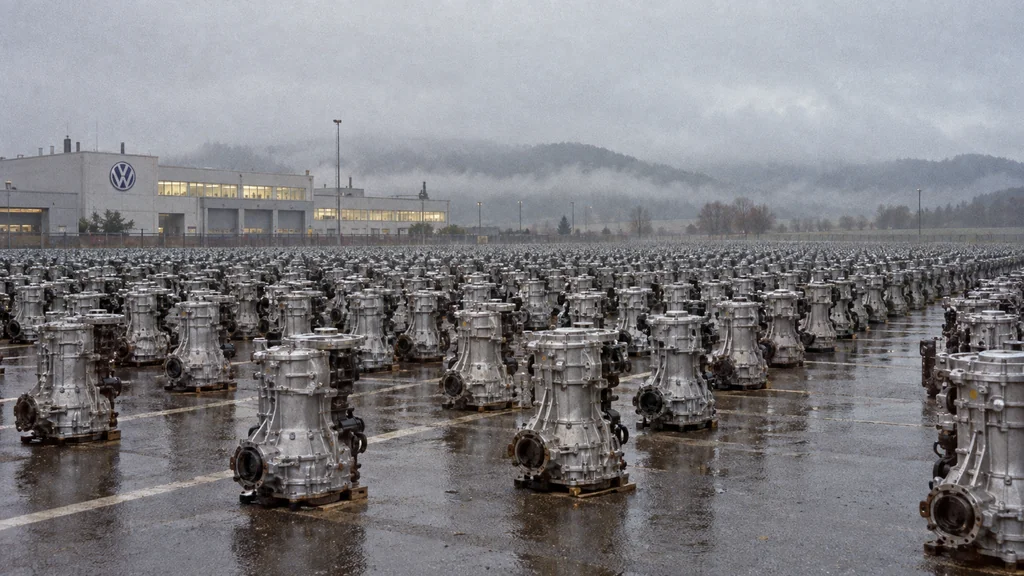
Volkswagen’s old machinery accumulates while its promised future waits.
Image composition · tobriefVolkswagen kept €1 of operating profit for every €100 of sales in its revised 2026 forecast. Weeks earlier, the target had been 4–5.5% (Volkswagen). The gap is roughly €10 billion in special charges, and it raises a question the company's sweeping turnaround plan cannot yet answer: will the promised savings arrive fast enough to pay for the transformation?
Where the €10 billion goes
About €6 billion is an impairment on Porsche. An impairment, under international accounting rules (EUR-Lex), means the parent admits a subsidiary is worth less than its books say. Volkswagen wrote the value down after Porsche supplied weaker long-term financial assumptions (Volkswagen). That charge cuts reported profit immediately but does not send €6 billion out the door. No factory closes; no worker is paid off.
The remaining charges do cost cash. Restructuring provisions, under the same accounting framework (EUR-Lex), commit the company to severance, plant-conversion costs and supplier settlements that will be paid over the coming years. Volkswagen's ad-hoc disclosure groups restructuring, China-related costs and other items together without publishing a breakdown, so the exact cash bill and its timing remain unclear (Volkswagen).
Strip those charges out and Volkswagen says underlying performance sits at roughly a 4% operating margin. That matches the floor of the old range rather than its midpoint. The weakness is concentrated in China, where the company faces falling sales and heavy discounting (Volkswagen financial publications). The one-off charges dominate the headline. China determines whether Volkswagen enters 2027 with a healthy base business.
The cash won't arrive before the bill
Volkswagen's Future Plan targets €135 billion in investment and R&D over 2027–31 and a 9% operating margin by 2030 (Volkswagen, Volkswagen Future Plan). Management frames the roughly 50,000 job cuts as self-financing: shrink costs now, reinvest the savings in electric vehicles and software.
Reporting by Der Spiegel, based on internal documents, puts the restructuring bill at roughly €16 billion, split between about €10 billion in workforce reductions and €6 billion in plant costs. According to AutoNext's account of that reporting, cumulative wage savings would not recover the total cost until early 2037 (AutoNext). That estimate is unconfirmed by Volkswagen and based on leaked documents rather than a published schedule.
Even so, the arithmetic matters. Annual savings can begin financing investment before the full restructuring bill is repaid. But the cited timeline suggests the programme will still be cash-negative as a whole when the 2030 margin targets are supposed to arrive. Volkswagen has not published its own schedule showing otherwise.
Two factories, two futures
The gap between plants that have received funded electric products and those that haven't shows where the restructuring's costs and benefits actually land.
Martorell, Spain began series production of two electric models in June 2026 after a conversion reported at more than €3 billion (Cinco Días). A PowerCo battery-cell factory at nearby Sagunto is under construction (La Vanguardia). The factory has a funded product, a supplier next door and workers on the line. Its constraint is demand: the plant started with one shift because orders do not yet support three.
Vrchlabí, Czechia sits on the other side. The plant made combustion transmissions for the group, but Volkswagen has published no electric successor for the site. Czech suppliers already report Volkswagen-related orders falling by tens of percent (Novinky). Within the same country, Mladá Boleslav has a new €205 million battery-system hall (Škoda). Investment and uncertainty are landing in the same country, at different postcodes.
What the numbers earn
Volkswagen has not shown that restructuring savings will arrive soon enough to finance its 2030 plan. The only payback estimate in the public record, based on reported internal documents rather than a published Volkswagen schedule, runs to 2037. The company's production-structure review, due by mid-2027, will determine which remaining plants get an electric product and which lose their reason to exist. Until then, every site without a funded successor faces an open question about its future.
Details about this article
- Model:
- claude-opus-4-6
- Generated:
- 9/19/2026, 1:40:38 AM
- Pipeline run:
- eu_pipeline_20260919_005005
- Watermark:
- SynthID (Google's invisible watermark)
- Human review:
- None before publication