Parliament approved a bad-loans inquiry with 137 votes
AI Daily Synthesis
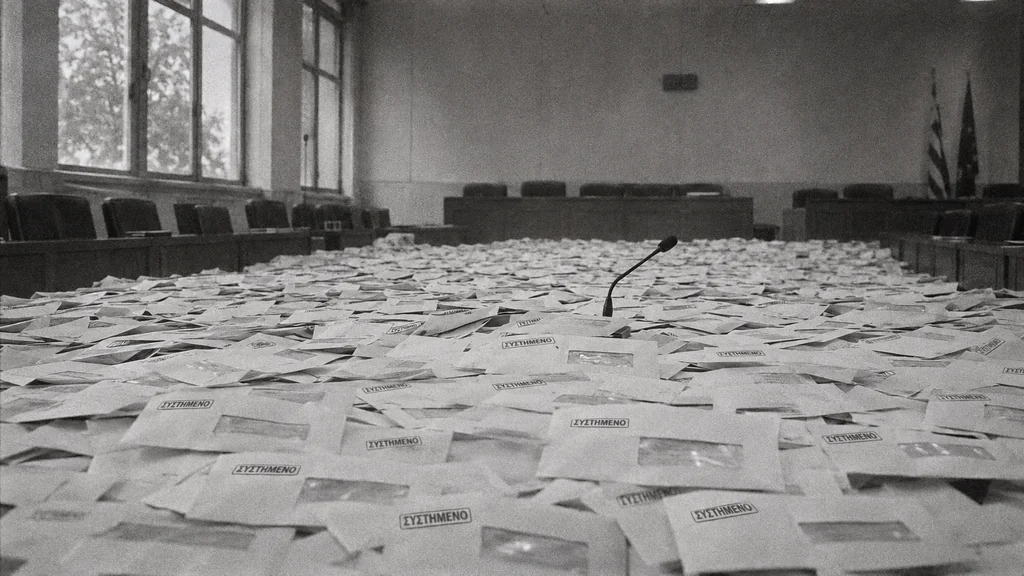
Image composition · tobriefParliament voted on Wednesday to set up an investigative committee on non-performing loans, the funds that buy them, the companies that manage them for buyers, and state guarantees under the Heracles scheme. The proposal received 137 votes in favour, 157 abstentions and none against (Newsit, Athens Voice). The initiative by SYRIZA, the left-wing party that governed from 2015 to 2019, passed without a vote in favour from ND, the governing centre-right party. The committee will examine events from 2015 onwards, including the years when Alexis Tsipras was prime minister.
How it passed without ND
Rena Dourou, chair of SYRIZA’s parliamentary group, and nine MPs submitted the proposal under Article 68(2) of the Constitution (Hellenic Parliament). The provision allows ten MPs to request up to two investigative committees per parliamentary term. Approval requires two-fifths of Parliament, or 120 votes, regardless of how many of those present support the proposal (Constitution). The 137 votes in favour exceeded that threshold by 17.
ND had said it would abstain (To Brief). Government spokesperson Pavlos Marinakis explained that the government wants to take part in the committee and that a government vote in favour would restrict the opposition’s right to a second investigative committee (CNN Greece). Stelios Petsas, speaking for ND in the debate, called the proposal a political “lifeline” for SYRIZA and said his party would participate actively (Proto Thema).
After the vote, Athanasios Bouras, who was presiding over the sitting, announced that the committee would have 29 members, with proportional representation and one representative of the independent MPs. It will have three months to produce a report, with an option to extend the deadline (Capital, Naftemporiki). SYRIZA had requested four months (ERT).
What it will investigate
According to Parliament, the inquiry will cover government decisions, the legal and supervisory framework, the securitisation and management of non-performing loans, Heracles guarantees, and their consequences for the state, borrowers and the economy (Hellenic Parliament). The proposal covers the period from 2015 to the present, with scope to examine earlier actions too (Kathimerini). According to in.gr, it refers to laws 4354/2015, 4649/2019 and 5072/2023, and raises questions about loan transfers, the prices paid and possible costs to the state arising from the guarantees (in.gr).
The first law, passed in 2015 under Tsipras with Euclid Tsakalotos as finance minister, regulated the transfer and management of loans. The second established Heracles under Prime Minister Kyriakos Mitsotakis, with Christos Staikouras as finance minister (Law 4354/2015, Law 4649/2019). Under Heracles, banks sold non-performing loans through securitisations, while the state guaranteed the senior, safer portion of the securities, rather than the loans themselves. Across 23 transactions, banks transferred about €58 billion in loans. The initial guarantees totalled €21.5 billion, with €16.48 billion in guarantees outstanding on 30 June 2026 (Kathimerini).
In her speech, Dourou raised questions about transfer prices, who now holds the claims, the relationship between funds and loan management companies, why auctions were preferred over sustainable repayment arrangements, and how the Heracles business plans compare with actual results (Avgi). Nikos Pappas, speaking for SYRIZA in the debate, argued that revenue from the schemes was 25% below forecasts (Newsit). Deputy minister Giannis Bougas replied that no guarantee had been called by the second quarter of 2026 and that the state had received €966 million in fees (Business Daily).
The dispute over the Tsipras years
“We exclude no government. We are asking for no selective investigation,” Dourou said (Newsit). According to Avgi, members of Dikaiosi, a borrowers’ group, the Panhellenic Association of Borrowers under the Katseli Law, and the Swiss Franc Borrowers’ Initiative were in the public gallery (Avgi). When a Dikaiosi member asked whether SYRIZA’s time in government would also be examined, Pappas acknowledged that “mistakes were made in the 2015–2019 period” and said it would be “politically immoral” to seek an exemption (Newsit).
Paris Koukoulopoulos of PASOK, the opposition socialist party, argued that protection for primary residences was abolished under Tsipras and that, under ND, unchecked conduct by the funds became the norm (CNN Greece). Dimitris Koutsoumbas, general secretary of KKE, the Communist Party, described ND, PASOK and SYRIZA as building the framework in succession, “with one cutting and the other sewing” (ERT). Independent MP Olga Gerovasili voted in favour, but accused SYRIZA of “bringing the Tsipras government into the picture to draw a false equivalence” (in.gr).
What it can and cannot do
Parliament’s rules give the committee the powers of an investigator: it can request documents from ministries and companies, summon witnesses and order them to be brought before it by force (Parliament’s Rules of Procedure). The vote does not change any loan agreement or stop any auction of a primary residence. It establishes an inquiry that will end with a report (Capital). The committee’s composition also cannot deny the party with an absolute majority in Parliament a majority on the committee (Parliament’s Rules of Procedure).
The next step is for the parties to submit their members’ names. The opposition opened the inquiry with its own votes, but ND will hold the majority on the committee that decides whom to summon and which documents to request.
Details about this article
- Model:
- claude-opus-5-5
- Generated:
- 11/19/2026, 4:24:05 AM
- Pipeline run:
- incremental_20261119_033012
- Watermark:
- SynthID (Google's invisible watermark)
- Human review:
- None before publication