Parliament votes on inquiry into bad loans
AI Daily Synthesis
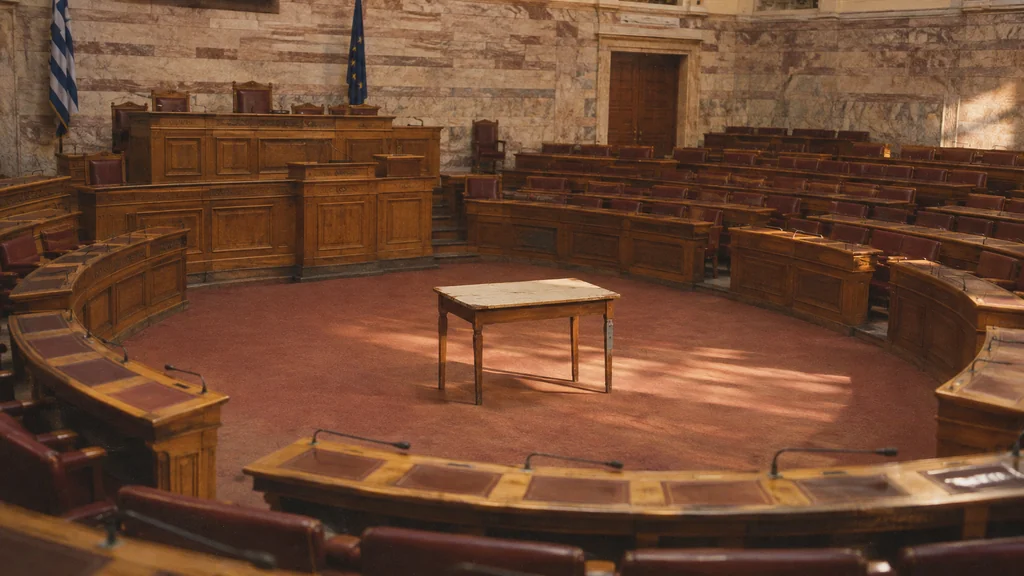
Image composition · tobriefThe Greek Parliament will hold a roll-call vote today on a proposal by SYRIZA, the left-wing party that governed from 2015 to 2019, to set up a parliamentary inquiry into non-performing loans. The committee would examine securitisations, which turn packages of loans into bonds for investors; the management of those loans by loan servicing companies; and the state guarantees provided under the Heracles programme. The vote comes two weeks after the government introduced a bill on non-performing loans. The committee needs 120 votes in favour to be established. ND, the governing centre-right party, has said it will abstain, while the entire opposition has said it will vote in favour (ERT, Athens 9.84).
The arithmetic of 120
SYRIZA is using a minority right that allows up to two parliamentary inquiries per parliamentary term with the signatures of 10 MPs and 120 votes in favour, "regardless of the majority" (Constitution, Article 68). ND's abstention neither blocks the proposal nor adds votes to it. The opposition parties have 95 votes between them, so they need at least 25 independent MPs (ERT). Kathimerini counted 26, bringing the total to 121 (Kathimerini).
The vote was scheduled for the afternoon, with the result to be announced in Parliament after the count. If the proposal passes, Parliament will decide the committee's membership in proportion to the parties' strength and set a deadline for its report. If it fails, no committee will be established (Parliament's Rules of Procedure, Article 144).
What the proposal seeks to investigate
SYRIZA MP Rena Dourou and nine colleagues submitted the proposal, among them MPs Nikos Pappas and Pavlos Polakis. Dated 21 October 2026, it covers the period from 2015 to today, poses eight questions and calls for a report within four months (Avgi). It examines two laws passed under two governments: Law 4354/2015, enacted under then Prime Minister Alexis Tsipras with Euclid Tsakalotos as finance minister, which regulated loan transfers; and Law 4649/2019, enacted under ND with Christos Staikouras as finance minister, which created Heracles. The proposal seeks to establish who received guarantees, how much the state collected in fees and when guarantees were called, requiring the state to pay. It says that listing the laws does not presume wrongdoing (Avgi).
Under Heracles, a bank sells non-performing loans to a special-purpose company that issues bonds. The state guarantees the bonds paid first, not the loans (Government Gazette, Law 4649/2019). The European Commission first approved the scheme (SA.53519), Law 4818/2021 extended it, and a ministerial decision grants each guarantee for a specific securitisation after an opinion from the Guarantees Monitoring Committee (Government Gazette, Law 4818/2021).
From 2019 to 2025, there were 23 transactions involving €58 billion in loans and €21.5 billion in guarantees (Euro2day). On 30 June 2026, the state still guaranteed €16.48 billion. Bonds worth €5.02 billion, or 23.4% of the original guarantees, had been repaid from securitisation proceeds rather than by the state (Kathimerini). In the first quarter of 2026, the state collected €71.8 million in fees (Eleftheria).
The European Commission reports that banks' non-performing loan ratio fell to 2.8%, but the total stock of such loans in the economy stayed roughly the same, with recoveries below forecasts in several securitisations (European Commission). Loan servicing companies managed €80 billion at the end of 2025, according to the Commission, and €81.5 billion in June 2026, according to the Bank of Greece, the country's central bank (Efimerida ton Syntakton). The amount was roughly stable.
What the parties said
Dourou said the proposal began with an initiative by borrowers called "Vindication", whose members were watching from the public gallery. She asked: "Who profits, who pays, who oversees?" (Avgi). Pappas called for scrutiny using "documents, data and testimony" and acknowledged that "mistakes may have been made" during the government of SYRIZA and ANEL, its coalition partner (Athens 9.84).
ND's parliamentary spokesman on the proposal, Stelios Petsas, explained the party's abstention by citing the minority's right to request an inquiry. He said ND would present its policies since 2019 and SYRIZA's "disastrous interventions" (To Pontiki). He warned that the committee could worry investors and credit rating agencies and raise borrowing costs (Avgi). According to Enikos, ND believes no new guarantees should be given, but existing commitments must be honoured (Enikos).
Paris Koukoulopoulos, an MP for PASOK, the opposition socialist party, said it would vote in favour "on grounds of principle": investment funds were given a legal framework under SYRIZA and ANEL, and their unchecked conduct became entrenched under ND (To Pontiki). KKE, the Communist Party, represented in the debate by its leader Dimitris Koutsoumbas, accused successive governments of prioritising repayment to banks and investment funds. Greek Solution, Niki and Course of Freedom, three other opposition parties, are also voting in favour (Athens 9.84, Astra TV).
Which borrowers are affected
After securitisation, the special-purpose company owns the claim and the loan servicer deals with the debtor on its behalf (Insider.gr, Newsit). The borrower still owes the loan after it is transferred. The "Jewel" portfolio, for example, contained 824 borrowers, mainly with mortgages, and was worth €37.4 million. Their loans had been through Heracles securitisations, and they were making regular payments again (Crisis Monitor).
If the committee is established, the proposal gives it four months to answer "who pays", with €16.48 billion in state guarantees still outstanding (Kathimerini).
Details about this article
- Model:
- claude-opus-5-5
- Generated:
- 11/18/2026, 5:20:57 PM
- Pipeline run:
- incremental_20261118_163013
- Watermark:
- SynthID (Google's invisible watermark)
- Human review:
- None before publication