Vučić trades Serbia’s presidency for a vote
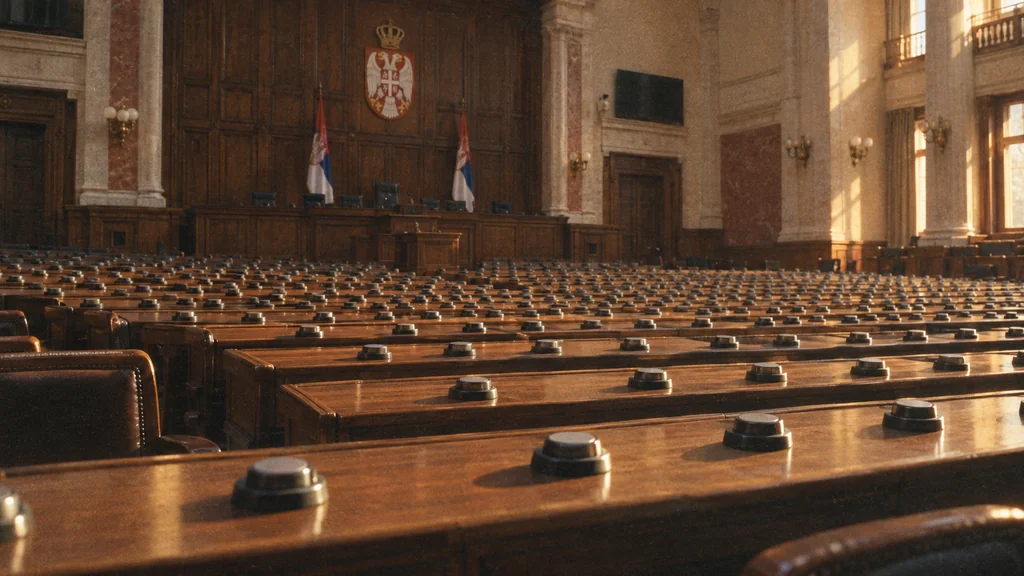
Vučić leaves the presidency seeking a parliamentary majority to bring him back to power.
Image composition · tobriefAleksandar Vučić resigned as Serbia's president on Sunday, 27 September, to lead his party into a snap parliamentary election on 25 October and campaign for the premiership (Reuters, BTA). He is giving up an office he already holds for one that only a new parliamentary majority can give him. Months of protests pushed Serbia into this election season, and he is now trying to turn it into a route back to power.
The move was planned. Vučić dissolved the 250-seat parliament on 9 September and called the October vote, which met a central demand of the student-led protest movement (AP). Ouest-France had reported both the election date and the contemplated resignation earlier that month (Ouest-France).
Ana Brnabić, the parliament speaker and a close Vučić ally, was due to assume presidential duties on Monday (BTA). The exact legal moment of the handover has not yet been confirmed.
Two elections, and a majority to build
On 25 October, Serbians vote for a parliament (Reuters). The prime minister is whoever that parliament backs. Vučić returns to power only if his list and its partners win enough seats to form a majority around him.
A presidential election must follow within roughly 90 days, according to BBC Serbian. That clock starts when the resignation is published in the Official Gazette, the state's official record of legal acts. Until then, the deadline is not fixed.
The students take the protest to the ballot
Vučić's main challenger grew out of the protests that followed the fatal collapse of the Novi Sad railway station canopy (AP). Serbia's electoral commission approved their "Student List – Students Win" on 15 September after validating 69,099 signatures (N1).
The list's programme centres on weakening party control over the institutions meant to check power (Danas). One example shows the ambition. The students want the media regulator and the state broadcaster freed from the governing party's influence.
The contest is uneven. Deutsche Welle reports that pro-government media branded the students the "blockader" list and targeted its leader, Ilija Srdanović. The same report carries Vučić's claim that his party stands at 47–48 percent, a figure he projects himself rather than one from independent polling (DW).
Serbia invited observers from ODIHR, the election-monitoring office of the OSCE (the 57-country European security organisation). Its mission opened on 16 September and began deploying 30 long-term observers on 25 September (OSCE/ODIHR). Their report will judge whether the vote was fair. It will not decide who governs.
Why neighbours are paying attention
Serbia's election is being followed across Europe: in French regional papers, on Germany's international broadcaster and on Bulgarian public radio. The Bulgarian coverage points to the most concrete European stake, which is energy.
Serbia is an EU candidate country, but it still buys its gas from Russia. According to Bulgarian public radio, Vučić discussed gas with Vladimir Putin on 26 September and expects a Russian supply annex expiring on 30 September to be extended (BNR). The oil side faces a similar deadline. A late-August company statement showed that the US sanctions licence keeping NIS, Serbia's Russian-controlled oil company, in operation also ran to 30 September (NIS). No newer confirmation of its status is available.
The resignation did not create either deadline. It does mean that decisions about Serbia's Russian energy ties fall in the middle of a campaign. For the next four weeks, the man negotiating them is formally a candidate, not a head of state.
Nothing on record shows Serbia changing course because Vučić resigned. What has changed is how he stays in power. That now depends on a parliamentary vote and a majority he has to build, in a campaign whose fairness ODIHR has yet to assess.
How was this article?
Help us get better
Help us get better
Details about this article
- Model:
- claude-opus-5-5
- Generated:
- 9/28/2026, 1:43:31 AM
- Pipeline run:
- eu_pipeline_20260928_005006
- Watermark:
- SynthID (Google's invisible watermark)
- Human review:
- None before publication