VW’s 12,000 cuts put job guarantees in play
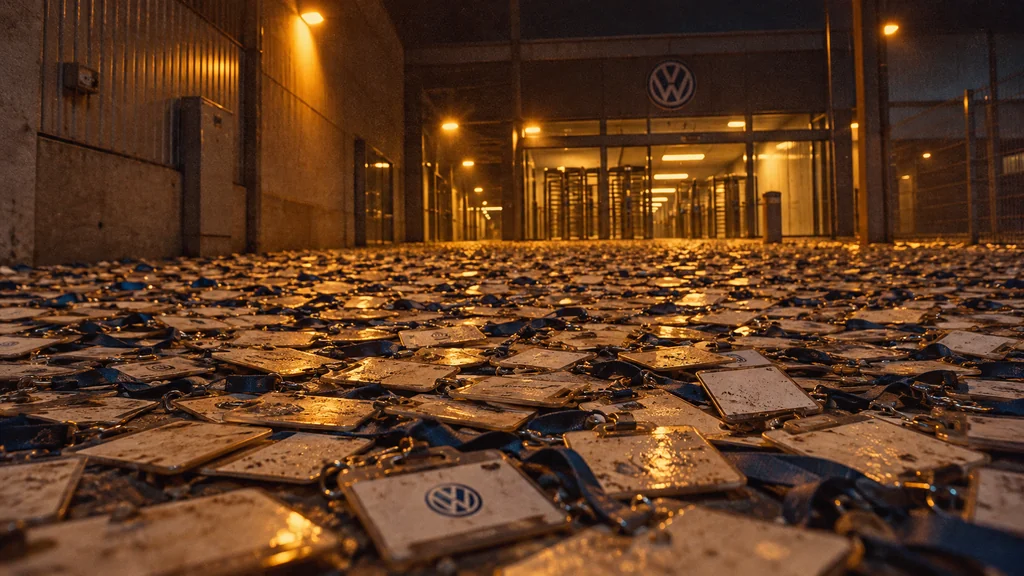
At Volkswagen, the terms of thousands more departures remain undecided.
Image composition · tobriefVolkswagen wants 12,000 more positions to disappear at Volkswagen AG, its core German company, by 2030. That comes on top of more than 35,000 cuts it agreed with the IG Metall union in December 2024 (DER SPIEGEL). The sharper fight is over how people would leave. Management wants to discuss transfer companies, and union leaders call that a broken promise.
Positions, not dismissals
The 2024 deal is signed and already being carried out, mainly through retirements and voluntary exits. With the new proposal, the planned reduction at Volkswagen AG would reach more than 47,000 positions (DER SPIEGEL). Personnel chief Arne Meiswinkel says economic conditions have deteriorated drastically since that agreement (VW).
A cut position is not the same as a sacked worker. When someone retires and the post is never refilled, nobody receives a redundancy notice. VW says it still honours its job guarantee for German staff, which is why the method of exit matters so much.
In September, as protests spread through Germany's car industry, attention went to a larger number (To Brief). VW's Future Plan sketches a worldwide reduction of roughly 50,000 positions beyond existing programmes. The company justifies it with its own estimate that its European plants can build more than 500,000 vehicles above what buyers will take (VW Future Plan). VW has not said how the new German cuts fit inside that worldwide figure. Its published totals look similar in size but cover different scopes, so they cannot be cleanly added together or netted off.
Who pays when a worker leaves
A transfer company starts with the worker's contract. The worker ends the VW contract and signs a time-limited one with a separate organisation, which helps with job-hunting and retraining. From then on, VW's job guarantee no longer protects them, and there is no promised way back.
The money comes next. If the legal conditions are met, the worker can draw a transfer allowance for up to 12 months, worth 60% of the calculated loss of net pay, or 67% for a parent (Federal Employment Agency). The agency pays it from unemployment insurance, which workers and employers across Germany fund through their contributions.
That is the cost transfer at the heart of the dispute. The allowance replaces only part of lost pay, so any top-up, plus the cost of running the scheme, would have to come from VW. The company's announcement gives no budget, headcount or terms for such a scheme (VW).
IG Metall's regional leader, Thorsten Gröger, called the proposal a breach of the bargaining promise "without a sound legal basis". He added: "Before contributors step in, shareholders have a duty" (dpa). Works council chair Daniela Cavallo said transfer companies would erode the job guarantee "through the back door" (Merkur). Whether VW's workers would meet the legal conditions for the allowance remains contested.
A closure in Brussels, under different rules
Audi Brussels, a VW Group plant that has already closed, shows how public money can step in after a shutdown. It does not predict what Germany will approve here. Audi paid severance and initial outplacement support, and Belgian regional job services then took over. The EU covered 85% of a €8,856,030 support programme for 3,414 redundant workers (EU Decision 2026/454).
About a year later, 1,203 of 3,181 supported workers had found a job and 369 had started training (BRUZZ). That snapshot counts people in work or training. It does not show how many of those jobs the support itself produced.
Bargaining is reportedly due to resume on 24 November (dpa). VW has explained why it wants fewer jobs, pointing to its own estimate of surplus factory capacity. It has not published the terms that would show who carries the cost of these exits. That means how much falls on shareholders, how much on workers giving up pay and protection, and how much on everyone in Germany who pays into unemployment insurance. Until VW puts numbers on that split, the union's charge that contributors are being asked to pay before shareholders stands unanswered.
Details about this article
- Model:
- claude-opus-5-5
- Generated:
- 10/25/2026, 1:25:54 AM
- Pipeline run:
- eu_pipeline_20261025_005006
- Watermark:
- SynthID (Google's invisible watermark)
- Human review:
- None before publication