Webb finds heavy hydrogen in 3I/ATLAS
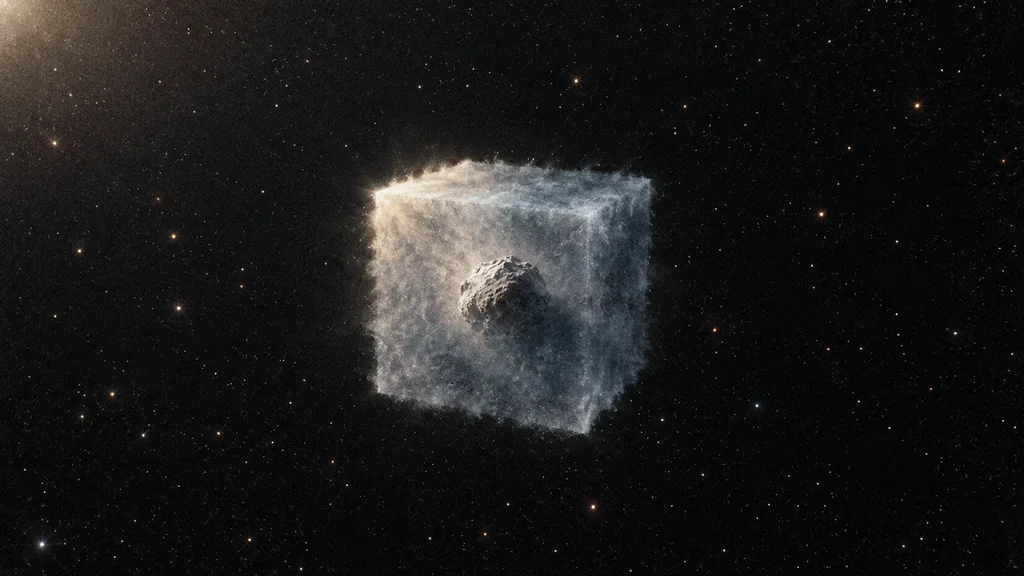
Webb finds an unusual chemical signature in ice from another star.
Image composition · tobriefComets are leftover ice from the birth of planets, and 3I/ATLAS carries ice made around another star. Webb has now measured how much heavy hydrogen sits in its methane. The figure is 3.18% ± 0.30% of the hydrogen, about 13 times the level Rosetta found at comet 67P, according to a Nature Astronomy paper by Nathan Roth's team published on 23 October (Roth et al., Nature Astronomy). That number can preserve clues to the conditions where the comet's ice formed. With only one other comet to compare against, it cannot yet say how common such ice is.
Heavy hydrogen, or deuterium, is ordinary hydrogen with an extra neutron in its nucleus. Swap one into methane (CH₄) and you get CH₃D, a slightly heavier molecule. That small difference changes how the molecule vibrates. It absorbs and glows in infrared light at its own wavelengths, like a guitar string retuned by a fraction of a note.
Nobody scooped up a sample. As the comet neared the Sun, warmth drove gas off its surface into a thin cloud called the coma. Webb's NIRSpec instrument spread that cloud's infrared light into a spectrum, a rainbow of fine lines, and a catalogue of the analysis files dates the key spectrum to 23 December 2025 (dataset catalogue). Every gas in the coma leaves its own pattern of lines, and many of them overlap. The team had to separate methane's two versions from their neighbours before comparing them.
The comparison with 67P is real but narrow. Rosetta's measurement there is the only other detection of this heavy methane in a comet (Rosetta study). The authors also note that no source beyond the Solar System had a measured methane ratio before this one. So 3I/ATLAS clearly stands out next to 67P. Whether it stands out across the Galaxy is still unknown.
Why the cold hoards heavy hydrogen
Hydrogen and deuterium usually behave alike, but deuterium's extra mass tilts a few chemical reactions. In the deep cold of star-forming clouds, some reactions hand deuterium to other molecules easily. The reverse reactions need a little heat that the cloud cannot supply (astrochemistry review). Think of a turnstile that spins freely one way and sticks the other. Over time, heavy hydrogen piles up on one side.
From that general principle, Roth's team proposes a specific kind of birthplace. It would be cold and relatively "metal-poor," which in astronomy means low in elements heavier than helium. It would also be bathed in cosmic rays, fast particles that knock electrons off gas and keep this chemistry going. The ratio is consistent with that scenario but does not prove it. Ionization levels, the other gases present and any later heating can all shift the final number.
Water points the same way. An earlier Webb study measured a deuterium ratio of 0.98% in the comet's water. It concluded that most of the water ice formed at about 30 kelvin (−243°C) or colder (Cordiner et al., Nature). Two different molecules, studied separately, both suggest a frigid origin.
Where "older than the Sun" comes from
Headlines calling the comet older than the Sun draw on a different study, one about its carbon. Each generation of stars slowly enriches galactic gas with carbon-13, a heavier form of carbon, so carbon that holds little of it may be ancient. In June 2026, Cordiner's team reported finding such carbon in the comet's carbon dioxide and carbon monoxide. Matched against models of the Galaxy's chemical history, it pointed to an assembly date as far back as 12 billion years (open full-text record). The authors call the comet's time and place of origin highly uncertain. The methane result does not measure an age at all.
Only three interstellar objects have been confirmed so far (NASA). That makes each one a rare sample of planet-building around another star. Webb has shown that this visitor's methane carries far more heavy hydrogen than the one comet methane we can compare it with, and that the signature fits a cold, cosmic-ray-soaked birthplace. Where exactly that birthplace was, and how often other stars make ice like it, remain open questions.
Details about this article
- Model:
- claude-opus-5-5
- Generated:
- 11/1/2026, 1:30:15 AM
- Pipeline run:
- eu_pipeline_20261101_005008
- Watermark:
- SynthID (Google's invisible watermark)
- Human review:
- None before publication