Who backs Ukraine’s next €70 billion?
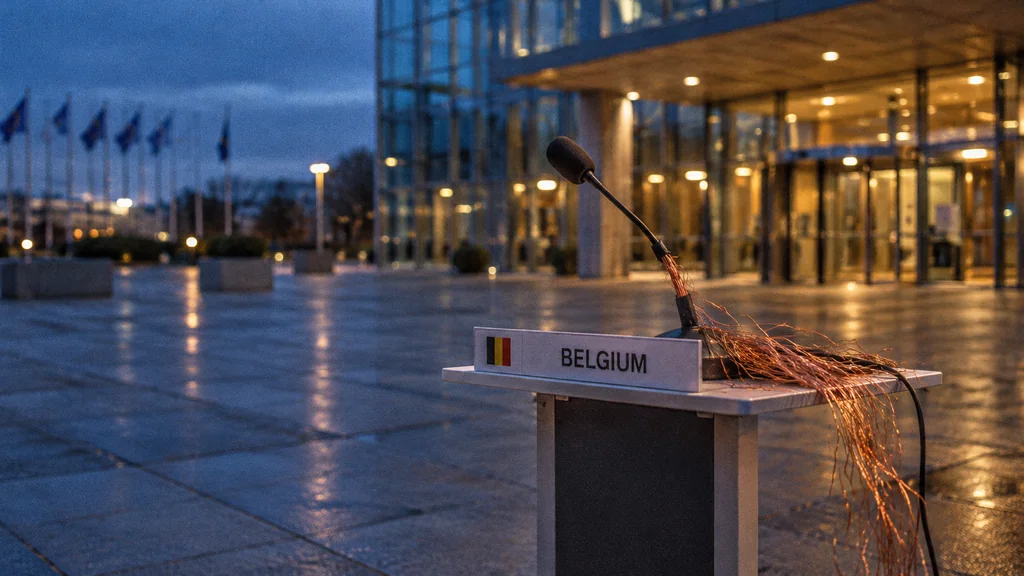
Belgium asks who would pay if Ukraine’s next loan cannot be repaid.
Image composition · tobriefUkraine asked EU leaders on 16 October for tens of billions more for next year, and Commission President Ursula von der Leyen acknowledged a €70 billion shortfall for 2027 (EFE). The leaders' written conclusions approve no additional money, no new loan and no decision on Russia's frozen assets (European Council conclusions). The EU has a loan in place for next year. What it has not agreed is how to meet Kyiv's extra request, or who would pay if Ukraine cannot.
The loan Europe already has
The EU's €90 billion Ukraine Support Loan covers both 2026 and 2027, and the EU funds it by borrowing on capital markets (Regulation (EU) 2026/467). The money is moving. On 14 October the Commission paid out €2.86 billion for drones, air defence and ammunition (Commission update).
That is why leaders could write that the means to cover Ukraine's 2026 needs had been identified (European Council conclusions).
The new request comes on top of that loan. Volodymyr Zelenskyy told the summit the war will cost Ukraine €155 billion next year. He wants at least €70 billion more from Europe for defence, weapons and resilience (Zelenskyy's address).
A Ukrainian Cabinet statement two days earlier described two separate gaps. One is about €30 billion that the state budget still has to raise from foreign lenders and donors. The other is about €40 billion in defence needs that sit outside the budget altogether (Ukrainian Cabinet). These are Kyiv's own numbers. The leaders' conclusions call for an updated assessment by the Commission and the IMF (European Council conclusions).
The summit's decision was narrow. European Council President António Costa said leaders asked the Commission to propose a way to cover the extra 2027 needs, and he set no deadline (Costa's remarks, EFE). That request opens a negotiation. It names no lender and releases no money.
Who pays if Ukraine cannot
Any new loan needs guarantors, meaning the governments whose budgets absorb the loss if Ukraine cannot repay. Estonian Prime Minister Kristen Michal told Reuters that another common EU loan is the probable answer because governments already know how it works. He hopes for a decision before year-end (Reuters).
The current loan shows how that could happen without everyone on board. It is backed by spare capacity in the EU budget, and 24 member states built it. Czechia, Hungary and Slovakia were excluded from its financial obligations (Regulation (EU) 2026/467).
That precedent shapes how to read Czech Prime Minister Andrej Babiš, who says Prague will not guarantee new loans to Ukraine (Deník N). On the 2026 model, his refusal keeps Czechia off the bill rather than stopping a loan. The precedent does not guarantee the arrangement will be agreed a second time. Each government that stays out also leaves a larger share of the risk with the ones that sign up.
Why the frozen assets remain stuck
The other route runs through Russia's immobilised central-bank assets, most of which are held by Euroclear, a financial firm based in Brussels. Belgium's worry is concrete. If the assets ever had to be returned to Russia, it fears the bill would land on Belgium.
Foreign Minister Maxime Prévot told the Belgian parliament the government still opposes using the assets unless three conditions are met (Belgian parliament). Other member states would have to share the risk in full. Cash would have to be guaranteed in case the assets must be repaid. Russian assets held outside Belgium would have to be included as well.
Belgium's leverage comes from being the country on the hook, and its government says it will not carry that risk alone. Until other capitals accept those terms, the asset route stays closed.
The summit did not agree to lend Ukraine more, did not choose a guarantor and did not touch the Russian assets. The €70 billion remains Kyiv's estimate, and the Commission and IMF review could change it. The political fact will not change. Leaders approved nothing beyond the existing loan, and von der Leyen's Commission must now propose a plan that says which governments carry the risk.
Details about this article
- Model:
- claude-opus-5-5
- Generated:
- 10/17/2026, 1:32:16 AM
- Pipeline run:
- eu_pipeline_20261017_005006
- Watermark:
- SynthID (Google's invisible watermark)
- Human review:
- None before publication