A year-frozen pig kidney makes urine
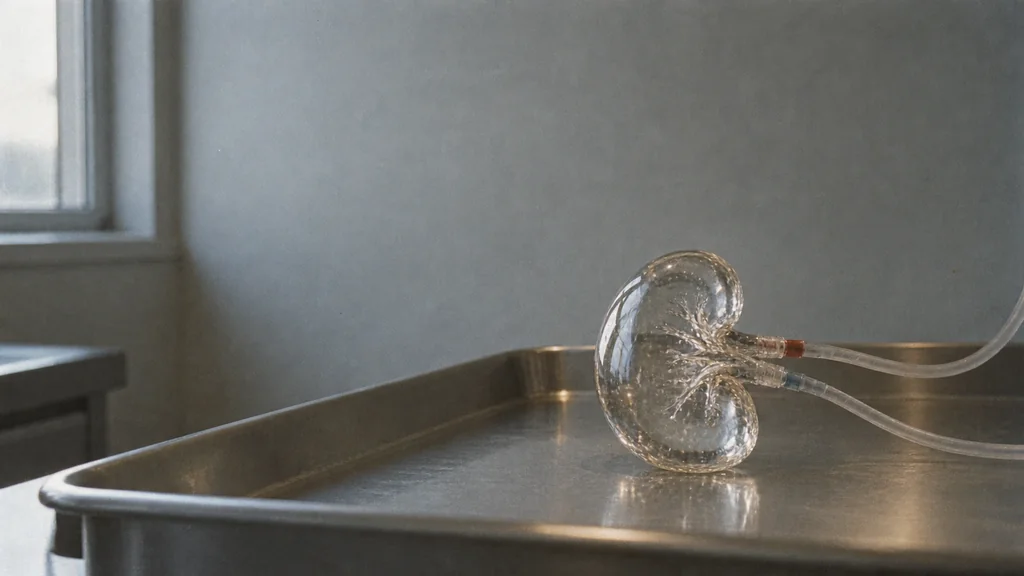
A year in storage ends with urine, but the longer test remains.
Image composition · tobriefA pig kidney kept at −150°C for just over a year began making urine after researchers rewarmed it and connected it to a perfusion machine (MIT Technology Review). Donated kidneys today usually have to be transplanted within hours, so a way to bank them would give transplant teams time they have never had. The work is early: it has not been peer reviewed, and the kidneys placed into pigs were watched only briefly.
The University of Minnesota team posted the study to bioRxiv, a server for preprints (papers shared before peer review). Its kidneys were roughly human-sized and about 100 times larger than the rat kidneys the group had rewarmed before (bioRxiv preprint). That jump in size is the real news, because large organs are where cold storage has always struggled.
Turning a kidney into glass
A kidney is mostly water, threaded through a dense web of vessels and cells. Freeze it the ordinary way and ice crystals grow, tearing that delicate structure apart. The team instead pumps cryoprotectants, a kind of biological antifreeze, through the vessels. As the organ cools, its contents set into a glass, solid but without crystals.
Getting it back out of the cold is the harder half. Think of thawing a frozen turkey: the outside softens long before the centre does. In a glassy organ, that uneven warming can crack the brittle tissue. The team's answer, called nanowarming, fills the kidney's vessels with tiny particles that give off heat inside the organ, so warmth does not have to seep in slowly from the surface.
The group had already shown that its approach could bring rat kidneys back from storage and into working transplants, in a peer-reviewed 2023 study (Nature Communications). The open question was whether it could handle something the size of a human kidney.
What two hours can and cannot tell us
The kidney stored for a year was tested only on the machine, which pumps warm fluid through the organ in place of a body. In separate experiments, rewarmed kidneys that had been stored for shorter periods went into pigs. Blood flowed in, the organs regained their colour and urine appeared within about a minute, though at roughly two-thirds of the expected output (MIT Technology Review). The recipients were then observed for just two hours (bioRxiv preprint).
That short window matters because early urine is a first sign of life, not proof of a working transplant. A kidney's real job is to keep filtering waste from the blood day after day, and an organ can start well and still fail over the following days. Greg Fahy, a cryobiologist not involved in the work, welcomed the restored blood flow but told MIT Technology Review these experiments cannot show whether the kidneys would have kept an animal alive. Answering that would mean transplanting the longest-stored kidneys into pigs, removing the animals' own kidneys and following them for weeks. Readers weighing the claims should also know that the authors disclose patents related to the technology (bioRxiv preprint).
European transplant teams work against a tight clock. European Association of Urology guidance sets ideal windows of 18–21 hours for kidneys from brain-dead donors and 12 hours after circulatory death (EAU guideline). Hospitals already improve on simple ice storage with machines that pump cold fluid through the organ, which reduces delayed graft function, a sluggish start for the new kidney (Cochrane review). If a banked kidney can one day survive transplantation and keep working, storage measured in months could let surgeons wait for the best-matched recipient and schedule operations in advance instead of racing the clock overnight.
For now, the result is narrower and still remarkable. The year-stored kidney made urine on a machine, and separately transplanted kidneys made urine in pigs observed for only two hours (bioRxiv preprint). The Minnesota team has brought a human-sized organ back from long storage in glass and shown it can switch on; showing it can sustain a life is the next experiment it owes.
Details about this article
- Model:
- claude-opus-5-5
- Generated:
- 10/16/2026, 1:36:38 AM
- Pipeline run:
- eu_pipeline_20261016_005006
- Watermark:
- SynthID (Google's invisible watermark)
- Human review:
- None before publication