Riemann Hypothesis: a checked proof still unexplained
AI Daily Synthesis
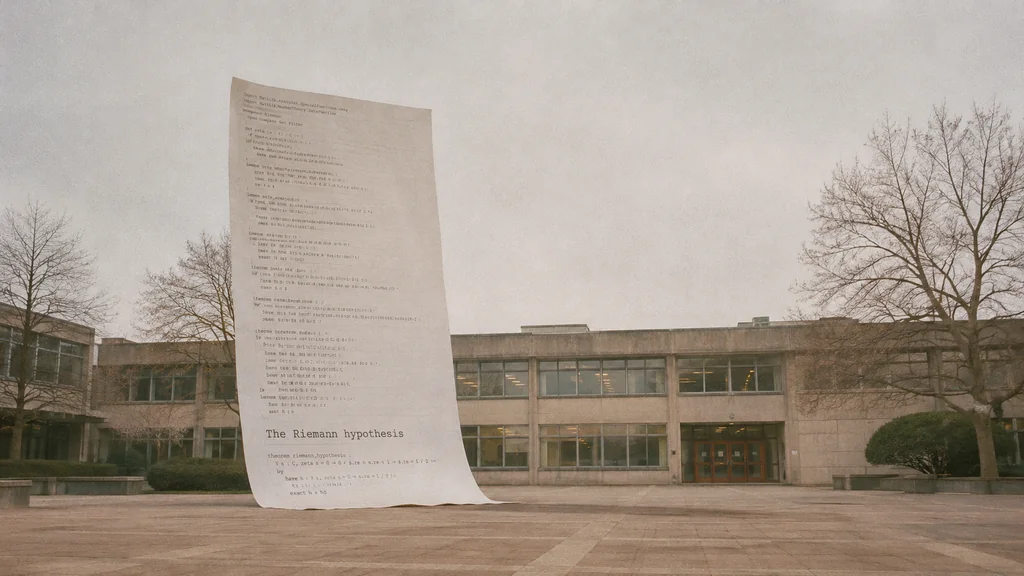
Image composition · tobriefA proposed proof of the Riemann Hypothesis, mathematics’ most famous problem (Al Jazeera), had passed the last major checks under way by 23 November. Lean, a programme that checks proofs step by step, and independent checkers accepted it (Sutherland, MIT). Yet no human can explain why it is true. Machines have checked the proof, but people cannot explain it. That gap is the story today.
Levent Alpoge, a mathematician at the AI company Anthropic, posted the proof on his personal website on 20 November. He wrote that he "believes" he found it while working with Claude, Anthropic’s AI model, and that near the end the model "far surpassed" him (Alpoge’s note). The note remains the primary source; the company has not commented, according to The Verge (To Brief). The accompanying code is so extensive that a prose version written by Claude would run to more than 250,000 pages (BBC).
At stake are prime numbers, which are divisible only by 1 and themselves. Taken one by one, they seem irregular. But count how many there are up to a large number and a smooth trend emerges, with small deviations, like a signal with a baseline and ripples. A function called zeta encodes all the primes, and the points where it equals zero determine how large those ripples can grow. Bernhard Riemann, the mathematician who proposed the hypothesis, conjectured that all those zeros have the same, specific position. That would impose a very strict limit on the deviations (Clay, Bombieri).
What exactly the computers checked
Lean works like a meticulous checker with no imagination: it tests whether the rules allow each step, without understanding the strategy. The first question is whether the proof establishes the right claim. An author who writes both a proof and its target can, even unintentionally, tailor the target to fit. That is ruled out here: the Riemann Hypothesis was already in Mathlib, Lean’s mathematics library, and experts had checked its formulation before Alpoge’s work. Two independent tools found that his theorem matches it exactly (Lean FRO and Mathlib).
The second question is whether every step is valid. Lean’s kernel, a small programme, gives the verdict by checking the proof’s final, simplified form. Others have independently rewritten that checker, including one version in a different programming language, so an error in one would not fool them all. The standard kernel finished its check on 22 November, the stricter “paranoid” kernel on 23 November, and the independent checkers agreed. Everything rests solely on Lean’s three usual axioms, with no hidden “assume this is true”; only the final stage of a repeat run using a newer version of Lean remained pending (Sutherland). Michael Rubinstein, a mathematician at the University of Waterloo, reached the same conclusion in his own recheck (Rubinstein).
The most specific objection came from J. L. Nielsen in a text that has not been peer reviewed. Nielsen found an intermediate definition in the code, anyGeometry, that always returns “true”, like a test anyone can pass (Nielsen). Nielsen acknowledges that the final theorem has exactly the form of the established statement, so the question is how much weight that definition carries. Zeng Zhijian argues that it concerns only 30 of roughly 1.5 million statements in the code, but the disagreement remains unresolved (Herald Business).
The gap in understanding
“We still don’t know why the theorem is true,” said mathematician Kevin Buzzard (Al Jazeera). Rubinstein is trying to write the proof for humans: his guide has reached 265 pages, but it reduces the step on which the whole argument rests to 13 assumptions that it does not prove (Rubinstein). Beside the more than 250,000 pages Claude’s prose version would fill (BBC), it is a first map. Fields Medal winner James Maynard suspects the proof will hold up and, if fully confirmed, will be a historic milestone (Nature).
The Clay Mathematics Institute’s prize is not close: today, 24 November, its page for the problem still says “Active”. Its rules require publication in a suitable journal, at least two years after that publication and general acceptance by the mathematical community before a solution can even be considered (Clay, Clay rules). The Riemann Hypothesis may well have been proved already; no human has yet understood the proof.
Details about this article
- Model:
- claude-opus-5-5
- Generated:
- 11/24/2026, 4:21:59 AM
- Pipeline run:
- incremental_20261124_033011
- Watermark:
- SynthID (Google's invisible watermark)
- Human review:
- None before publication