Zagreb’s driverless robotaxi isn’t on Uber
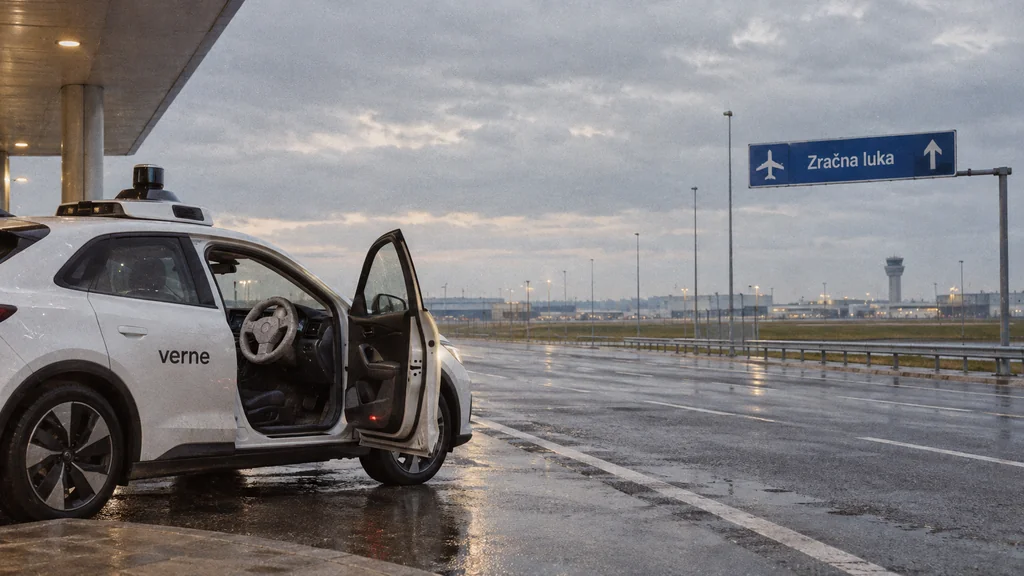
Zagreb crosses the driverless threshold before its safeguards become visible.
Image composition · tobriefA car with no one behind the wheel picked up its first passengers on the streets of Zagreb on 10 September. Pony.ai, a Chinese autonomous-driving company, and Verne, the Croatian mobility operator, began invitation-only test rides without a safety operator inside the vehicle. The rides run along a corridor between Verne's base in the Buzin business district and Zagreb's Franjo Tuđman Airport. Verne staff monitor operations remotely, though the companies have not explained whether those staff can steer the car or only authorize a recovery action.
That empty seat matters because nobody inside can grab the controls if something goes wrong. But the companies have not disclosed how the system detects its own failures, how remote assistance works, or under what conditions the car brings itself to a stop. This is driverless operation inside a restricted, invitation-only test on one corridor, not a service anyone can book.
Two operations, easy to confuse
Since April 2026, Verne has offered a separate commercial service with a licensed human operator onboard. In August, those rides became bookable through Uber: request a regular trip in Zagreb and you might get a Verne vehicle, with a person sitting at the wheel ready to intervene.
The new driverless rides are something else. They are non-commercial, cannot be ordered through Uber or Verne's app, and are open only to invited participants. The companies say they have all required Croatian approvals, but neither the permit details nor the operating conditions have been published (Tportal). Some early coverage described the launch as Europe's first fully driverless commercial robotaxi service through Uber, joining two different operations into one unsupported claim.
Passenger ratings can't measure driverless safety
Pony.ai and Verne cite more than 200,000 kilometres driven, several thousand rides and a 4.7-out-of-5 passenger rating since April. The companies do not separate driverless test mileage from mileage accumulated with an onboard operator. Those figures tell you passengers liked the experience. They cannot tell you how safe the car is when nobody is there to take over.
To judge safety, the public needs to know how far the cars drove without an onboard operator, where they drove, and what happened when something went wrong. That kind of reporting exists elsewhere. In the United States, Waymo publishes crash data from its driverless fleet, and California requires operators to file collision and intervention reports. Those datasets cover different roads and conditions, but they show what transparent evaluation looks like. Zagreb has disclosed none of the equivalent information.
Getting from test to taxi
Pony.ai and Verne describe this as Europe's first fully driverless public-road test with passengers. The claim is plausible: Germany's KIRA project in Darmstadt began Level 4 trials with a safety driver still onboard. But no independent European registry tracks such milestones, so "first" remains the companies' own characterisation.
Scaling beyond a test introduces a separate set of requirements. Under EU law, a vehicle can be approved as a technical product across the bloc, but permission to carry paying passengers without a driver requires additional authorisation from each country. Germany, for example, demands a defined operating area and a designated technical supervisor before any driverless vehicle can carry passengers, plus a passenger-transport licence on top of that. A Croatian national vehicle approval would not automatically transfer to another member state under Regulation 2018/858.
Zagreb has carried invited passengers on a public road without an onboard safety operator. That is a real operating threshold, beyond anything demonstrated elsewhere in Europe. The next one is harder: a publicly bookable service backed by disclosed driverless mileage and independently visible operating conditions.
Details about this article
- Model:
- claude-opus-4-6
- Generated:
- 9/12/2026, 1:49:41 AM
- Pipeline run:
- eu_pipeline_20260912_005006
- Watermark:
- SynthID (Google's invisible watermark)
- Human review:
- None before publication