Zaporizhzhia’s ten-day margin isn’t a meltdown clock
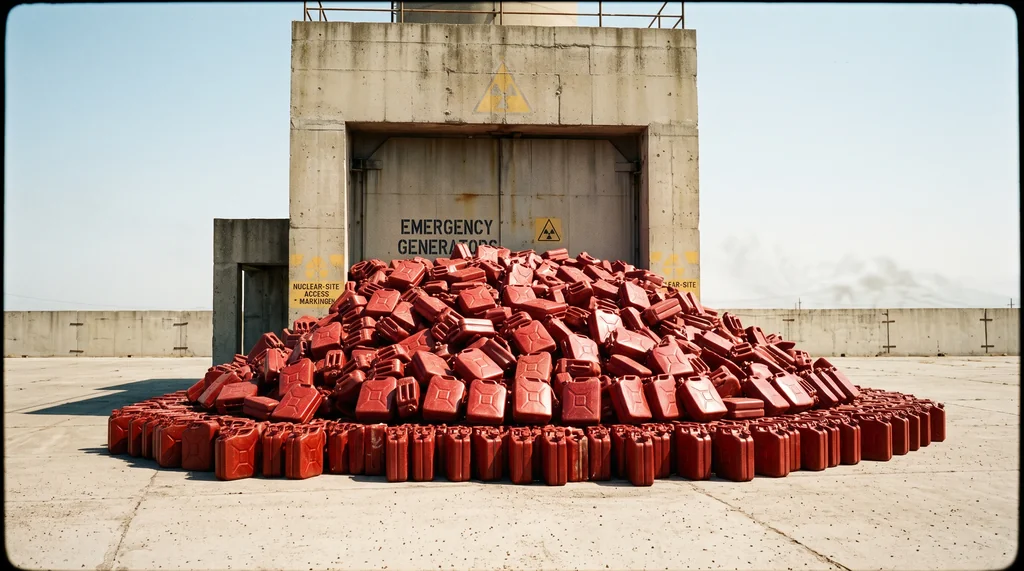
Zaporizhzhia’s safety rests on fuel reserves outsiders cannot fully inspect.
Image composition · tobriefInside Europe's largest nuclear plant, emergency generators have been the only source of electricity for eleven days. Zaporizhzhia's six reactors are shut down and produce no power, but their fuel assemblies and spent-fuel pools still generate heat from radioactive decay. Pumps that remove that heat, instruments that measure it, and fire-protection systems all need electricity. Since 20 August, when fighting north of the Dnipro severed the plant's last external power line, diesel engines have supplied every watt (IAEA on X, Al Jazeera).
IAEA Director General Rafael Grossi warned on 28 August that without restored grid power or fresh diesel deliveries, the plant could lose all electricity in roughly ten days. That figure has been widely read as a countdown. It is more precise, and less comforting, than that.
Ten days is a fuel margin, not a meltdown clock
The ten-day number comes from plant staff, relayed to the IAEA as the minimum diesel reserve required under operating rules (LIGA, The Hindu). It was not independently audited. IAEA inspectors checked fuel levels in most of the plant's 20 emergency generators and watched diesel trucks arrive from two nearby locations on 27–28 August (NV, UNN). But they have not visited the main off-site fuel depot since March 2025. Security concerns and military activity blocked access, and a scheduled May delivery was postponed (IAEA update 313, Straits Times).
If diesel does run out, the result would be serious but not instant. Finland's nuclear regulator STUK told Yle that because the plant has been shut down since 2022, a severe accident after total cooling loss would likely take weeks to develop and might not develop at all, because the reactor structures absorb heat (Yle). Bellona, a Norwegian environmental foundation, estimated that even complete cooling failure would leave water evaporating in the reactor buildings for two to three weeks before fuel could be exposed (Bellona). Operators also raised spent-fuel pool water levels at all six units earlier in August, buying more time before boiling could begin (World Nuclear News, Nuclear News Network).
The situation is not safe. But the danger is fewer layers between the plant and failure, not a ticking bomb.
Who can fix it?
Before Russia's full-scale invasion, Zaporizhzhia drew from ten external power lines. War reduced that to one. When the 330 kV Ferosplavna-1 line failed on 20 August, diesel became the plant's only backup, a system designed for emergencies lasting hours, not weeks (Zeit, DW). Grossi is now trying to broker a localized ceasefire so technicians can reach the damaged line (World Nuclear News).
The problem is a three-way authority split. Ukraine remains the legal sovereign; its nuclear regulator is the lawful safety authority. Russia controls the site physically: access, staffing, fuel logistics. The IAEA can inspect, warn and mediate, but it cannot enforce safety standards inside a country or order repairs (IAEA FAQ). And the UN Security Council, the only body with coercive authority, is blocked by Russia's veto.
The EU's position is to back IAEA access and insist all units stay in cold shutdown. In practice, that means sanctions, diplomacy and contingency planning in case a radiological incident reaches EU territory (European Parliament question E-003880/2025, EEAS). France treats Zaporizhzhia as a war-risk problem, not an argument against its own reactors, while NGOs press for Rosatom sanctions that Paris has not endorsed (Connaissance des Énergies). Hungary relays IAEA data without connecting the crisis to its own Paks II expansion, financed by Rosatom, a dependency that limits Budapest's political room on Russian nuclear issues (Portfolio).
The Russian-installed plant spokeswoman Yevgenia Yashina maintains that staff are monitoring supply and rejects the idea of an inevitable countdown (TASS). That is an operator-side claim from the occupying administration. It may even be accurate today. But Zaporizhzhia's safety now depends on a diesel supply chain functioning under occupation, near active fighting, with inspection access that outside observers can only partly verify. The institution with physical control has no legitimate authority to run the plant, and every institution with legitimate authority cannot reach it.
Details about this article
- Model:
- claude-opus-4-6
- Generated:
- 8/31/2026, 1:48:48 AM
- Pipeline run:
- eu_pipeline_20260831_005006
- Watermark:
- SynthID (Google's invisible watermark)
- Human review:
- None before publication