Hungary lets Ukraine prepare, keeps its veto
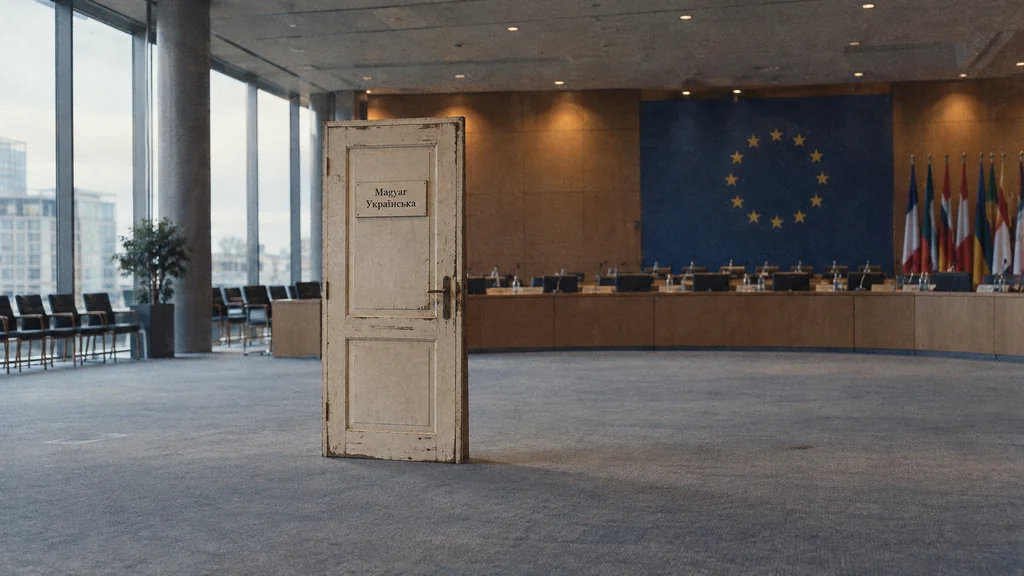
A vote on Ukrainian schools holds two countries at the threshold.
Image composition · tobriefHungary has let Ukraine and Moldova begin preparing the next stage of their EU membership talks, while keeping the power to stop that stage from formally opening. On 7 October, EU ambassadors agreed to invite both countries to submit negotiating positions for two new blocks of talks, after Budapest stopped holding up the step (European Pravda, Kyiv Independent). Hungary still ties its consent to the actual opening to a Ukrainian minority-schools bill that Kyiv's parliament has not passed (Euronews).
What the ambassadors cleared
EU membership talks are divided into thematic blocks called clusters. Before one opens, the European Commission assesses how closely the candidate's laws match EU rules, and national governments sign off on that assessment. The agenda for Wednesday's meeting of ambassadors listed exactly that sign-off for Clusters 2 and 3, which cover the single market and economic competitiveness (Council agenda).
The sign-off lets the EU ask candidates to set out their positions, but it does not start negotiations. Opening a cluster takes a separate decision by governments and a formal meeting with the candidate. The agenda shows only what ambassadors were due to approve. The account of what they actually agreed comes from EU diplomats quoted in the press, because no decision text has been published.
The bill Budapest is waiting for
Hungary's demand concerns schooling for ethnic Hungarians in Ukraine's Transcarpathia region, and the grievance predates this dispute. The Venice Commission, the Council of Europe's panel of constitutional lawyers, criticised Ukraine's 2017 education reform for shrinking minority-language teaching (Venice Commission). Prime Minister Péter Magyar's government, which replaced Viktor Orbán's, had already signalled earlier this week that it was ready to soften its stance (To Brief).
Kyiv's answer is a bill that would give special status to schools teaching mainly in a minority language such as Hungarian. It was registered in the Rada, Ukraine's parliament, on 1 October and had still not come to a vote by 7 October (Rada bill card, draft text). Foreign Minister Anita Orbán welcomed the draft. Reuters, citing two EU diplomats, reported that Hungary would stop opposing the two clusters once the Rada adopted it (Reuters).
That sequence explains why Budapest gave ground on this step and not the next one. Letting candidates draft their positions costs Hungary nothing. Its leverage sits at the formal opening, and it kept that.
Moldova waits on a vote in Kyiv
Moldova has paid for a quarrel that was never its own. Other governments refused to move its file separately from Ukraine's, so Chișinău waited while Budapest and Kyiv argued (Euronews). On Wednesday, Deputy Prime Minister Cristina Gherasimov said Moldova had received the invitation from Ireland, which currently chairs the EU's Council of governments. She described it as preparation for a formal opening at a future conference (Moldpres).
The timetable is tight but conditional. Diplomats have pointed to 12 October for agreeing the common EU positions, meaning the joint stance the 27 governments take into the talks. That date depends on a Rada vote coming first. They have also pointed to a meeting of ministers and candidates in Luxembourg on 13 October, where the clusters would formally open (Kyiv Independent).
Every one of those steps requires all 27 governments to agree. Ukraine's negotiating framework, the rulebook for its accession talks, says the Council of national governments decides unanimously to open each cluster, on a Commission proposal. Unanimity means any single government can block (negotiating framework). Hungary therefore needs no new procedure to stop the opening. It only has to withhold its signature.
Hungary has given up nothing it cannot take back. It allowed the preparatory step, kept its veto over the formal opening, and left Moldova's progress hanging on a vote in a parliament where Chișinău has no say. If the Rada passes the schools bill in the coming days, both candidates could open the two clusters within the week. If the vote slips, Moldova slips with Ukraine, for reasons that have nothing to do with its own reforms.
Details about this article
- Model:
- claude-opus-5-5
- Generated:
- 10/8/2026, 1:34:15 AM
- Pipeline run:
- eu_pipeline_20261008_005007
- Watermark:
- SynthID (Google's invisible watermark)
- Human review:
- None before publication