France offers to defend Yanbu’s stalled oil outlet
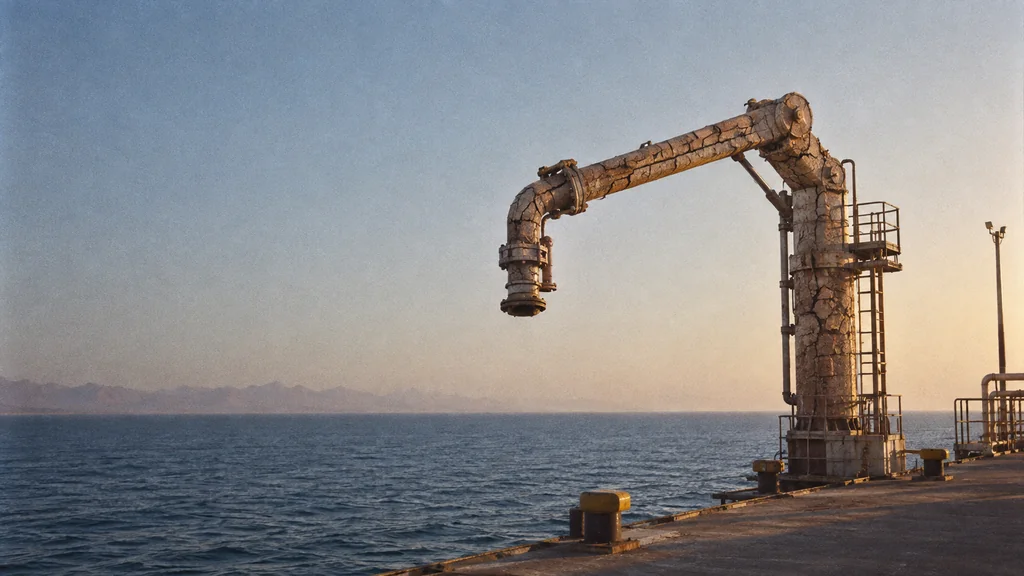
France can guard Yanbu’s outlet while damaged pumps restrict the flow.
Image composition · tobriefFrance has promised air defences for Yanbu, the Red Sea terminal that lets Saudi crude reach buyers without crossing the Strait of Hormuz. The damage that cut the oil reaching Yanbu this month hit pumping stations far inland, on the pipeline that feeds the port (Arab Gulf States Institute). French batteries could protect the terminal once that pipeline recovers, but they cannot fix the damage now holding back its exports.
A promise still waiting for orders
Emmanuel Macron announced the commitment in a televised interview on 24 September, saying France meant to protect a site rather than enter a regional war (TF1). He presented the talks with Riyadh as finished.
On 27 September, Foreign Minister Jean-Noël Barrot said the assets "to be sent" would be "strictly defensive", scaled to Saudi requests and French capacity (franceinfo). He also said he did not expect the Houthis, the Yemeni armed movement fighting the Saudi-led coalition, to treat France as a party to the war. That is his expectation, not a guarantee.
When we first reported the pledge (To Brief), the equipment list was unspecified. It still is. Paris has published no deployment order, no unit list and no rules on when its forces may fire, so what "strictly defensive" allows on the ground remains unknown.
The site does face attack. The Saudi-led coalition said it intercepted six ballistic missiles aimed at areas including Yanbu on 24 September (Saudi Press Agency). That is the coalition's own account, and it reports no hit on the terminal.
Why the oil stopped flowing
Yanbu matters because of the East-West pipeline, which carries crude across the peninsula from the kingdom's eastern oilfields to the Red Sea. From there, tankers can sail north through Suez toward Europe. That bypass has become vital: flows through Hormuz fell from 21.6 million barrels a day in late 2025 to 4.9 million in the second quarter of 2026, according to the US Energy Information Administration.
Around 10 to 13 September, drones struck three pumping stations on the pipeline and severely damaged one (Arab Gulf States Institute). Who launched them remains unconfirmed.
Pumping restarted on 22 September at a low rate, and no figure has been published for how much oil is moving (The National). Full restoration is forecast to take roughly six weeks, according to the same report.
What air defence can and cannot protect
Once the pipeline runs normally again, radars and interceptors near Yanbu could shoot down missiles aimed at its berths and storage tanks. A hit there would shut the outlet a second time. A battery on the coast cannot repair a pump inland, though, or guard a pipeline by standing at one end of it.
Each link in the route has a different owner. Paris controls its own deployment, while Saudi operators control repairs and loading. The EU's naval mission, Aspides, escorts and defends merchant ships at sea, not Saudi berths or pumps (Council decision).
Macron suggested that securing such sites could ease French fuel prices within two days (TF1). Markets can react to expected supply before a tanker sails. So far, though, nothing in the record shows that the pledge has improved deliveries or lowered French pump prices.
Poland's ORLEN shows where the shortfall lands. Saudi Aramco supplied roughly 40% of the crude processed by the company, which runs refineries in Poland, Lithuania and Czechia (Straits Times). ORLEN has since contracted 16 substitute deliveries from other suppliers (LRT).
On 25 September, ORLEN still had no confirmation that its Saudi cargoes had loaded at Yanbu, and the oil it bought at short notice cost more (Rzeczpospolita). One refiner cannot stand for all of Europe. It does show that buyers are already paying for the gap while the pipeline recovers.
France has offered to defend the coastal end of a route that broke far inland. Until those pumping stations run at full rate again, French batteries at Yanbu would guard a terminal with little oil passing through it.
Details about this article
- Model:
- claude-opus-5-5
- Generated:
- 9/28/2026, 1:44:34 AM
- Pipeline run:
- eu_pipeline_20260928_005006
- Watermark:
- SynthID (Google's invisible watermark)
- Human review:
- None before publication