Macron gives EU budget a December deadline
AI Daily Synthesis
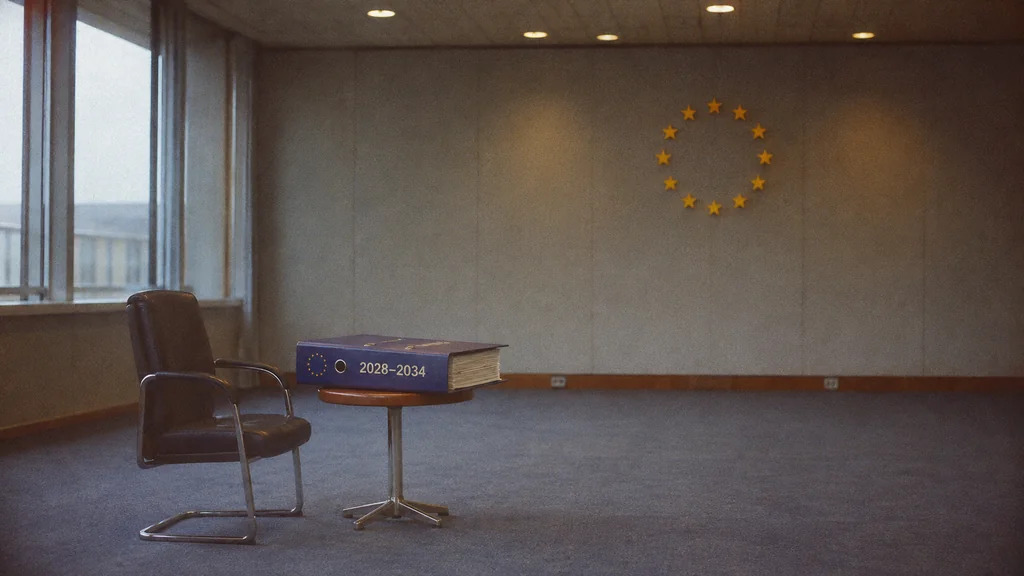
Image composition · tobriefAn adviser to French President Emmanuel Macron said on Wednesday that Macron does not see how negotiations on the EU’s seven-year budget can continue beyond December if no agreement is reached by then (TV5MONDE/AFP). The statement came on the eve of the 26–27 November summit, where the 27 leaders are discussing how much the EU can spend each year from 2028 to 2034 on farmers, regions and defence (European Council). For Greece, the stakes are measurable: based on the 2023–2025 average, it receives about €3.8 billion more from the EU each year than it pays in, an amount close to 1.7% of its national income (Fondation Robert Schuman). That balance counts only payments to and from state coffers, not the overall benefit of EU membership.
“It is clear to the president that it does not seem possible to continue this negotiation beyond December if it has not concluded by then,” said the unnamed adviser. The Élysée Palace, the French president’s office, linked the urgency to France’s presidential election in spring 2027 (POLITICO). Speaking to French farming organisations the same day, Macron said the Common Agricultural Policy was France’s “first priority” and that not a single euro should be taken from France’s agricultural allocation (Le Figaro).
The EU treaty sets no such deadline. If a new framework is not approved by the end of 2027, the 2027 spending limits remain in force until a new one is adopted (EUR-Lex). The governments themselves set December as a target so that the laws can pass during 2027 and funding can flow without interruption from 1 January 2028 (Council of the EU). A delay therefore does not erase the funding. The risk is that new programmes start later.
What is on the table
The leaders are discussing a compromise proposal submitted on 21 November by António Costa, president of the European Council (To Brief). The Council’s official table puts it at about €1.58 trillion in constant 2025 prices (excluding inflation in the years ahead), about €180 billion less than the European Commission’s initial proposal: nearly one euro in ten (Council table).
The cut is not spread evenly. The guaranteed minimum for farmers’ income support stays at €261 billion, the amount the Commission proposed, while the broader fund for national and regional plans, which will also finance regional measures, loses about €30 billion (Council table, Costa proposal). Costa protects the core of farm support and cuts the shared fund around it.
Where it meets resistance
The strongest resistance comes from the European Parliament. Its co-rapporteurs for the budget, Siegfried Mureșan and Carla Tavares, calculate that the proposal amounts to 0.97% of the EU’s gross national income (the total the 27 countries produce and receive), less than one euro in every hundred, compared with 1.11% under the current framework. They said they could not support it (European Parliament, 21 November). The full Parliament has not voted on Costa’s proposal; its two negotiators were speaking. In the debate on 25 November, Mureșan called it “a weaker position for a weaker EU”. The Parliament’s official position since April has been 1.27% (European Parliament, 25 November).
Athens sent its own message. Greek government sources said on 25 November that Greece would not accept further cuts to agricultural policy and cohesion funding, and supported new sources of EU revenue, such as proceeds from future auctions of 6G spectrum (Proto Thema). The proposal’s figures show where Athens and Paris differ: the farm funding Macron wants remains intact, while the shared fund that will also finance the cohesion funding Athens is defending shrinks. The proposal does not yet give an amount for Greece, only the allocation formula (Costa proposal). On the other side of the table is Germany, the largest net contributor, paying about €18 billion a year on average over the past three years (Reuters, Fondation Robert Schuman).
Even if the 27 agree unanimously in December, the framework will not yet be approved. The treaty also requires the consent of a majority of all members of the European Parliament, not merely those present (EUR-Lex). Macron’s deadline presses governments to agree on a smaller overall budget. That is the same budget the European Parliament’s negotiators have already said they will not support.
Details about this article
- Model:
- claude-opus-5-5
- Generated:
- 11/26/2026, 4:41:01 AM
- Pipeline run:
- incremental_20261126_033009
- Watermark:
- SynthID (Google's invisible watermark)
- Human review:
- None before publication