Europe has gas, at €103 for December
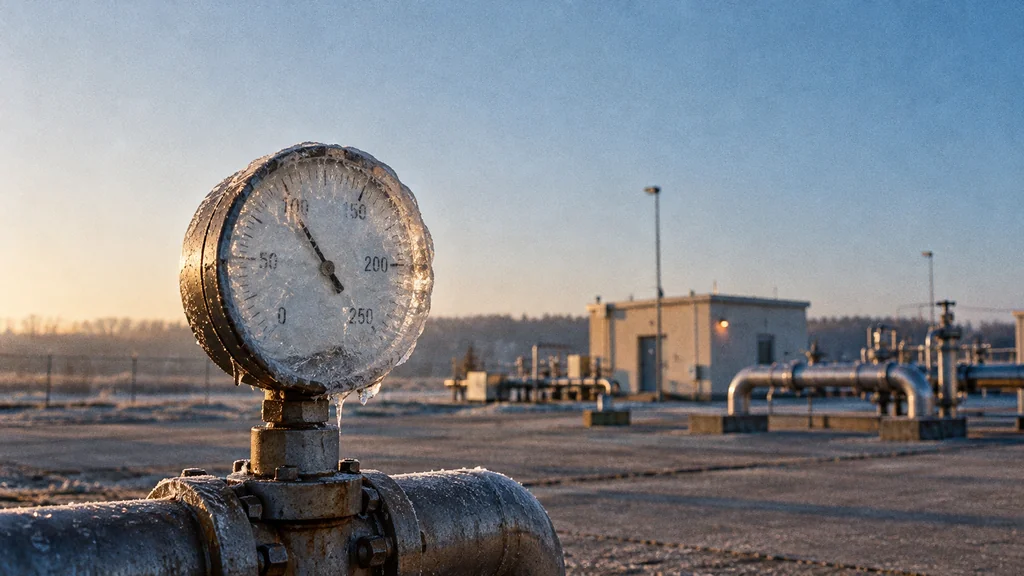
Europe expects enough gas this winter, but replacement cargoes raise its price.
Image composition · tobriefThe futures contract for gas delivered in December last traded at €103.505 per megawatt-hour on Friday, according to ICE's delayed market screen. Europe's network operators expect enough gas for an ordinary winter. The real cost is replacing cargoes that stopped arriving from the Gulf, and that cost reaches factories and households at different times.
That quote comes from the Dutch TTF (Title Transfer Facility), the trading hub whose futures set Europe's benchmark gas price. A future is a contract to buy gas later at a price agreed today. Friday's trade therefore shows what traders will pay for December gas. It does not show what every buyer is paying now, because many locked in their gas earlier.
The €100 line was first crossed on 28 October, when the expiring November contract briefly touched it during trading for the first time since December 2022 (Reuters). We covered that move at the time (To Brief). The two figures come from different contracts, so they show prices staying high rather than a measured rise.
Why missing Gulf gas costs Europe money
The trouble starts with deliveries that stopped. Edison, an Italian importer, says QatarEnergy has extended force majeure (a legal suspension of delivery obligations for events beyond its control) until the end of December. Edison also says 38 of its cargoes have been affected since April and that it has replaced 27 of them (Edison). The release does not say what the replacements cost.
Europe buys relatively little gas straight from Qatar. About 8% of EU imports of LNG (liquefied natural gas, shipped by tanker) came from there in 2025, but the Strait of Hormuz normally carries roughly a fifth of global LNG trade (ENTSOG). LNG trades on one global market. When Gulf cargoes disappear, European and Asian buyers bid against each other for the ships that remain, and the higher price applies even to buyers that never had a contract with Qatar.
ACER, the EU agency of energy regulators, found that no significant Qatari LNG reached the EU last summer. It estimated that higher prices added €18–33 billion to the EU's gas bill over summer 2026 for the same quantity of gas, so the extra spending came from price, not from buying more (ACER).
Storage gives some protection, but not evenly. On 1 November, EU underground storage was 74.68% full. Germany stood at 61.17% and Italy at 91.05% (GIE). Each share measures a country against its own storage capacity, so it tells you how full the sites are, not how many weeks of heating they cover. Germany's network regulator judges the immediate supply risk low, but it warns that stocks could be low by the end of winter (Bundesnetzagentur).
Who pays, and when
Households rarely pay the screen price directly. Suppliers hedge, buying gas months ahead to lock in a price, and many sell fixed-price contracts. A wholesale jump therefore reaches bills with a delay, and in about a third of euro-area economies that delay runs seven to twelve months (ECB). Households on fixed tariffs feel it when their contract renews. Those on indexed tariffs, whose bills follow a published reference price, feel it sooner.
France shows the indexed route. Its energy regulator, CRE, raised its monthly reference price by 6.6% on 1 November, which adds about €12 to an average November bill on linked contracts and reflects September's wholesale prices (CRE). The late-October spike will appear only in later monthly resets, and only if prices stay high.
Factories whose contracts track the market pay sooner. Around Castellón, the centre of Spain's tile industry, gas supplied 90% of the ceramic sector's energy in 2025. The sector association ASCER has warned of lost production and jobs (Castellón Plaza).
Enough gas, at a higher price
ENTSOG, the association of Europe's gas network operators, finds that an average winter can be covered even if LNG stays tight. A cold winter with scarce cargoes is different: its model leaves 12% of gas demand that the system cannot supply (ENTSOG). That figure comes from a stress test. It is not a forecast of rationing.
Under ENTSOG's assumptions, Europe has enough gas for an average winter. The cost is that Europe pays more for it, and that extra cost already reached billions of euros over the summer, by ACER's estimate. One caveat matters: in a cold winter, the operators' own model shows a real gas shortfall, not only higher bills. If December prices hold, households on indexed tariffs like France's will feel them in the coming monthly resets, and households on fixed contracts will feel them when they renew.
Details about this article
- Model:
- claude-opus-5-5
- Generated:
- 11/2/2026, 1:38:34 AM
- Pipeline run:
- eu_pipeline_20261102_005008
- Watermark:
- SynthID (Google's invisible watermark)
- Human review:
- None before publication