Channel octopus boom has a shellfish cost
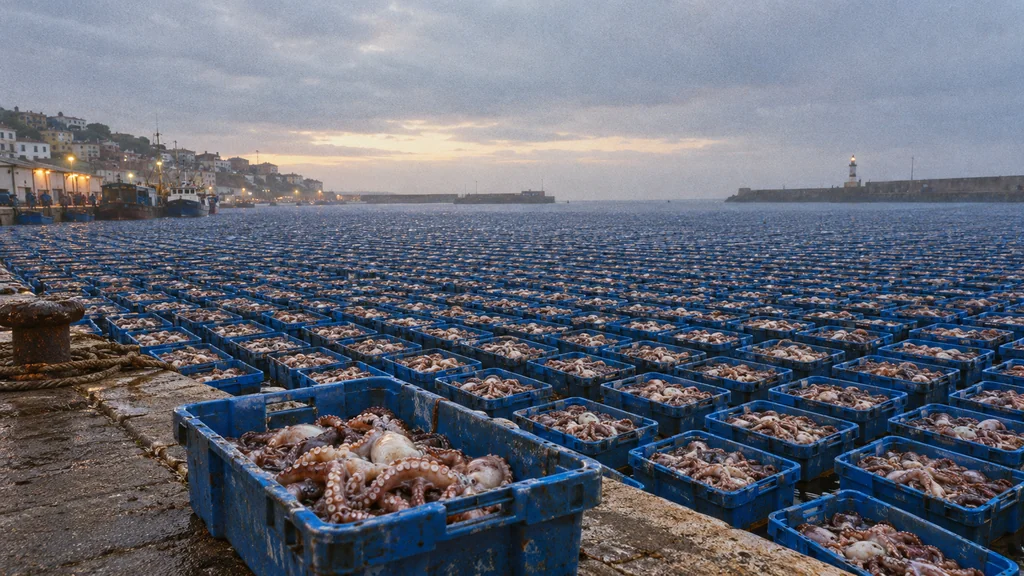
The Channel’s unexpected catch fills crates as older fisheries count the cost.
Image composition · tobriefFishers in the English Channel landed about 2,600 tonnes of common octopus in 2025 and more than 3,000 tonnes so far in 2026, after years of fewer than 30 tonnes, according to UK Marine Management Organisation figures reported by Reuters (Reuters via AsiaOne). For Brixham fish merchant Ian Perkes, that has meant large deliveries and eager buyers in southern Europe. The octopus arrived as Europe's seas had their warmest summer in a record that begins in 1982, with the surface averaging 21.6°C from June to August, according to the same Reuters analysis (Reuters via AsiaOne).
A windfall with a bill attached
The jump is steep enough that scientists have studied it. A peer-reviewed analysis of the catch records put 2025 commercial landings at nearly 65 times the 2017–2024 annual average (Journal of Fish Biology). Because it draws on the same landing data Reuters used, it describes the surge in more detail rather than confirming it independently.
Octopus are hungry neighbours. They eat brown crab, lobster and scallops, the backbone of the Channel's established shellfish fleets. The Marine Biological Association estimated the boom could account for about £10 million in lost shellfish catches between January and September 2025, against roughly £12 million in octopus landings (Reuters via To Vima). That figure is an estimate for last year, before this summer's heat.
Landing figures record when the octopus showed up. They cannot say why. The surge coincided with warm seas, but catches also rise and fall with the number of boats chasing a species, the gear they use and what buyers want. Cefas, the UK government's fisheries science agency, recorded several site temperature highs this summer, along with reports of unusual sharks, sunfish and jellyfish, and says it is still assessing what they mean for the industry (Cefas).
What "record-warm sea" actually measures
The European record describes the ocean's skin. Satellites read the heat radiating off the top layer, and buoys and ships measure the water directly to keep those satellite estimates honest (NOAA). Think of dipping a hand into the top of a bath. You learn the surface is hot, not whether the heat reaches the bottom where crabs and scallops live.
Scientists also judge sea heat against each place's own normal for that time of year (Hobday and colleagues). Water that is ordinary in the Mediterranean can be extraordinary further north. The Bay of Biscay, between France and Spain, averaged 21.4°C over the summer, more than 2.4°C above its 1991–2020 norm (Reuters via To Vima).
The nurseries disappearing off Spain
The octopus show which animals can move in as water warms. Across the bay, on Spain's northern coast, the worry is about what gets lost. Marine ecologist José Manuel Rico Ordás estimates that about 95% of the large brown kelp stands off Asturias have disappeared since 2010 (Reuters via Gulf Times).
Kelp forests work like underwater nurseries, tall seaweed where young fish find food and places to hide. Ordás blames mainly climate change, helped by grazing from Sarpa salpa, a fish that does well in warmer water. His estimate tracks more than a decade of decline, so it does not isolate what this summer did.
All of this sits on a warmer starting point. The IPCC links human-caused warming to more frequent and longer marine heatwaves (IPCC). In early September, Copernicus reported an exceptionally warm global ocean surface for August, a different area and dataset from the European record (Copernicus), which we covered alongside the heat on land (To Brief).
For fishers in Brixham, the change is already on the quayside, in the crates and in the prices southern European buyers will pay. The Channel octopus surge has changed what fishers land and sell; how much it has cost shellfish fleets remains unproven.
Details about this article
- Model:
- claude-opus-5-5
- Generated:
- 9/30/2026, 1:53:35 AM
- Pipeline run:
- eu_pipeline_20260930_005007
- Watermark:
- SynthID (Google's invisible watermark)
- Human review:
- None before publication