Europe waits outside the Ukraine talks
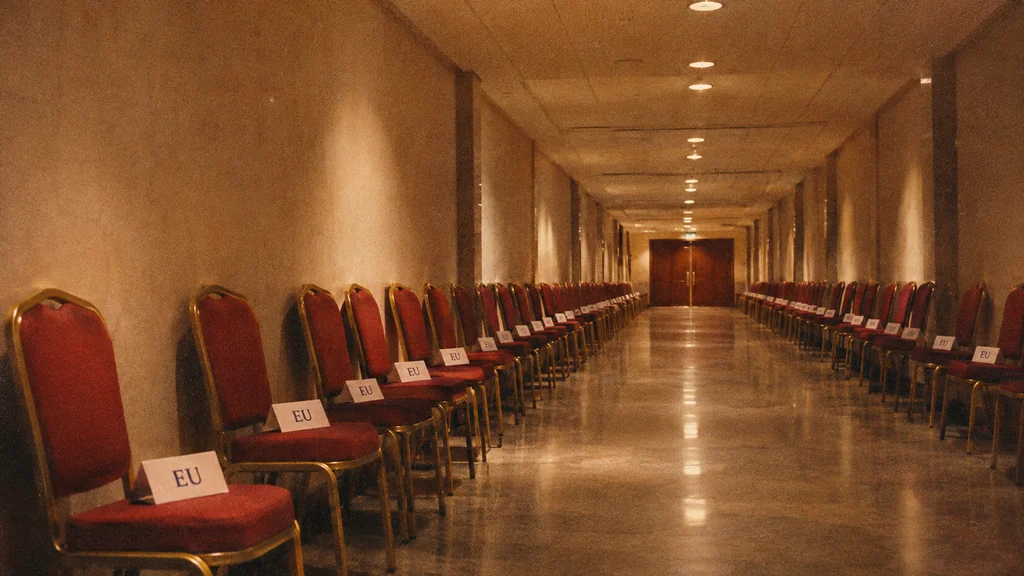
Europe waits outside negotiations whose terms may require its approval.
Image composition · tobriefUkrainian, Russian and American negotiators met for about four hours in Abu Dhabi on 10 November, their first three-way round since February (Kyiv Independent). European envoys were in the same city but not in the room. Any settlement that requires European troops or changes to EU sanctions would still depend on decisions that only European governments can take.
The most concrete topic was a large prisoner swap between Ukraine and Russia. No agreement was announced. An unnamed Ukrainian official told AP that the details would be addressed in the coming days (AP). Russia's deputy foreign minister, Sergei Ryabkov, said it was too early to assess results (TASS). No list, number or date has been published.
The two warring sides also disagree about what the talks are for. Volodymyr Zelensky called them "constructive and substantive" and wants the war ended first, Ukraine's guarantees defined next, and Europe-wide arrangements discussed last (President of Ukraine). A member of Russia's delegation reversed that order and told Reuters that Moscow saw a new European security framework as the main point of the talks (Reuters).
Consulted beforehand, absent from the room
Security advisers from the main European capitals, joined by EU and NATO officials, met the Ukrainian and American delegations before the three-way session. They then stayed outside the main room, according to POLITICO. Their joint statement reaffirmed Ukraine's sovereignty and called for credible security guarantees (European Council).
Briefing Kyiv and Washington just before the session probably gave the Europeans some influence over what those two delegations raised. It gave them no chance to question Russia's negotiators or bargain over wording. Moscow had objected to Europeans at the main table, as we reported on the eve of the talks (To Brief), and the objection held. US Secretary of State Marco Rubio called the day "very productive" and said Washington hoped eventually to widen the format to include Europeans (Guardian).
Moscow has not said what its European security framework would contain. Lithuania has already set one limit. Foreign Minister Kęstutis Budrys said Vilnius would reject any deal that gave Russia leverage over which allied forces are stationed in its region (LRT). Decisions about troop deployments belong to European governments and NATO allies, and a framework negotiated without them would be asking them to accept terms they never discussed.
Even if the format widens, the EU has not decided who would represent it. Italy's Giorgia Meloni has asked António Costa, president of the European Council, to settle who speaks for the EU and with what mandate. Costa chairs the summits of national leaders but cannot appoint an envoy on his own. The leaders themselves would have to agree on one. They next meet, informally, in Dublin on 13 November (Irish presidency), though no published agenda confirms that they will take up the question there.
Decisions that stay in European capitals
The gap is clearest on security guarantees. The Paris Declaration, adopted in January 2026 by the Coalition of the Willing (the mostly European group planning Ukraine's post-war security), foresees a multinational force only once fighting credibly stops. It leaves each country's contribution to that country's own national approval procedures (Élysée). Washington cannot commit a single European soldier, and neither can Kyiv.
Sanctions work the same way. The EU generally adopts them by unanimity, which means any single member state can block a decision (Council of the EU). Nobody negotiating in Abu Dhabi can bind the EU to lift its measures against Russia, however much a deal might rely on that relief.
The first day produced a working channel and a possible prisoner swap, which Ukraine and Russia can agree between themselves. A lasting settlement is a different matter. If it asks Europeans to supply troops or to change EU sanctions, it needs approval from the governments that waited outside the room, and no one at the table can give that approval for them.
Details about this article
- Model:
- claude-opus-5-5
- Generated:
- 11/11/2026, 2:06:37 AM
- Pipeline run:
- eu_pipeline_20261111_005008
- Watermark:
- SynthID (Google's invisible watermark)
- Human review:
- None before publication