France’s looted shops await compensation terms
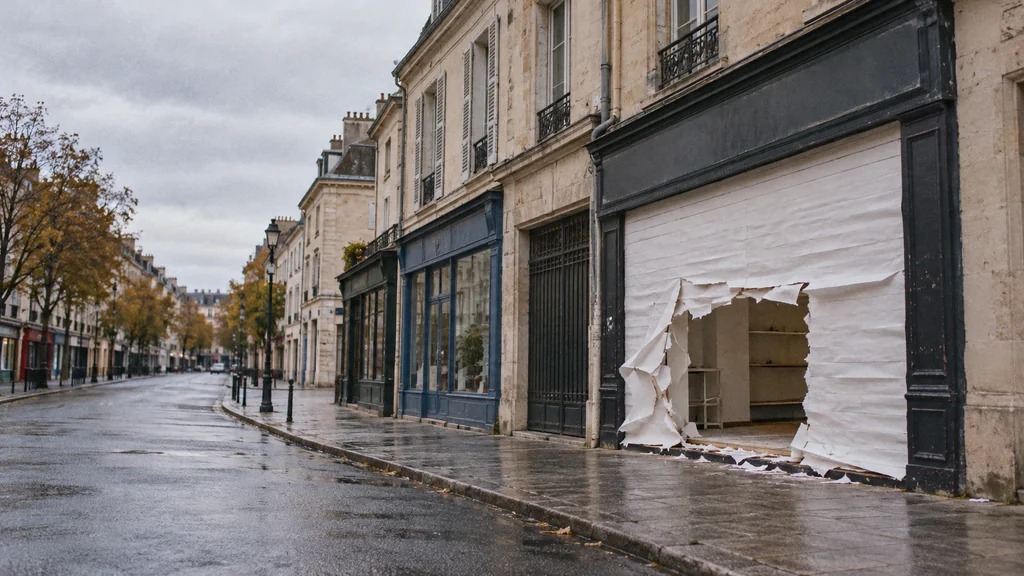
France’s looted shopkeepers await the terms of a promised rescue.
Image composition · tobriefEmmanuel Macron told France's shopkeepers on Sunday night that they would not be left alone after Saturday's looting. He named no compensation amount, no rule for who qualifies and no payment date (Élysée). The retail federation estimates damage at several hundred million euros across some 1,500 businesses, and until the government attaches terms to the promise, that bill sits with the people who were looted (Le Monde).
Who is paying for now
The damage figure comes from Alexandre Bompard, who heads the retail federation, and he warns it is too early for a precise bill. It is an industry estimate, not an audited total from the state or from insurers. For a trader with smashed windows and stripped shelves, the difference matters. An estimate is not a claim anyone has agreed to pay.
Shops are not the only ones carrying costs. Town halls are paying too: fire badly damaged Limoges city hall, while most marchers across the country protested peacefully and the violence hit particular places (Reuters).
The Interior Ministry's count gives a sense of scale. It reported 2,397 people detained on 17 October and 997 police and gendarmes injured, seven of them seriously (La Provence). Detention is not prosecution, and that injury figure covers officers only. The people who looted are a much smaller group than the people who marched, and Macron's speech treated them separately.
Who can turn a speech into payments
Macron made three commitments: pursue those who destroyed property, help businesses, and listen to peaceful demonstrators (Élysée). The president did not design the help himself. He passed the follow-up to Prime Minister Sébastien Lecornu, who chairs a crisis meeting on 19 October.
That meeting is the first point where a figure, an eligibility rule and a timetable could appear. Lecornu's ministers can set those terms. If the help needs fresh money rather than existing funds, it will run into a parliament already split over Lecornu's 2027 budget. That is an inference from the timing, but the budget fight is real and predates the weekend.
The schools show how deep that fight runs. Pupils had blockaded schools for weeks before Saturday, and the prime minister's earlier promises did not end them (Reuters). Their target was the budget itself.
Le Monde reported on 1 October that the plan raised education spending while cutting 1,588 teaching posts (Le Monde). Education Minister Édouard Geffray defends the cuts by pointing to falling pupil numbers. Sunday's address offered nothing new on schools, wages, fuel or public services. The grievances that filled the streets and the bill left by the looting now land on the same government.
Same weekend, different demands
France was not the only country with trouble that Saturday, as we reported at the time (To Brief). A closer look shows separate disputes rather than one campaign. In Milan, organisers of the "Italia in Piazza" marches cited France as their inspiration, and clashes broke out there and in Bologna and Turin (RaiNews). In Brussels, rioters on the fringes of a demonstration caused heavy damage (BX1).
Spain's protest has a different cause. In Madrid, a camp in the Puerta del Sol square has been running since 26 September to demand lower rents and an end to evictions (EFE). Each of these protests answers to its own national or city government, and none of them can be settled in Brussels.
In France, the answer runs through Lecornu's crisis meeting. Macron supplied the reassurance. His prime minister and ministers now owe shopkeepers a sum, a rule for who qualifies and a date. Until they provide them, Saturday's damage stays on the books of the shops that were looted.
Details about this article
- Model:
- claude-opus-5-5
- Generated:
- 10/19/2026, 1:33:48 AM
- Pipeline run:
- eu_pipeline_20261019_005005
- Watermark:
- SynthID (Google's invisible watermark)
- Human review:
- None before publication