France’s rejected budget taxes return Tuesday
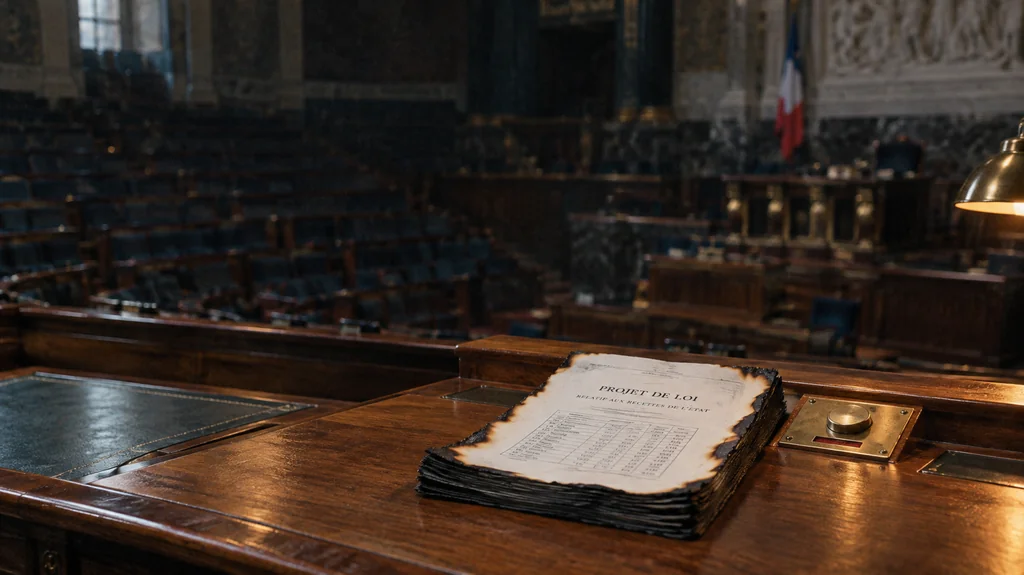
The rejected tax plan returns intact to the full Assembly.
Image composition · tobriefThe French National Assembly's finance committee rejected the revenue half of the 2027 budget on Friday 9 October, by 31 votes to 3 with 2 abstentions (LCP, Assemblée nationale). The vote changed no law. Under Article 42 of the Constitution, the full Assembly debates the government's original bill, not the committee's version (Légifrance). Prime Minister Sébastien Lecornu's tax plan therefore returns intact when the floor debate opens this week.
The finance committee is a smaller group of deputies that examines the budget before the whole chamber does. It spent three days amending the revenue section, then voted down its own amended version. Only President Emmanuel Macron's Ensemble pour la République backed it. Everyone else split for opposite reasons, some objecting to the government's taxes and others to the committee's additions (Franceinfo). As we reported on Friday, those no votes add up to a refusal rather than an alternative budget (To Brief).
Who the government's taxes would reach
The first disputed measure hits retirees. French pensioners deduct 10% of their pension from taxable income, up to a ceiling per household. The government wants to lower that ceiling from €4,439 to €3,000, which would raise taxable income for households whose deduction exceeds the new cap, in practice those with larger pensions. It expected the change to raise about €1.4 billion (amendment I-CF196).
The second targets people off work through illness or injury. Employees receiving certain long-term illness payments would pay income tax on half of them, and workplace-accident victims would pay tax on more of their compensation. The draft valued the measure at €963 million (Capital).
The committee deleted both. Neither deletion carries over. Both measures come back in the government's text, and removing them again would take a fresh vote in the full chamber.
Ministers argue that the committee's amendments, taken together, would have widened the deficit. Public accounts minister David Amiel puts the cost at €8 billion compared with the government's draft (Le Figaro). Philippe Juvin of Les Républicains, the committee's lead budget reporter, estimates €9.6 billion, enough to leave the deficit near 5.35–5.4% of GDP rather than the government's 5% target (Capital).
No published accounting reconciles the two figures. Both also describe a package that no longer exists. They become a real cost only if deputies vote those amendments back in.
What 20 October decides
Debate on bill 3210 opens on Tuesday 13 October, with the vote on the revenue section set for 20 October (Assembly dossier). If the Assembly rejects that section, budget law treats the whole bill as rejected at first reading, before deputies ever reach spending (budget framework law).
The Socialists have threatened a preliminary rejection motion, a vote to throw out the bill before debate begins (Le Monde). Les Républicains want deeper spending cuts but oppose taking more from pensioners, which sets them against the pension cap.
If Parliament stalls, Article 47 lets the government enact the budget by ordinance (a decree that puts it into force without a final vote), but only after 70 days without a decision (Légifrance). Economy minister Roland Lescure said on Sunday that he would prefer to avoid that route, while calling it a "safety barrier" (La Croix).
Brussels does not pick France's taxes, but it does hold Paris to a direction. France is in the excessive-deficit procedure, the EU's process for countries whose deficit exceeds 3% of GDP, which commits the government to an agreed path for bringing it down (Council of the EU). On 8 October, euro-area finance ministers urged Paris to pass a budget that would reassure investors (Reuters).
Friday showed less than the lopsided margin suggests. Deputies rejected the committee's compromise without agreeing on how to replace it, and the full Assembly may vote differently on the same measures. If the pension cap and the benefit tax fall again on the floor, the burden moves from retirees and sick workers back onto the deficit. Lecornu's ministers will then owe deputies costed substitutes before 20 October, because a general promise of savings cannot replace revenue they have already priced in euros.
Details about this article
- Model:
- claude-opus-5-5
- Generated:
- 10/12/2026, 1:36:38 AM
- Pipeline run:
- eu_pipeline_20261012_005007
- Watermark:
- SynthID (Google's invisible watermark)
- Human review:
- None before publication