France sets €0.28 price for reserve diesel
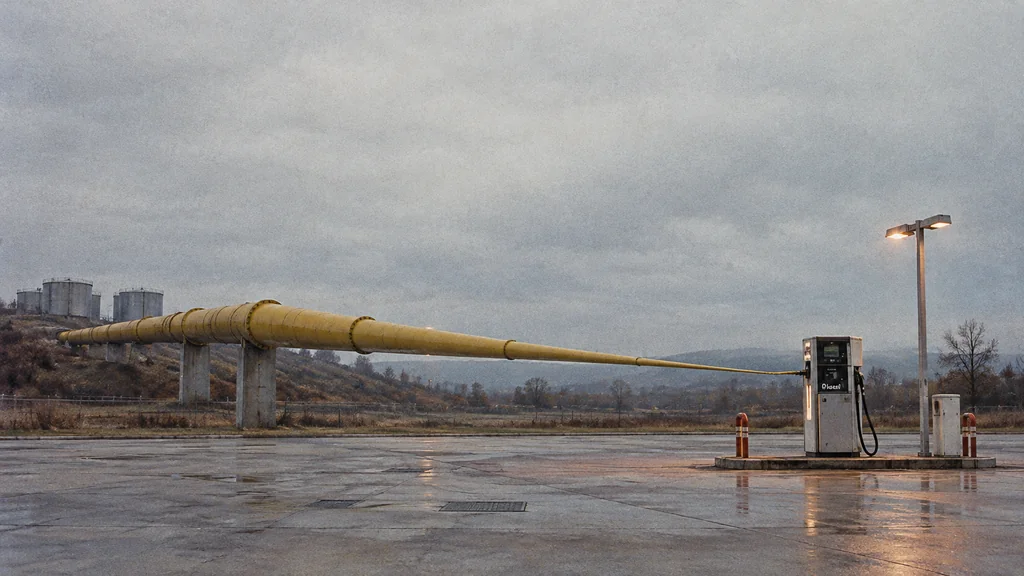
France releases cheap reserve diesel; drivers receive only part of the saving.
Image composition · tobriefFrom 28 October, SAGESS, the agency that holds France's strategic fuel stocks, will sell diesel to distributors for about €0.28 a litre, roughly what it paid, against a market price the government puts near €1.10 (Ministry, Government). The International Energy Agency (IEA, through which 32 countries coordinate oil emergencies) agreed on 15 October to speed up the rest of its emergency release, but set no deadline for the diesel (IEA). An IEA decision moves no fuel until a national government acts, so French drivers may see cheaper diesel next month while most of the release has no published timetable.
Why a big discount becomes a small cut
The French government expects pump prices to fall by 12–18 cents a litre from 1 November (Government). That is far smaller than the gap between €0.28 and €1.10, and the scheme's design explains why. The 10 million barrels go out over November, December and January, shared among distributors according to their 2025 market shares (Ministry).
Each distributor therefore mixes the cheap reserve fuel with diesel it still buys at full price. Its average cost falls by much less than the headline discount. This is our reading of the mechanism. The government has not published its own calculation.
Nobody yet knows who will keep the difference. Distributors receive the cheap stock first. Hauliers, farmers and other heavy users gain only if resale prices and their supply contracts reflect it. The scheme also covers off-road diesel for farming, fishing and construction, plus heating oil (Franceinfo). TotalEnergies, the country's largest fuel retailer, expects a cut of 8–12 cents, below the government's range (DNA). Some stations may not show any cut until around 10 November, and more than 300 rural stations will get cash-flow help so they can lower prices before the cheaper fuel reaches them (TF1 Info).
What the IEA actually agreed
In March, after war disrupted shipping through the Strait of Hormuz, IEA members pledged to make 400 million barrels available. That was a headline figure, which the agency then broke down country by country (IEA, IEA). The later totals are rounded too. On 15 October the board said about 330 million barrels had gone out and agreed to finish the remaining roughly 100 million, including more than 20 million barrels of diesel "as soon as possible" (IEA).
Those rough figures add up to more than 400 million partly because some countries released more than they pledged. The board has set no final total (Reuters). The push to go faster came from the G7, the group of seven large advanced economies. On 2 October its leaders asked for 100 million barrels to be brought forward over four months, with diesel first (G7).
Diesel comes first because it is the fuel running short. Middle Eastern shipments of refined products fell to about 1.9 million barrels a day in September, from 4.7 million before the war (IEA). Stored diesel is already refined, so it can reach buyers almost at once. Attacks on ships near the strait this week have tightened supply further (To Brief).
Germany adds barrels, the Netherlands holds back
Each government must authorise its own draw. Its stock agency then either sells the fuel or lowers the stocks companies must hold (ZDFheute). The IEA statement gives Germany no quantity and no date (IEA). Its agency, EBV, sells released stocks at market prices (ZDFheute). Extra barrels can ease scarcity, but German buyers get no discount like the French one.
The Netherlands had released nearly 4.7 million of its 5.4 million pledged barrels by early October. It is resisting an extra diesel draw, arguing that emptied reserves are hard to refill (NU.nl). Every member faces that trade-off. On 7 October members still held about 1.1 billion barrels of public emergency stocks, including more than 200 million of diesel (IEA). Yet the agency does not expect the world's shortage of gasoil (diesel and heating oil) to be made up before the second half of 2027 (IEA).
France has named a date, a price and a list of buyers for its reserve diesel. Its drivers should see part of that discount, depending on how much distributors pass on once the cheap fuel is spread across three months of sales. In Germany and the Netherlands, and in the IEA's own statement, the release adds barrels without a comparable delivery timetable. That buys months of supply. It does not restore the shipping route that used to bring Gulf diesel to Europe.
Details about this article
- Model:
- claude-opus-5-5
- Generated:
- 10/16/2026, 1:34:59 AM
- Pipeline run:
- eu_pipeline_20261016_005006
- Watermark:
- SynthID (Google's invisible watermark)
- Human review:
- None before publication