Greenland weighs US passage rights
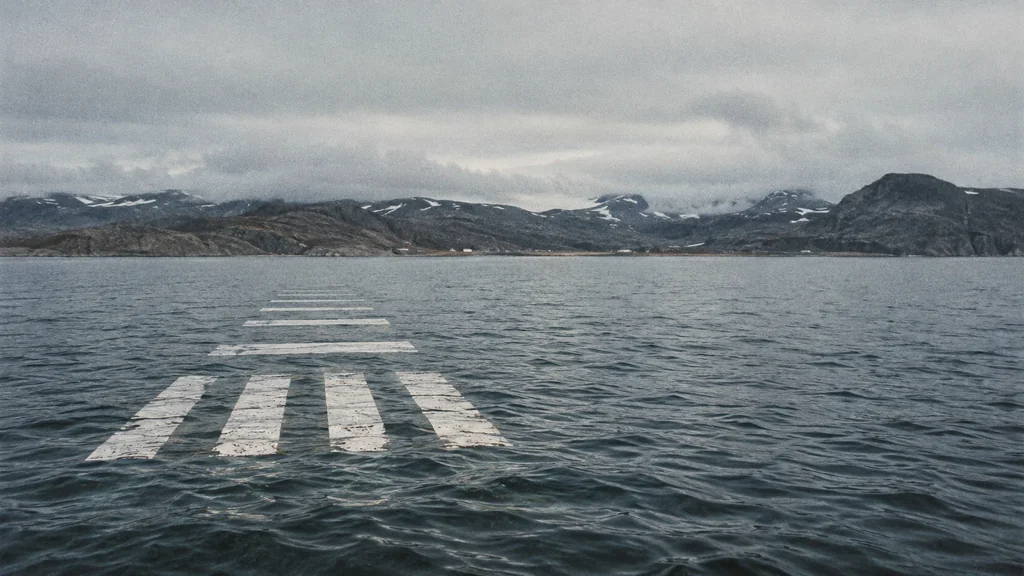
Greenland weighs passage rights before its new defence sites have a purpose.
Image composition · tobriefDonald Trump, Danish Prime Minister Mette Frederiksen and Greenland's premier Jens-Frederik Nielsen signed an amendment to the 1951 US defence treaty on Greenland in New York on 22 September (Reuters, ABC News). It designates Narsarsuaq and Mestersvig as new US "defence areas", meaning places where the treaty permits American military activity. It names no troop numbers, budget or opening date for them (Signed agreement). What the deal does settle is movement: US military traffic gets standing rights across Greenland, while new sites still need Greenland's consent.
Free passage without asking each time
Once the amendment takes effect, US forces, vehicles and government ships and aircraft can move freely between defence areas by land, sea and air. Government aircraft may fly over and land anywhere in Greenland, and government vessels gain undersea access in its territorial waters (Danish published text). No individual flight or voyage needs a fresh vote from the three governments.
Analysts disagree on how much this adds. The 1951 treaty already let the US build facilities, station forces and operate inside agreed areas (1951 text). A Norwegian clause-by-clause reading still finds a real expansion in the wording on landing rights and undersea access (Samfunn og politikk).
The existing base gains most directly. Pituffik Space Base in the northwest already runs missile warning and space surveillance (US Space Force), and the amendment lets Washington modernise and expand its activities there. The preamble mentions a possible "Golden Dome" missile shield, but Reuters found no money, troops or timetable attached to it (Reuters).
Where Greenland can still refuse
The two named sites remain blank. Narsarsuaq is a civilian airport in the south, built on a former American airfield. Mestersvig is a remote logistics site on the east coast. All three governments must still agree how large each will be and what may operate there (Signed agreement).
Any further defence area starts with a written proposal on location, size, planned activities and steps to limit local impact. A joint committee of the three governments reviews it. If the committee cannot agree within 90 days, talks climb to deputy ministers and then to ministers (Danish Foreign Ministry text). The published clause approves nothing automatically at any stage, so deadlock means no new site and Nuuk can simply say no.
That consent rule is where Trump's claim of "permanent control" (White House) outruns the text. The amendment has no end date, so the permanence is real (Danish Foreign Ministry text). Control is shared, though. New sites, and any installation or persistent force from a country outside NATO, require agreement from all three parties (Danish published text).
Denmark and Greenland also commit to ensuring that a future independent Greenland stays in NATO and takes over the arrangement (Danish Foreign Ministry text). That pledge binds only the governments that signed it. An independent Greenland would be a new state making its own alliance choices.
What lawmakers are asked to approve
None of this takes effect until Denmark and Greenland complete their parliamentary procedures and notify Washington by diplomatic note (Danish government). Domestic reporting identifies the chambers as the Folketing, Denmark's parliament, and Inatsisartut, Greenland's (n-tv). Nielsen has presented the deal as protecting Greenland's self-determination (To Brief).
European governments have applauded the deal but offered no forces of their own. German Chancellor Friedrich Merz praised a solution he said respects international law and strengthens NATO (German government). On 27 September, Britain's Andy Burnham and Norway's Jonas Gahr Støre welcomed it but announced no deployment or funding for Greenland (UK government). For now, security on this stretch of NATO's Arctic flank remains a matter for three governments.
Once in force, the amendment lets US aircraft and vessels move through Greenland without fresh three-government approval, while the use of the two named sites still needs agreement. Analysts dispute how far those movement rights reach beyond the 1951 treaty. Either way, Greenland's lawmakers would grant them now, before anyone has said what Narsarsuaq and Mestersvig will host. Nielsen's government owes Inatsisartut that explanation before the vote.
Details about this article
- Model:
- claude-opus-5-5
- Generated:
- 9/28/2026, 1:49:16 AM
- Pipeline run:
- eu_pipeline_20260928_005006
- Watermark:
- SynthID (Google's invisible watermark)
- Human review:
- None before publication