Hormuz tanker hit amid costly crossings
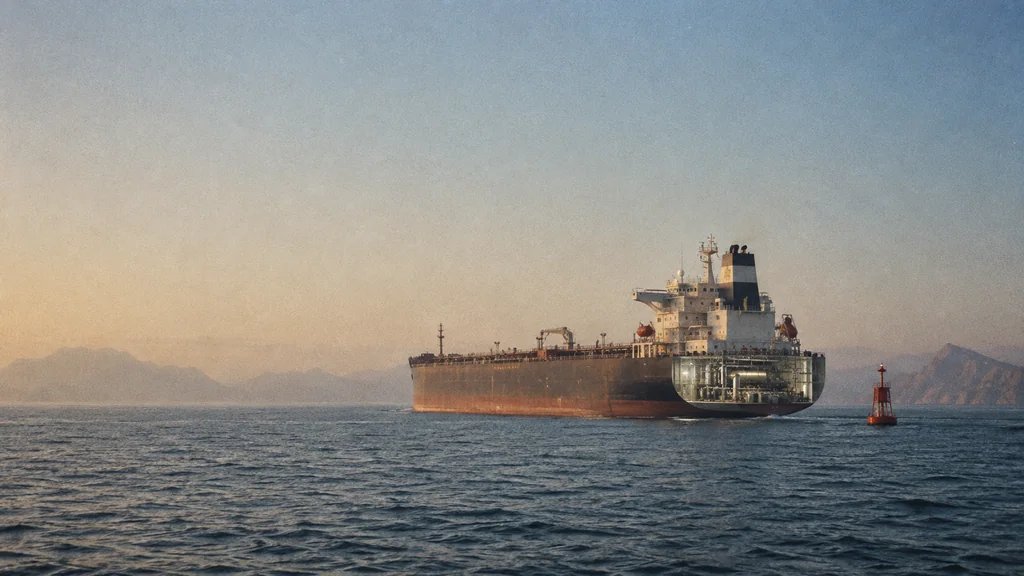
A reported engine-room strike deepens the risk of crossing Hormuz.
Image composition · tobriefA tanker's master has reported that an unknown projectile struck the ship inside the Strait of Hormuz and damaged its engine room, where the machinery that drives and powers a vessel sits. The report was published on 4 October by UK Maritime Trade Operations, the British service that relays threat reports to merchant ships (UKMTO Warning 150-26). The hit adds danger to a route where traffic had already collapsed and insurance had already become expensive. So far, nothing shows that this particular tanker's cargo was delayed.
A master's report, not an inspection
The crew were reported safe, and no pollution had been reported when the warning went out. Beyond that, the warning is thin. It names no ship, flag, owner, cargo or destination, and gives no exact position. Its publication date need not match the time of the strike.
Even the type of ship is unclear. Arab News noted that UKMTO did not say whether the vessel carried oil or liquefied natural gas (Arab News). Calling it an oil tanker would go beyond what the record shows.
The Associated Press reported the same details about the engine room, the crew and the absence of pollution (AP). Every account traces back to the master's single report. No inspection, statement from the owner or account of the voyage has been published.
That gap matters for the economic story. Engine-room damage can knock out a ship's propulsion or its electrical power, leaving it stopped or in need of a tow. The warning does not say whether this tanker lost either, or whether it kept sailing. It names no attacker.
What it costs to cross
Few ships were crossing before this report. Windward tracking data reported by Argus counted 17 passages on 29 September, against roughly 135 a day before the war (Argus). That figure counts ships, not barrels. It shows how few owners are willing to make the trip. It does not show how much oil or gas actually reached buyers.
A lot of energy normally moves through this route. Before the conflict, about 20 million barrels of oil a day passed through Hormuz, roughly one-fifth of world consumption, according to the US Energy Information Administration (EIA).
The ships that still cross pay far more to insure the trip. War-risk premiums, the extra insurance that covers damage from conflict, have risen more than fortyfold since the war began in late February. That estimate comes from Neil Roberts of the Lloyd's Market Association, speaking to S&P Global (S&P Global). It describes how much the price has moved across the market, not what any single voyage paid.
Individual quotes show the cost from another angle. In late September, some reached 6-9% of a ship's value, for cover usually priced per seven-day period (MarineLink). The two figures measure insurance in different ways, so they cannot be joined into one price history. Both point the same way: a week in the strait now costs far more to insure than it did before February.
The shipowner buys that cover. Who ends up paying for it depends on contracts. A charter, the agreement under which a trading firm hires the ship, may shift war-risk costs onto that firm, which may then try to recover them in the price of the oil or gas. A higher insurance quote alone does not prove a higher price for European buyers.
The options also differ by fuel. Saudi and Emirati pipelines can carry some crude around the strait, but Qatar's liquefied natural gas has no such bypass, according to the EIA (EIA). That leaves gas buyers more exposed than oil refiners when the strait itself becomes riskier.
What this strike changes
Washington and Tehran remain deadlocked over terms for reopening the strait (To Brief), and that standoff, not this single report, set the conditions shippers face. By late September, traffic was already a small fraction of its pre-war level, and quoted insurance was already many times higher (Argus). Warning 150-26 adds a damaged ship inside the shipping lane, on a route owners were already avoiding. It does not yet show a lost or late cargo. Only the tanker's owner or its flag state, the country where the ship is registered, can say whether the vessel stopped, and neither has spoken.
Details about this article
- Model:
- claude-opus-5-5
- Generated:
- 10/5/2026, 11:48:18 AM
- Pipeline run:
- eu_pipeline_20261005_005007
- Watermark:
- SynthID (Google's invisible watermark)
- Human review:
- None before publication