Iran threatens ships using Oman’s Hormuz route
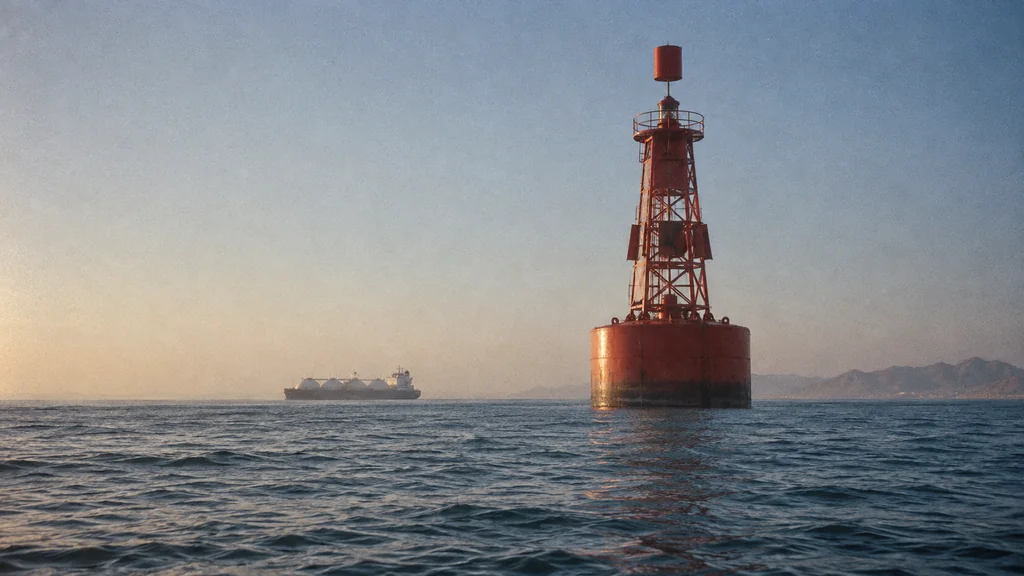
Iran’s warning hangs over ships choosing a passage through Omani waters.
Image composition · tobriefIran's Revolutionary Guard navy said on Friday 9 October that it had struck the gas carrier NV Sunshine for using what it called an unauthorised route south of the Strait of Hormuz, starting a major engine-room fire (Tasnim). No independent source has confirmed the attack. The warning attached to it is clearer. The Guard said ships on routes it rejects could be pursued and punished anywhere in the region, which reaches every European operator weighing a passage through Omani waters.
What Iran demands, and what Oman has opened
Ships leaving the Gulf now face two competing sets of instructions. Tehran has published passage terms that require an Iranian permit for every vessel, a fixed corridor near Iran's Larak Island and a ban on any other route (Iranian passage terms). Nothing in the public record shows whether NV Sunshine ever sought or held such a permit.
Oman, the strait's other coastal state, has opened a temporary corridor through its own waters. It set the corridor up with the International Maritime Organization, the UN body that writes the rules for global shipping (Omani notice).
Tehran has been building toward Friday's claim. On 7 October an Iranian adviser warned that the southern route along Oman's coast would soon be blocked (Reuters). The Guard then presented the NV Sunshine strike as enforcement, after a week of rising tanker incidents in the strait (To Brief).
That sequence shows the limits of Iran's power as well as its reach. The Omani corridor runs through Oman's waters, and nothing in the reporting gives Iran authority to close it. Tehran's leverage comes from the threat of force. The simplest reading of the NV Sunshine announcement is that it is meant to make that threat look real.
A strike resting on one party's word
The Guard gave no coordinates, no weapon, no crew account and no damage assessment. Iranian outlets do not even agree on the day. Tasnim placed the strike hours before its Friday report, while Mehr put it on Thursday 8 October (Mehr).
The ship itself is easy to identify. NV Sunshine is a Vietnamese-operated carrier of liquefied petroleum gas (LPG), and reports calling it an LNG tanker have the wrong ship type (Nhat Viet, VesselFinder).
Tracking data cannot settle what happened to it. A position signal linked to the ship showed it at anchor off Qatar's Ras Laffan on the afternoon of 9 October (MyShipTracking). That fits a ship that was never hit, but a damaged ship can also keep sailing after a fire. Denmark's maritime authority warns of a high risk of signal interference across the Gulf, which makes these readings less reliable (Danish Maritime Authority).
The only confirmed fire that Friday involved a different ship. UKMTO, the British navy's centre for merchant-shipping alerts, said an unnamed vessel was struck 13 nautical miles off the UAE coast and that the fire was later put out (UKMTO). Maritime sources told Reuters the vessel was the laden crude tanker GEM NO.2, and no one has claimed that attack (gCaptain).
Who decides whether ships sail
Some European operators were already staying out of the strait before this week. In February, Hapag-Lloyd suspended its Hormuz transits, citing a security closure (Hapag-Lloyd). Iran's new warning is aimed at the operators still sailing, and above all at those using Oman's route rather than Tehran's.
Iran has threatened to pursue ships that use routes it rejects anywhere in the Gulf, while its claimed strike on NV Sunshine remains unverified. Nhat Viet and Vietnam's maritime authorities are best placed to say what condition the ship is in, and their silence leaves Tehran's account unchallenged for now. Iran cannot decide whether the Omani corridor stays in use. That choice belongs to shipowners, who must weigh the risk of crossing it against the cost of an Iranian permit or of staying away, and to the European governments whose flags many of those ships fly.
How was this article?
Help us get better
Help us get better
Details about this article
- Model:
- claude-opus-5-5
- Generated:
- 10/10/2026, 1:35:35 AM
- Pipeline run:
- eu_pipeline_20261010_005006
- Watermark:
- SynthID (Google's invisible watermark)
- Human review:
- None before publication