Low Danube leaves Romania’s power buyers exposed
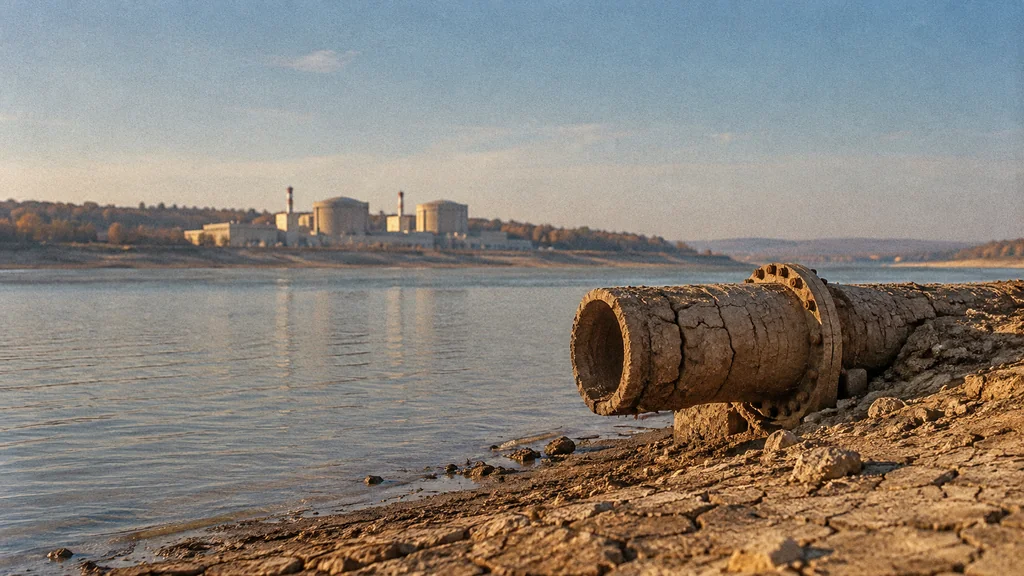
At Cernavodă, two stopped reactors still depend on the Danube.
Image composition · tobriefBoth reactors at Romania's Cernavodă nuclear plant will stay switched off until the Danube allows safe operation, their operator Nuclearelectrica said on 11 October, without giving a restart date (Nuclearelectrica). The notice does not take any more power off the grid. It extends a shutdown that began in the summer, and the cost lands first on the companies that bought the plant's electricity in advance.
Unit 1 went into a controlled shutdown on 28 July and Unit 2 followed on 13 August (Unit 1 disclosure, Unit 2 disclosure). A study of Romania's power supply for 2020–2025 estimated the pair's net capacity at about 1.3 GW (adequacy study). Net capacity is the power a plant can deliver to the grid after covering its own needs. The figure is a planning estimate. It does not measure how much electricity was missing on any particular day.
Why a stopped reactor still needs the river
Switching off a reactor ends the chain reaction. The fuel keeps giving off decay heat, though (warmth from radioactive by-products), and pumps must carry that heat away. Nuclearelectrica says both units remain in a safe shutdown state with their safety functions maintained (Nuclearelectrica). Petre Min, who heads the response centre at nuclear regulator CNCAN, said the stopped units still need Danube water and that crews were directing more of it towards the intake (HotNews).
That water is close to running short. On 10 October, water authority ANAR reported a reading of −259 cm at Cernavodă, three centimetres above the −262 cm level below which the cooling pumps can no longer reliably draw water (Agerpres). The minus signs measure distance from a fixed reference mark. They are not a negative depth.
To raise the level, ANAR ordered an extra 20 cubic metres per second released from the Iezer reservoir between 10 and 18 October (Mediafax). We reported the release when it began (To Brief). No published measurement yet shows how much of that water reaches the plant's pumps.
A higher gauge reading would not restart the reactors by itself. The −262 cm mark only tells you whether the pumps can draw water. The restart decision rests on the operator's judgement that conditions allow safe operation, and it has published no figure for that (Nuclearelectrica). Relief from the river also looks slow. On 7 October, energy ministry state secretary Cristian Bușoi said forecasts showed no sustained rise in the Danube over the following ten days (Digi24).
Who pays for the missing power
The lights have stayed on without the plant. Grid operator Transelectrica's public data showed zero nuclear output on 11 October, with wind, solar and imports filling the gap and net imports (power bought from abroad minus power sold) averaging 446 MW over the day (Solar Industry).
The pressure falls on the buyers. Nuclearelectrica had sold its output in advance to electricity suppliers and large consumers. It has since issued force-majeure notices on some of those contracts, which are declarations that events beyond its control prevent delivery (BVB). Those buyers still need the electricity, so they have to arrange replacements themselves.
Bușoi put the contracted volume that needs replacing at about 900 MW. He said buyers cover it on the day-ahead market (an auction for next-day delivery) or, at peak hours, with imports from neighbours such as Bulgaria, sometimes at much higher prices than in the original deals (Digi24). That figure is not a second outage. It is the part of Cernavodă's missing output that had already been sold.
The 11 October notice prolongs that shortage rather than adding to it (Nuclearelectrica). For as long as it lasts, buyers who received force-majeure notices must buy that power on the open market and absorb whatever premium it carries over their original contracts (BVB). Households will feel it only if their suppliers pass the cost on, which depends on their contracts and on how long the Danube stays low. Bușoi has dismissed talk of a 50% rise in bills but expects significant pressure if supply stays tight (Jurnalul).
Details about this article
- Model:
- claude-opus-5-5
- Generated:
- 10/12/2026, 1:37:01 AM
- Pipeline run:
- eu_pipeline_20261012_005007
- Watermark:
- SynthID (Google's invisible watermark)
- Human review:
- None before publication