Morocco stops 294 at Ceuta’s edge
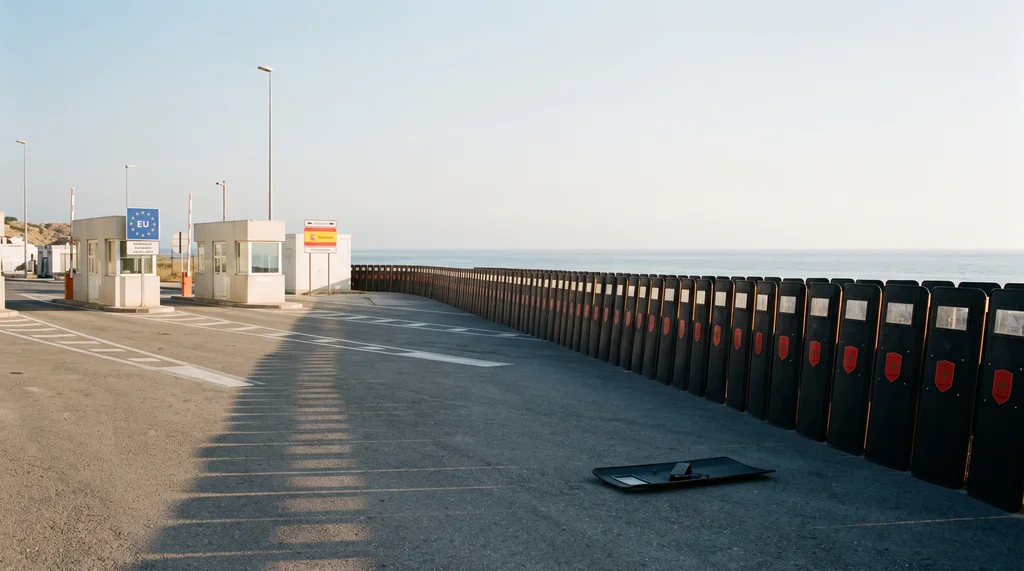
Europe’s southern gate stays shut when Rabat chooses to hold it.
Image composition · tobriefThe feared repeat of late July's mass crossing into Ceuta did not happen on 15 August. Moroccan security forces intercepted groups near Fnideq, three kilometres from Spain's North African enclave, using tear gas, helicopters and police dogs. At the El Tarajal crossing, Spanish authorities reported calm with no collective entry (Europa Press, EFE). The quiet revealed where control actually sits: not in Madrid or Brussels, but in Rabat.
Morocco chose to enforce
In the days before, Moroccan police arrested 61 people for allegedly promoting crossing attempts on social media. On 15 August itself, security forces stopped 294 people at Fnideq, a count that rose through the day from early reports of 111 (Hespress). Spain deployed about 1,600 police and Guardia Civil officers around the enclave and cancelled military leave (El País). The Spanish mobilisation was insurance, not the deciding factor.
As our earlier coverage detailed (To Brief), late July's surge happened when Moroccan enforcement appeared insufficient or permissive. Thousands reached Ceuta over several nights, turning a bilateral border dispute into an EU-wide argument about who bears responsibility at Europe's external frontier. Ceuta is Spanish and EU territory, but Spain requires identity checks for travel from the enclave to the mainland, which sharply limits onward movement. The enclave matters less as a migration gateway than as a test of who actually controls access to EU soil.
On 15 August, Morocco chose to enforce. The contrast with July sharpens a single question: if Rabat can stop crossings when it wants to, Europe's border at Ceuta works at Rabat's discretion.
Money without command
No treaty commits Morocco to policing Europe's frontier. The arrangement shows up in money, not in binding text. Days after July's breach, Commission President Ursula von der Leyen wrote to Prime Minister Pedro Sánchez. She called Morocco "an important strategic partner" and offered more technical and financial support (Brussels Signal). Commissioner Magnus Brunner cited Spain's additional 114 million euro emergency allocation, including about 28 million euros for Ceuta reception and return systems (Euronews).
The power chain runs one way. Morocco controls who reaches the border. Spain absorbs the legal consequences once people arrive on its soil. Brussels offers money and Frontex (the EU's border agency, which assists national forces but does not command them). The Commission cannot order Moroccan gendarmes to disperse a crowd. It can only reward cooperation after the fact. The Belgian think tank Denktank Minerva put it plainly: Ceuta exposes "Fortress Europe" as reliant on a partner that can switch cooperation on and off (Denktank Minerva). German coverage drew the same conclusion (Tagesschau).
What success makes harder to see
The more effective Morocco's enforcement before people reach Spanish control, the harder it becomes to scrutinise. On 15 August, Moroccan authorities ordered EFE and Spanish public broadcaster TVE journalists to leave Fnideq during the police operation (elDiario.es). EU legal protections apply once people reach Spanish jurisdiction: asylum procedures, court review, fundamental rights guarantees. Before that point, the EU has no direct tools to oversee how Morocco conducts interceptions or uses force.
A 22-government letter co-promoted by Italy and Denmark used Ceuta to push for harder external borders and third-country processing centres (Euronews). Italy's Prime Minister Giorgia Meloni and Interior Minister Matteo Piantedosi argued for shifting asylum processing outside EU territory. Madrid countered that onward movement from the enclave stayed below one percent and accused Rome of electoral posturing (Il Fatto Quotidiano).
The 15 August operation proved that paying a non-EU country to stop crossings first can prevent a visible crisis on a single day. It did not prove the arrangement reduces deaths, eases migration pressure, or removes Rabat's leverage over when and whether to cooperate. The contrast with late July, when Morocco's enforcement appeared insufficient or permissive, is the clearest evidence of the bargaining position Rabat holds. Europe's border held because Morocco decided it would. That is dependence dressed as success.
Details about this article
- Model:
- claude-opus-4-6
- Generated:
- 8/16/2026, 2:05:54 AM
- Pipeline run:
- eu_pipeline_20260816_005006
- Watermark:
- SynthID (Google's invisible watermark)
- Human review:
- None before publication