Poland pauses crossings after nearby drone strike
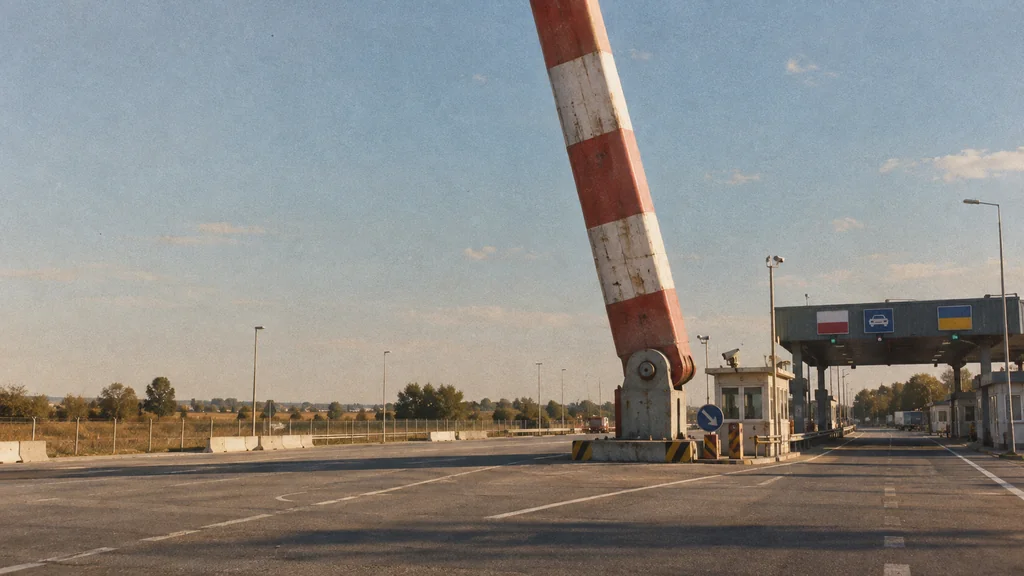
A strike across the border stops the road on Poland’s side.
Image composition · tobriefA Russian drone that struck Ukraine on 28 September still forced Poland to pause traffic on its own side of the border. For a little over half an hour, Polish officers stopped checks at two road crossings into Ukraine (Radio Lublin). Polish officials say nothing entered their airspace. The strike stayed in Ukraine, but it still cost an EU member state time, travel and calm.
A strike just across the line
Defence Minister Władysław Kosiniak-Kamysz said the drone was a Russian jet-powered model. It hit Ukrainian soil about two kilometres from the Dorohusk crossing, and he said Polish airspace was not violated (Ukrainska Pravda).
On the Ukrainian side, the accounts of damage differ. Volyn's acting governor, Roman Romaniuk, said the blast wave damaged premises at the entrance to the Yahodyn terminal, the crossing opposite Dorohusk, and that no one was hurt (Ukrainska Pravda). Border guard spokesman Andriy Demchenko gave a narrower, preliminary assessment and said the crossing itself was not damaged (UNN).
Volyn Customs said serious destruction had been avoided and vehicle clearance resumed promptly (NTA). Several outlets repeated the governor's statement. None of them independently checked the damage.
What Poland paused, and who reported it
The Polish response came from several agencies, and each reported its own step. The Armed Forces Operational Command said military aircraft were in the air and ground-based air defence stood ready (Polsat News). The jets were there to be ready. No report describes an interception or a drone over Poland.
Civilians felt the precautions more directly. The Government Security Centre, Poland's civil-protection alert service, sent an urgent phone message in the Lublin region telling people to find a safe place. An all-clear followed later (Radio Lublin).
Lublin and Rzeszów airports suspended operations to give military aircraft room, then reopened (Censor.net). The reports do not say who ordered that pause.
At the border itself, Border Guard spokesman Maj. Dariusz Sienicki said officers evacuated the Dorohusk and Zosin crossings. Checks restarted at about 17:20 Polish time, and he reported no incident on Polish soil (WP).
Why this stayed a Polish matter
NATO's founding treaty offers two tools for moments like this. Article 4 lets any ally ask for consultations when it believes its territorial integrity, political independence or security is threatened. Article 5, the mutual-defence clause, covers an armed attack on a member (NATO).
A breach of Polish airspace is not a precondition for Article 4. Consultations also never start on their own, because a government has to request them. The reporting from 28 September documents no Polish request. Article 5 does not apply, because the strike hit Ukraine, which is not a member.
Romania's recent case shows the other kind of event. On 24 September, a drone entered Romanian airspace for about four minutes and crashed near Solca (AGERPRES, To Brief). That was an incursion into NATO territory. Dorohusk was a precaution against a strike that never crossed the line.
The Yahodyn strike imposed a real, brief operational cost on Poland without entering its airspace. Drivers at two crossings, passengers at two airports and Lublin residents told to seek shelter all absorbed it, and traffic was moving again the same afternoon. When the target sits two kilometres beyond the border, the frontline EU state pays that cost on its own unless it chooses to ask its allies for more.
Details about this article
- Model:
- claude-opus-5-5
- Generated:
- 9/29/2026, 2:25:44 AM
- Pipeline run:
- eu_pipeline_20260929_005007
- Watermark:
- SynthID (Google's invisible watermark)
- Human review:
- None before publication