Romania downs two drones; ships wait offshore
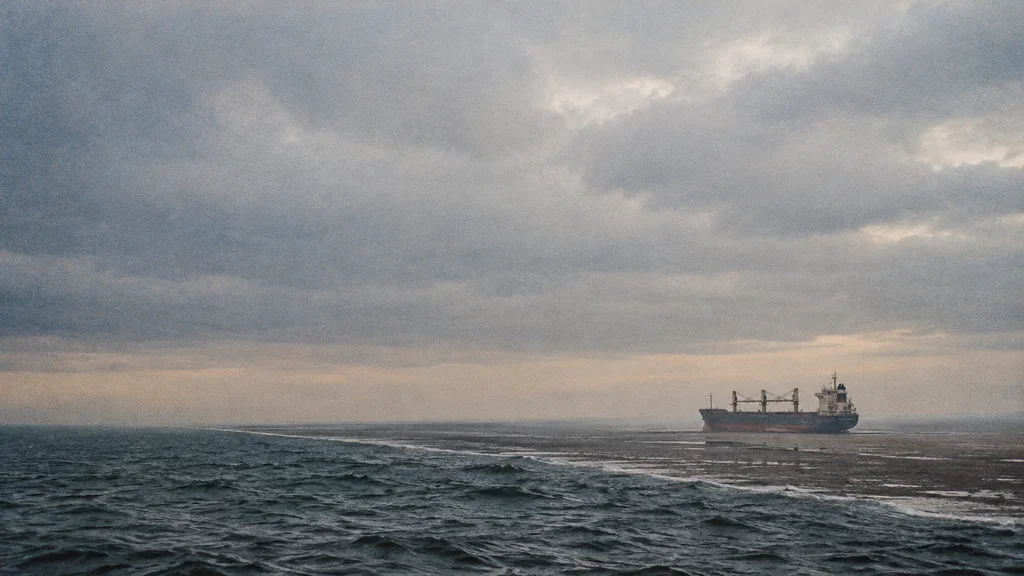
Beyond Romania’s airspace, merchant crews await a decision on protection.
Image composition · tobriefRomanian F-16s destroyed two jet-powered attack drones over the Black Sea on 17 October. The first fell at 18:01, two minutes after it entered Romanian airspace (MApN). Romania could act on its own because the drones crossed into its own sky. Protecting merchant ships farther offshore, where vessels were hit earlier this week, needs a decision Romania's allies have not yet made.
Seen coming, shot down inside the line
Romanian radar tracked a group of aerial targets about 120 kilometres east of Ukraine's Snake Island, heading southwest, according to the Defence Ministry. Two F-16s were flying air-policing duty, the standing patrol that guards national airspace in peacetime. They took off at 17:43 and were already airborne when the first drone crossed in (Kyiv Independent).
The second drone was destroyed at 18:05, the ministry said (MApN). An updated notice identified both as Geran-family attack drones (MApN), the type Russia fires at Ukraine. A drone's type does not tell you who launched it. Romania has published no launch point and no intended target.
The boundary matters because Romania controls the airspace above its territorial sea, the strip of water closest to its coast, under the UN Convention on the Law of the Sea (UNCLOS). The pilots fired over water, but they were defending national territory. The sequence ran in order. Radar detected the drones, the jets were in position, and the pilots fired only after the drones entered.
The ships beyond the line
The merchant ships attacked this week sat outside that zone. They were in Romania's and Bulgaria's exclusive economic zones, where a coastal state controls fishing and seabed resources but not the airspace above. A Romanian pilot has clear authority over a drone above the territorial sea. Farther out, a ship has no equivalent guarantee.
The ministry did not say Friday's drones were heading for ships, and nothing published ties them to the earlier strikes. Those attacks remain publicly unattributed (To Brief). President Nicușor Dan confirmed they were drone strikes but declined to blame Russia, although an anonymous NATO military source did (Reuters). France said on 15 October that it had not attributed the attacks and was waiting for the investigations (French foreign ministry).
The allied response so far has been words and information. On 16 October, the European Council (where EU heads of government set the bloc's direction) condemned the attacks, called for safe passage to be restored and created no escort force (European Council). NATO's Shipping Centre exists to share warnings with merchant crews, but it does not guard them (NATO).
Governments have so far declined to name a culprit, and they have announced no escorts. The public record does not show that the first explains the second. Officials have given no reason for either.
Who decides next
Foreign Minister Oana Țoiu says Romania has called a dedicated discussion on Black Sea defence at the North Atlantic Council, where NATO governments decide together, for 20 October (Politico). That table holds the power Romania lacks on its own. Bucharest can scramble jets over its territorial sea. Sending warships or aircraft to protect shipping in open waters would need allies to commit forces and accept the risk.
What happened on Friday is clear. Romania shot down two drones after they crossed into its airspace, and its radar saw them coming. Crews sailing farther out have a condemnation from EU leaders and a NATO information channel. No government has yet put its name to a mission that would defend them. The ministers meeting on 20 October will decide whether that changes.
Details about this article
- Model:
- claude-opus-5-5
- Generated:
- 10/18/2026, 1:32:44 AM
- Pipeline run:
- eu_pipeline_20261018_005006
- Watermark:
- SynthID (Google's invisible watermark)
- Human review:
- None before publication