Russian diesel licence meets US import ban
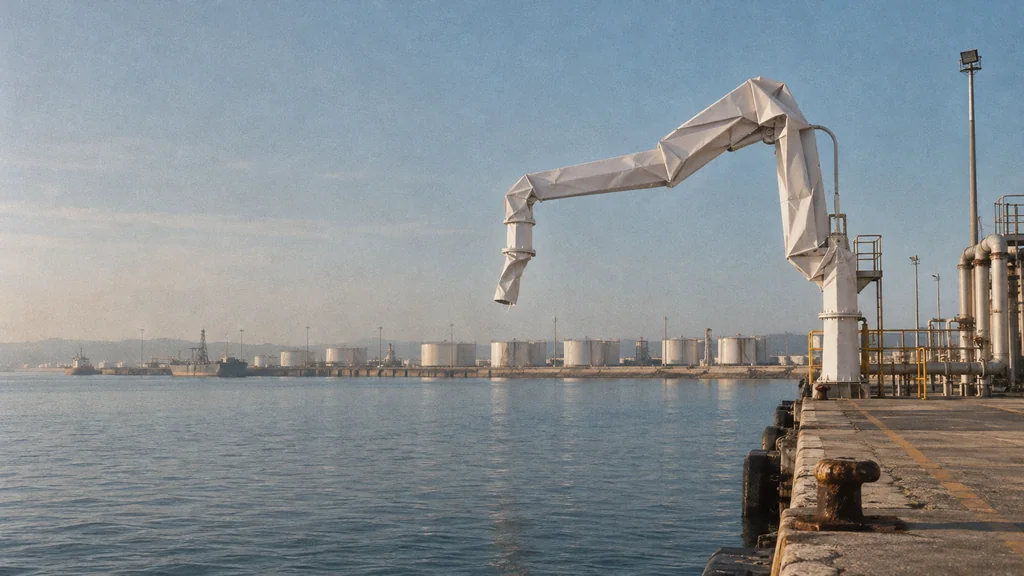
Washington opens a route for Russian diesel; the berth remains empty.
Image composition · tobriefUS diesel futures fell almost 5%, to about $4.64 a gallon, within hours of Donald Trump's 9 October announcement that Russia would send fuel to world markets (Reuters). The drop suggests traders are pricing in fuel they expect to arrive later. Two days on, Washington has opened a legal route for Russian diesel. No new shipment appears in the available reporting, US import law is unresolved, and Europe's own ban still stands.
Our earlier report covered the licence itself (To Brief). This piece follows what has and has not happened since.
Three sizes of promise
Trump's post listed more than 300,000 tonnes immediately, 500,000 tonnes in November, 1 million tonnes after that and a further 3 million tonnes, depending on the state of Russian refineries (Truth Social).
Moscow committed to less, and in vaguer terms. According to a Russian government notice on 10 October, the country partly lifted its diesel export ban for a first stage of up to 500,000 tonnes, and oil companies would now start arranging foreign contracts (Russian government). The notice named no exporter, buyer, ship or loading date. It did not say the fuel was headed for America, and no new shipment under the deal is documented in the available reporting.
The central doubt is whether Russia has the fuel at all. The International Energy Agency has documented serious damage to Russian refining from Ukrainian strikes (IEA). Russian diesel and gasoil exports fell to about 144,000 barrels a day in September, a decade low (Rigzone). Analysts told AP that any fuel sent to America might simply be taken from Russia's existing customers, adding nothing to world supply (AP).
A licence that runs into a law
The American move is legal, not physical, and it has two layers that point in opposite directions. Start with what Treasury permitted. Its General License 135, a blanket permission from the sanctions office, lets companies sell, deliver and import Russian diesel until 7 April 2027 without applying case by case (OFAC). It sets no limit on volume.
Congress sits above Treasury. In 2022 it passed a law banning imports of Russian petroleum into the US, with strict conditions for lifting that ban (US Congress). The licence never mentions that law.
An importer now holds a permission from one branch of government and a prohibition from another. Treasury has not explained whether a Russian diesel cargo can actually clear US customs. A buyer weighing a contract has no clear answer on whether the fuel could legally land.
What changes for Europe
EU law has not moved. Article 3m of the bloc's main Russia sanctions regulation still bars imports of Russian petroleum products, diesel included (EUR-Lex). A US licence cannot amend it, so European buyers face the same rules they faced last week.
The European objection is about money. Kaja Kallas, the EU's foreign policy chief, argued on 10 October that easing diesel sanctions gives Moscow extra revenue for its war (Kallas). Her case rests on what the EU embargo was built to do: shut Russia out of big fuel markets so its war budget feels the loss. A working American outlet would weaken that pressure.
So far that outlet exists mainly on paper. Russia earns nothing new unless it has spare diesel to sell and buyers can legally land it in the US. If the fuel is only redirected from existing customers, as the AP analysts suggest, the effect on Moscow's earnings is harder to predict. That is an inference from the supply picture, not a measured result.
European drivers should not expect much relief either. Diesel trades as a single world commodity, so a cheaper price in New York can pull down what European importers pay for cargoes from elsewhere. Even so, Germany's fuel industry association expects little effect at German pumps (Tagesschau).
Treasury now owes Congress and importers an answer on how General License 135 fits with the statutory import ban. Until it gives one, the deal amounts to this: Moscow has authorised fuel it has not shown it can supply, for a market that may not be legally open to it.
Details about this article
- Model:
- claude-opus-5-5
- Generated:
- 10/11/2026, 1:33:51 AM
- Pipeline run:
- eu_pipeline_20261011_005006
- Watermark:
- SynthID (Google's invisible watermark)
- Human review:
- None before publication