Six governments split over EU budget cuts
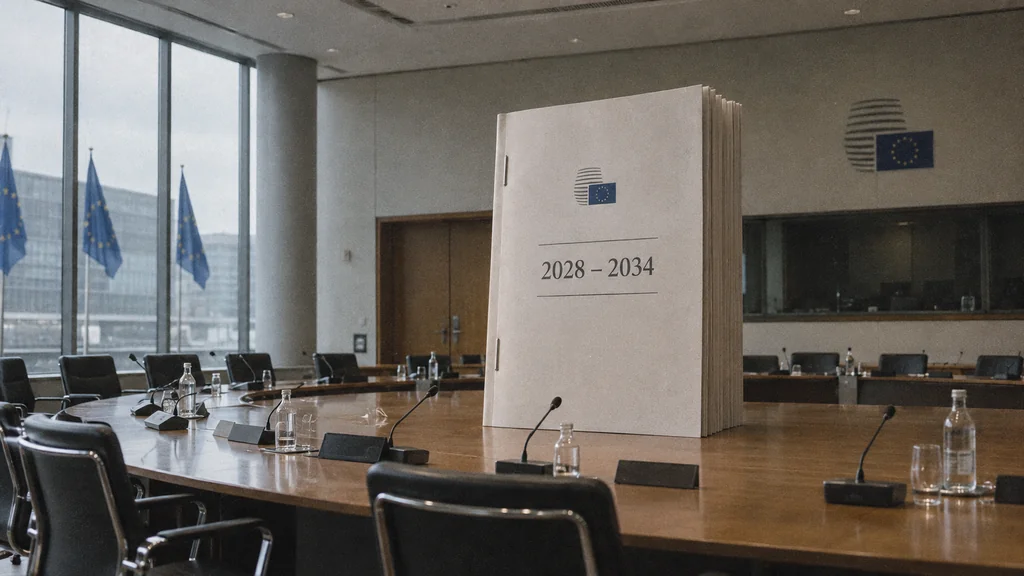
Europe’s budget proposal grows while agreement on where to cut recedes.
Image composition · tobriefIreland, which chairs the talks among EU governments, has proposed a 2028–34 EU budget of €1.826 trillion, below the €1.985 trillion the European Commission asked for (ORF, Council of the EU). This is a negotiating text, not an adopted budget. Germany and five allies say it is still too large, but they disagree about which programmes should give way.
German Chancellor Friedrich Merz said on 10 October that a budget of that size was no basis for an agreement (German government). Ireland's numbers show why demanding more savings is easier than finding them.
Part of the gap between the two totals is simply expected inflation over seven years. Measured in 2025 prices, which hold purchasing power fixed, Ireland's proposal is €141 billion, or about 8%, below the Commission's (Council of the EU, Reuters). Both figures are ceilings. They limit what the EU may promise to programmes over the period, rather than counting cash paid out at once.
Farms and regions are spared most
Ireland did not share the savings evenly, as we reported when the draft appeared (To Brief). Farm subsidies and cohesion funds (EU grants meant to narrow gaps between richer and poorer regions) sit in a budget section that loses only 3.4% (Council of the EU). The guaranteed minimum for farmers' income support stays at just over €261 billion in 2025 prices (CAP Reform).
Other parts of the budget take bigger hits. The section holding research, defence and other competitiveness spending loses 12.8%, while foreign-policy spending loses 17.4% (Council of the EU). Within the research and defence section, two programmes carry the biggest visible losses. Horizon Europe, the EU research programme, falls from about €154.9 billion to €140.0 billion, and the line for defence industry, security and space falls from about €115.7 billion to €100.7 billion (Council of the EU).
None of this takes money from a university or arms maker today, because these are lower ceilings for future spending. The effect comes later. Universities, labs and defence suppliers would compete for a smaller pot, so fewer of the projects they propose would win funding.
Deeper cuts, but whose?
Germany, Denmark, the Netherlands, Austria, Finland and Sweden have asked for savings of "several hundred billion euros" (Danish government). Their joint statement names no new total and no split across programmes. It also does not say whether the savings count from the Commission's plan or from Ireland's (German government). Whichever starting point they use, Merz has made clear that Ireland's cut falls short.
The six also want different things cut. Denmark's finance minister Peter Hummelgaard wants farm support and regional development money to take a smaller share of the budget (DR). Finland's prime minister Petteri Orpo also wants a lower total. But he argues that defence, research and new technology already absorbed too much of the savings, and he welcomed the protected farm minimum (Finnish government).
Both of those options run into opposition outside the group. On 2 October, 17 leaders, including Italy's Giorgia Meloni and Romania's Nicușor Dan, demanded that farm and cohesion money be preserved (Slovenian government). The European Parliament's lead negotiators, Siegfried Mureșan and Carla Tavares, object to the cuts Ireland already made to competitiveness and foreign policy (European Parliament).
Those objections carry weight because the budget needs every government's agreement plus Parliament's consent (EU Treaty, Article 312). Any one capital, or Parliament, can block the final deal.
The six are therefore split by two contested choices. They can dig into farm and regional money that 17 governments defend, or deepen research and defence cuts that Finland and Parliament oppose. Merz has rejected Ireland's total without saying which he prefers. Leaders discuss the budget on 15–16 October (European Council). If the six do not arrive with their own figure and a list of programmes to cut, Ireland's draft will be the only set of numbers in front of them.
Details about this article
- Model:
- claude-opus-5-5
- Generated:
- 10/12/2026, 1:37:20 AM
- Pipeline run:
- eu_pipeline_20261012_005007
- Watermark:
- SynthID (Google's invisible watermark)
- Human review:
- None before publication