€15 Million Lifts Paks 20 Centimetres
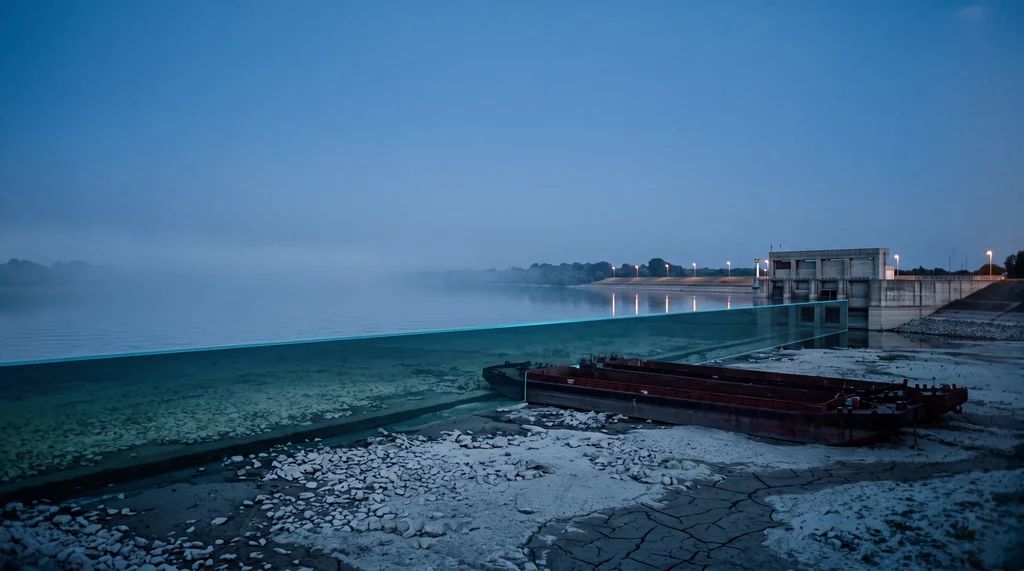
Twenty centimetres of water bring Hungary’s nuclear heart back online.
Cumadóireacht íomhá · tobriefOn the Danube, 20 centimetres was enough to bring Hungary's nuclear plant back from the edge. Crews sank two barges and built a temporary dam on the riverbed to push water back towards the intake pumps at Paks. By 23 August, four of the plant's eight turbines were running again, output was above 800 MW, and the government expected the full 2,000 MW to be restored by midweek (Portfolio, Euronews HU). The point is not that emergency engineering failed. It did work. The warning comes from Romania, where similar works at Cernavodă, its only nuclear plant, still ended with both reactors lost. You can buy a cooling margin. You cannot command a river.
What crews built and why it was enough
A nuclear plant needs vast amounts of water after the turbines have done their work. The water cools the steam so the system can keep cycling safely. At full power, Paks needs about 100 cubic metres per second from the Danube. When the river fell to record lows, the plant's fixed-depth pumps could no longer draw enough water, and operator MVM began reducing output in late July (MVM).
On 12 August, the Hungarian government ordered two interventions. The first was a bottom sill, a low barrier built on the riverbed to slow the current and raise the water level at the intake. The second was the controlled sinking of two 80-metre barges to block more flow. The bill was HUF 6.1 billion, about €15 million, against an official estimate of at least HUF 50 billion per month for replacement power in the event of a full shutdown (kormany.hu, Energy Connects). Spend €15 million to avoid €50 million a month: there was no great mystery in the arithmetic.
By 22 August, crews had built 242 metres of sill. Together with the barges, it raised the water level by more than 20 cm. Seven of the eight cooling pumps were operating and intake was close to capacity (kormany.hu, MTI).
Romania's warning
Romania had already tried much the same approach at Cernavodă, which normally supplies about a fifth of the country's electricity (World Nuclear). Crews blasted a rock formation, dredged channels and sank barges to redirect the Danube towards the intake (The Guardian, Financial Intelligence). The first intervention lifted the water by 8 cm and gave Unit 2 about nine more days (HotNews). Then the Danube kept dropping. Unit 2 shut on 13 August. Romania has since approved a second emergency package because the first bought time, not security (AGERPRES).
The difference was not competence. Both countries moved quickly and threw equipment at the same physical problem. Hungary got 20 cm where 20 cm was enough. Romania got 8 cm where the gap was still widening.
Who paid, who profited
Once Paks looked likely to shut down, Hungarian week-ahead power climbed to about EUR 250–263/MWh, roughly 15–20% above the previous day's level (Argus). Those prices reach industrial buyers quickly. Hungary doubled electricity imports, pulling in about 4 GW at night, while the government asked households not to use washing machines and dryers between 17:00 and 22:00 (Euractiv). A separate decree gave the grid operator power to cut large industrial consumers above 0.5 MW, with penalties set at 200% of the spot price for factories that ignored the order (HVG). Households were asked to help. Factories were told.
Romania's position was more exposed. On one evening, imports reached 1,839 MW, covering 27.4% of consumption (Curs de Guvernare). Bulgaria was the short-term winner, with exports rising to roughly 32,000–33,000 MWh per day as neighbouring nuclear output disappeared (Mediapool). Slovakia, whose Mochovce and Bohunice plants use cooling towers rather than direct river cooling, kept running at full power and quietly benefited from higher regional prices (Info.sk).
The river still decides
Hungary avoided the immediate cost of replacing Paks. The sill-and-barge operation cost €15 million, while a prolonged shutdown would have cost tens of millions every month. But the fix did not remove the underlying exposure. Paks still depends on fixed-depth pumps drawing cooling water from the Danube, and the next low-water spell may last longer or fall further than a temporary sill can cover.
France's EDF is spending €9 billion over 15 years to climate-proof its nuclear fleet (Le Monde). Hungary built 242 metres of sill in 11 days. It was enough this August. The harder question is whether it will be enough next time.
Details about this article
- Model:
- claude-opus-4-6
- Generated:
- 8/24/2026, 1:51:24 AM
- Pipeline run:
- eu_pipeline_20260824_005006
- Watermark:
- SynthID (Google's invisible watermark)
- Human review:
- None before publication