Belgium Balks at €210bn Reserve Plan
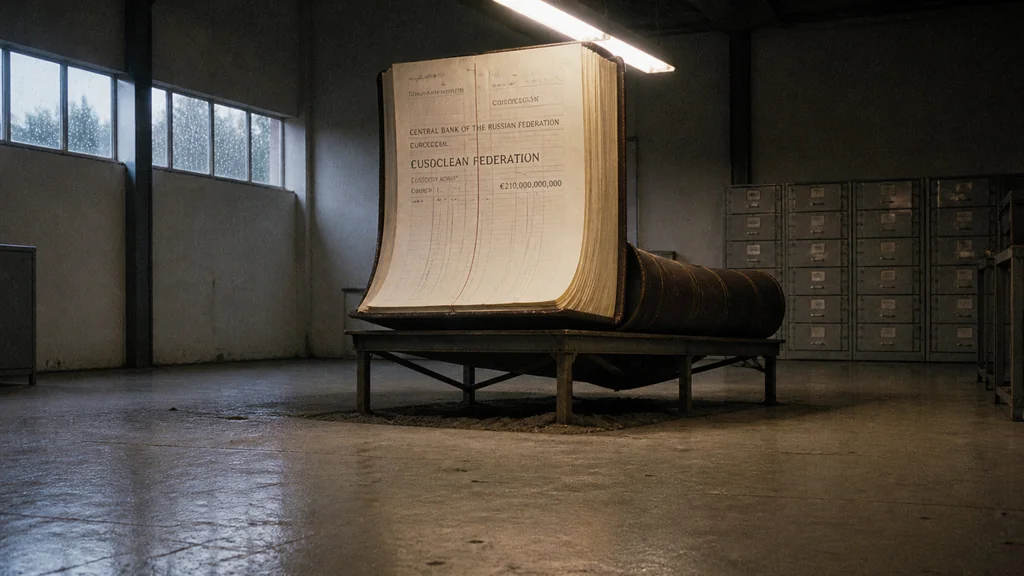
Europe’s frozen reserves still rest on one Belgian balance sheet.
Cumadóireacht íomhá · tobriefThree former Western officials have reopened one of the most difficult questions in Europe’s support for Ukraine: whether the EU should go beyond using the profits from frozen Russian state assets and take administrative control of the assets themselves.
The proposal, made on 8 August by Annegret Kramp-Karrenbauer, the former German defence minister, Nathalie Loiseau, the former French minister for European affairs, and Daleep Singh, a former senior US sanctions official, would see the EU take control of roughly €210bn in frozen Russian central-bank reserves. It was first reported in German media (FAZ, RBC Ukraine).
This is not EU policy. It is a political campaign aimed at moving the debate. The distance between those two things is where the argument now sits.
The profits-only system Europe already runs
When the EU froze Russian central-bank reserves after the 2022 invasion, it did not seize the underlying assets. The bonds and cash deposits remained formally Russian-owned, but they kept producing income. Interest built up. Coupons matured. The EU then created a mechanism to skim those windfall profits and send them to Ukraine, while leaving the principal untouched (Council, EUR-Lex).
On 3 August, the EU transferred €1.4bn from that stream, bringing the total to €8bn since the system began (EEAS, Euronews). Most of the money, 95%, helps Ukraine service G7 loans. The remaining 5% goes through the European Peace Facility for military support (Commission Representation in France).
The G7 structure is a clever piece of wartime finance. Lenders provide money to Kyiv now, and future profits from the frozen Russian assets help repay them over time (G7 Apulia communiqué). But it still relies on income from the assets, not the €210bn principal. Set against Ukraine’s war costs and eventual reconstruction bill, €8bn is useful but limited. That gap is what keeps drawing politicians and former officials back to the bigger pot.
What custody would change — and why Belgium is blocking
The awkward fact for the EU is that most of the frozen Russian money is not spread neatly across the continent. It is concentrated in one Belgian institution: Euroclear, the Brussels-based body that records ownership of securities and settles transactions between buyers and sellers. Around 90% of the EU’s frozen Russian assets are held there (EUobserver).
That gives Belgium leverage far beyond its size. Any move beyond skimming profits, whether custody transfer, seizure or a new use of the principal, needs Belgian cooperation because the assets sit inside Belgian financial plumbing. If Belgium refuses, the plan does not move.
The proposed custody model would move the reserves out of Euroclear and into a new EU-controlled body. Russia’s central bank would remain the formal owner, allowing the authors to describe the move as administration rather than confiscation (FAZ, Fakti). In practice, though, it would shift risk. At the moment, Belgium and Euroclear carry much of the legal and operational exposure for a political decision taken by all 27 EU governments.
That exposure is already visible. In July, a Moscow appeals court upheld an 18.17 trillion-ruble order against Euroclear in a case brought by Russia’s central bank (Washington Post, Brussels Times). The ruling cannot be enforced under Belgian law, but it shows Moscow’s strategy: put pressure on the institution holding the reserves, not on the EU as a whole. Belgium’s caution is not foot-dragging for its own sake. It is the response of a small state being asked to carry concentrated risk for the bloc.
The legal line Europe has not crossed
The distinction between profits and principal matters. International law gives central-bank assets unusually strong protection among sovereign property (UN Convention on State Immunity). Using profits generated after the freeze is one thing. Taking control of assets Russia already owned before the war is another.
The custody proposal is designed to sit in the space between those two positions. Ownership would remain with Moscow on paper, while control would move to the EU. The unresolved question is how other central banks would read that in practice. If reserve managers conclude that assets held through European systems can be moved by political decision, some may reduce their exposure to the euro. The ECB has acknowledged the wider risk that sanctions-related actions could affect the international role of European financial infrastructure, though it has not named this custody proposal directly.
Poland and the Baltic states would welcome a "Russia pays" model that reduces pressure on their own public finances. Ukraine would receive support under either approach, but the scale depends on which legal line Europe is willing to cross. Belgium and Euroclear, meanwhile, face legal risks that the proposal has not really solved. For now, the EU position remains: profits yes, principal no. Three former officials want to change that. The 27 governments have not.
Details about this article
- Model:
- claude-opus-4-6
- Generated:
- 8/9/2026, 1:48:31 AM
- Pipeline run:
- eu_pipeline_20260809_005005
- Watermark:
- SynthID (Google's invisible watermark)
- Human review:
- None before publication