Bulgaria’s Lukoil Licence Runs Out
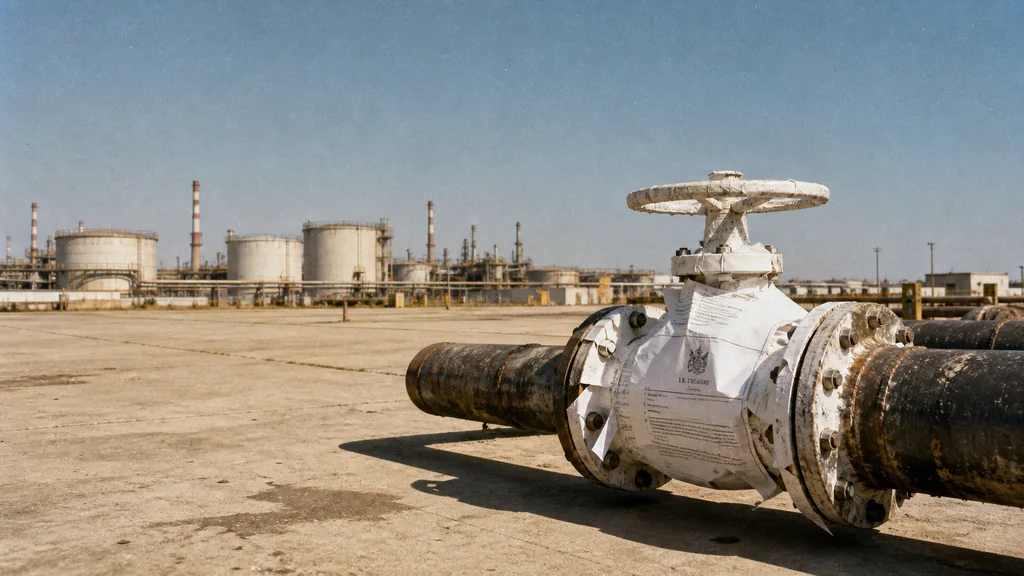
The fuel keeps moving while Bulgaria postpones the proof.
Cumadóireacht íomhá · tobriefOn 29 October, Bulgaria’s only major refinery runs out of legal breathing space. From that point, every bank transfer, insurance policy and fuel sale linked to the Burgas plant risks becoming a sanctions problem unless London extends the permission again.
The UK’s Office of Financial Sanctions Implementation, the Treasury unit that enforces British financial sanctions, extended the licence on 12 August, moving the deadline from 13 August to 29 October (sanctions.com). Sofia had asked London to align the date with a parallel US licence (BNR News). It is the third extension since the original wind-down period expired in late 2025 (Interfax).
The licence keeps banks, insurers and fuel buyers legally able to deal with the Burgas refinery (Fakti). What it does not prove is the harder point: that profits, payments or sale proceeds from the plant have stopped reaching Lukoil, its sanctioned Russian parent. No public data confirms that separation.
Crude through September, payments through October
For the moment, the physical supply problem looks contained. Evgeni Simeonov, the special commercial manager overseeing Lukoil’s Bulgarian assets, says crude has been contracted through September, with October deliveries still being negotiated (NOVA). Processing volumes have risen from about 450,000 tonnes earlier this year to 560,000 tonnes in July (Sega, Fakti).
That tells its own story. Bulgaria is not facing an immediate fuel shortage, and the refinery is still commercially alive. But the same rising output also means more money is moving through a corporate structure whose Russian ownership has not been resolved.
A refinery does not operate simply because crude is sitting in tanks. It has to pay suppliers, collect from customers, arrange shipping, secure insurance and settle through banks. The licence is the legal cover that allows those routine transactions to continue. Without it, banks, traders and insurers dealing with Burgas would face sanctions exposure, and most would step back (24 Chasa).
Simeonov says the refinery buys crude only from "global giants", not sanctioned companies (Vesti). There is no published evidence either way: no customs declarations, supplier names, tanker identities or payment flows that confirm or disprove the claim. The latest licence change adds one check, requiring any entity using the permission for the first time to notify the UK Treasury within 14 days (sanctions.com).
Romania pays if Burgas stops
Bulgaria’s fuel problem would not stay Bulgarian for long. The country shares a Black Sea diesel-supply zone with Romania, which lost a nearby source of supply when Lukoil’s Ploiești refinery closed last November. Romania now produces only about 20–22 percent of its diesel domestically (Ziare.com).
If Burgas stops, Romania has to compete harder for imported diesel cargoes coming from farther away. That pushes up the price both countries pay. Analyst Eugenia Gusilov told Romanian media that Bulgaria is better insulated while Burgas is running; Romania, already dependent on costlier diesel imports, would feel any disruption more sharply (Adevărul).
The EU sanctions regime is also moving into more awkward territory for Sofia. The 21st Russia sanctions package is concerned not only with where crude comes from, but with whether payments, ownership chains or intermediaries still allow sanctioned value to move (Skadden). A refinery can buy non-Russian crude and still have a sanctions problem if its profits end up with a sanctioned parent.
A licence is not a separation
Deputy PM Alexander Pulev described the extension as a win that had prevented a shock rise in fuel prices (Darik). In immediate political terms, it did. But a licence is a pause, not a solution.
US terms require proceeds from any Lukoil asset sale to remain in a blocked American account until ownership transfers receive separate approval (RBC). A wider UK licence for Lukoil International runs until February 2027, but the Bulgaria-specific permission ends in October (Kommersant). When Germany faced a comparable problem at Rosneft’s Schwedt refinery, it put the plant under state trusteeship, shifting operational control rather than merely licensing trade. Bulgaria has a special manager and a rolling licence. It does not yet have a structural break.
London and Washington have practical reasons to extend again. Freezing a refinery that supplies millions of Bulgarians and affects regional diesel markets helps nobody. But every extension granted without public evidence on cargo origins, payment flows and refining margins makes continuity look less like transition and more like preservation under another name. October is not mainly a supply deadline. It is a proof deadline, and Sofia is the capital that has to provide the answer.
Details about this article
- Model:
- claude-opus-4-6
- Generated:
- 8/14/2026, 2:11:23 AM
- Pipeline run:
- eu_pipeline_20260814_005006
- Watermark:
- SynthID (Google's invisible watermark)
- Human review:
- None before publication