Cyprus Cable Awaits Greek Notice
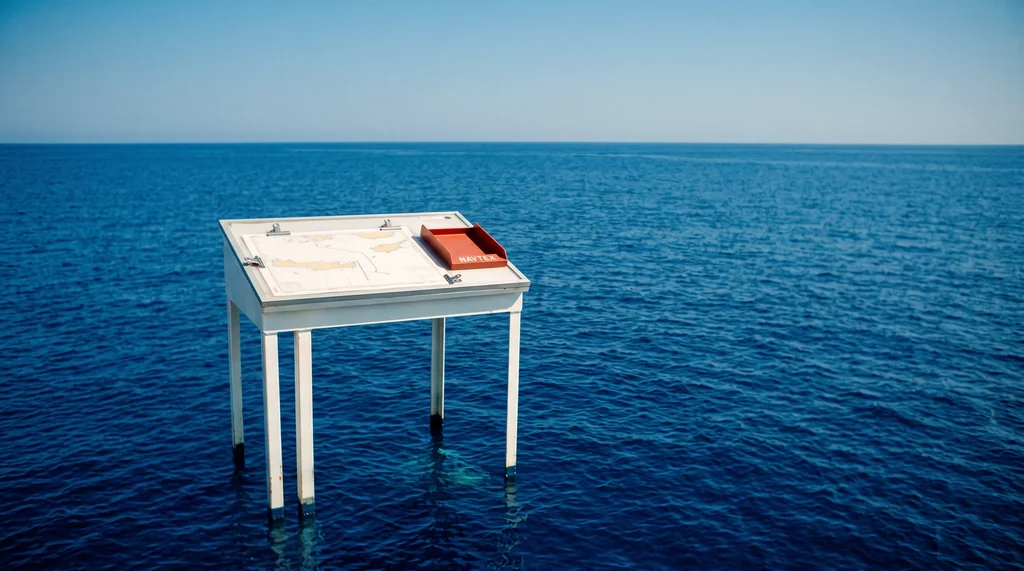
A missing notice leaves Europe’s cable stranded in contested waters.
Cumadóireacht íomhá · tobriefSomewhere between Crete and Cyprus, a survey ship is waiting on a piece of paperwork. The navigational notice that would let it move has still not been issued. Until it is, one of Europe’s most ambitious electricity projects remains where it has been for two years: designed, funded and politically endorsed, but stopped at sea by a sovereignty dispute no one has found a way around.
The cable, the gap, the blocked ship
The Great Sea Interconnector, or GSI, is supposed to end Cyprus’s isolation as the only EU member state without an electricity link to the European grid. The plan is for a 1,208 km cable from Crete to Cyprus, running at depths close to 3,000 metres, with an estimated price tag of €1.9 billion (Enerdata). The European Commission has designated it a Project of Common Interest, the EU label used for cross-border infrastructure it wants built, and has committed almost €658 million through the Connecting Europe Facility, its infrastructure funding programme (Euronews, Cyprus Mail).
Roughly 60% of the seabed mapping has been completed. The remaining 40% sits in waters claimed by both Greece and Turkey (Greek News Agenda). That is where the project stops being engineering and becomes power politics. In July 2024, when an Italian-flagged survey vessel entered the corridor south of Kasos and Karpathos, Turkey sent warships. The vessel halted. No survey work has advanced since (DW).
France bought a stake, not a guarantee
On 5 August, French infrastructure investor Meridiam bought majority control of the project company. IPTO, Greece’s grid operator, remains in charge of the technical work (Prime Minister of Greece). A separate agreement between IPTO and French cable maker Nexans, which already has a cable contract worth about €1.43 billion, covers the seabed surveys needed before any cable can be laid (Energynews.pro, Powergame).
France now has money, industrial contracts and diplomatic credibility tied up in the cable. Reports say Greek prime minister Kyriakos Mitsotakis, Cypriot president Nikos Christodoulides and French president Emmanuel Macron have discussed moving quickly on the navigational notice once operational decisions are ready (Cyprus Mail). Greek press reports have floated the possibility of a French naval escort, but there has been no official confirmation from Paris, Athens or Nicosia (RUA). French involvement raises the political cost of blocking the project. It does not remove the risk for Greece in sending the ship back in (Kathimerini).
Ankara has not shifted. Turkish officials say seabed work in waters Turkey claims needs Turkish permission (Hürriyet). The legal argument is real, not invented for the moment. Greece and Cyprus rely on the UN Convention on the Law of the Sea, the treaty that sets rules for maritime jurisdiction, and argue that islands generate exclusive economic zones. Turkey has not signed that treaty and says islands do not carry the same weight when their claims overlap with a mainland continental shelf.
On Turkey’s reading, the waters between Crete and Cyprus fall within its zone. On Greece’s reading, Greek and Cypriot zones meet. That makes a seabed survey more than preparatory work. It helps fix the route of a cable that either side may later treat as evidence for its wider maritime claim. Turkey’s intervention in 2024 showed where it sees the line: survey permission is the practical test of sovereignty (Daily Sabah).
Cyprus pays the most, sees the least
Cyprus would carry 63% of the cable’s cost, about €786 million, because it is the EU’s last isolated electricity market (Euronews). Of the €251 million IPTO says it has already spent, Cyprus’s energy regulator has judged only 32% recoverable (ProtoThema). Opposition leader Stefanos Stefanou has asked the finance minister how Meridiam’s arrival affects the total cost, the project’s viability and the burden on consumers. It is the obvious question. Cypriot taxpayers and bill-payers are being asked to finance a cable whose next physical step depends on a confrontation they cannot control.
ENTSO-E, the body that co-ordinates Europe’s electricity grid operators, confirmed in April that GSI is the only recognised interconnector for Cyprus. It refused to consider any alternative routed through Turkey or northern Cyprus (ENTSO-E). The Commission says its commitment is "crystal clear". The navigational notice expected around October will test what that phrase means in practice.
Brussels has spent nearly €658 million designating, funding and planning a cable whose next step requires a survey vessel to enter waters where a non-EU state sent warships two years ago. Up to now, the Commission has treated GSI as an energy project. The next navigational notice will show whether it is prepared to treat it as a sovereignty problem.
Details about this article
- Model:
- claude-opus-4-6
- Generated:
- 9/7/2026, 1:35:41 AM
- Pipeline run:
- eu_pipeline_20260907_005005
- Watermark:
- SynthID (Google's invisible watermark)
- Human review:
- None before publication