Cyprus Cable Still Awaits Ship
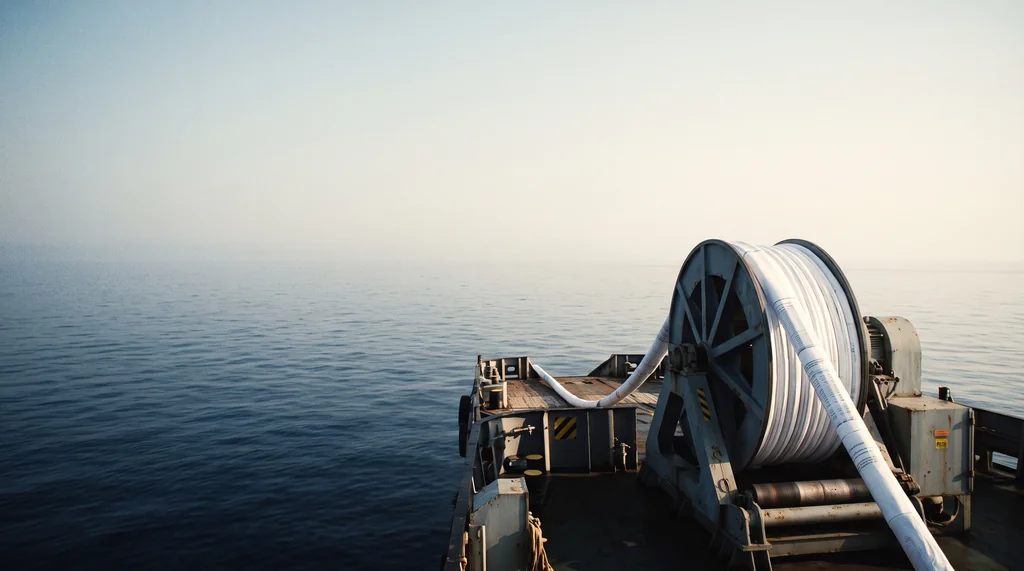
Europe’s promised connection remains stronger on paper than at sea.
Cumadóireacht íomhá · tobriefThe French money has changed the Great Sea Interconnector in the way money often does in European infrastructure: it has made the spreadsheet easier to defend. It has not, yet, put a survey vessel back in the water.
There is still no NAVTEX, the formal maritime notice needed before survey work can begin. No ship has been named. No coordinates have been published. Cyprus remains the only EU member state without an electricity link to the continental grid, and the project meant to end that isolation is still, three weeks after its largest ownership change, living off announcements rather than activity at sea.
What the new money changes
Meridiam, the French infrastructure fund, now holds a majority stake in the GSI project company. Greece's ADMIE, the national transmission system operator, keeps technical leadership and would operate the cable in future (EUalive, Balkan Green Energy News). The exact ownership split has not been published.
Nexans, the cable manufacturer, has signed on as contractor and completed a world-record 3,000-metre depth test for the kind of undersea power cable the route would need (Nexans). That matters. It shows the engineering is not fantasy. The harder problems sit elsewhere: who pays, who carries the risk, and whether a ship can work in contested waters.
Greek Prime Minister Kyriakos Mitsotakis described the French entry as "a very strong vote of confidence" (Economix). It is that, up to a point. But Meridiam is a private investor, not the French state. There is no sovereign guarantee in the public record, no export-credit instrument, and no French government statement putting Paris formally behind the project. Meridiam spreads the financial risk. It does not make it disappear.
Three gates the cable still has to clear
The first gate is the tariff formula. Greece's energy regulator has opened a public consultation, running until 11 September, on the methodology that will decide how much investors can recover through electricity bills (OT). ADMIE wants the formula to assume less debt during construction, which would allow a higher return to be charged to consumers once the cable is operating (iEnergeia). The question of who pays, and how much, is still open.
The second gate is political cover in Nicosia. Cyprus is waiting for the European Investment Bank to finish its economic assessment before committing further money (Politis). That assessment has no public completion date. It also gives the Cypriot government a defensible reason to wait.
Opposition parties in Cyprus want the Meridiam-ADMIE agreement fully disclosed before any further financial participation (Kathimerini Cyprus). The imbalance is already visible. ADMIE has declared roughly €251.4 million in spending, while Cyprus has recognised about €82 million (Proto Thema).
The third gate is the sea itself. Around 40% of seabed surveys remain, much of it in the stretch between Kasos and western Cyprus where Turkey says it must be notified before any work goes ahead. The European Commission's own Türkiye report confirmed that Ankara impeded survey activity linked to the project (Commission Türkiye report, Euronews).
The GSI has EU status as a Project of Common Interest, a priority label that brings access to funding and faster permitting under the Union's cross-border energy rules (TEN-E Regulation). Brussels has committed roughly €657 million so far. But an EU label cannot escort a vessel. If a naval confrontation develops, the regulation does not keep the survey work going.
The test is specific
Greek officials see French corporate involvement as a form of deterrence. Turkey, in that reading, would no longer be dealing only with Greek and Cypriot actors, but with a project carrying significant French exposure (Ekathimerini). That is a political calculation, not a security guarantee.
ENTSO-E, the body that coordinates Europe's grid operators, identifies the GSI as the only planned interconnector that would connect Cyprus to the continental system (ENTSO-E).
So the project is in a stronger position than it was: better investors, a credible cable contractor, and EU strategic designation. But the proof will be plain enough when it comes. A NAVTEX with dates and coordinates. A named vessel. Survey work that proceeds without accepting Turkish pre-approval. Until then, the cable is stronger on paper than it is at sea.
Details about this article
- Model:
- claude-opus-4-6
- Generated:
- 8/27/2026, 1:52:01 AM
- Pipeline run:
- eu_pipeline_20260827_005006
- Watermark:
- SynthID (Google's invisible watermark)
- Human review:
- None before publication