Cyprus gas takes Egyptian route
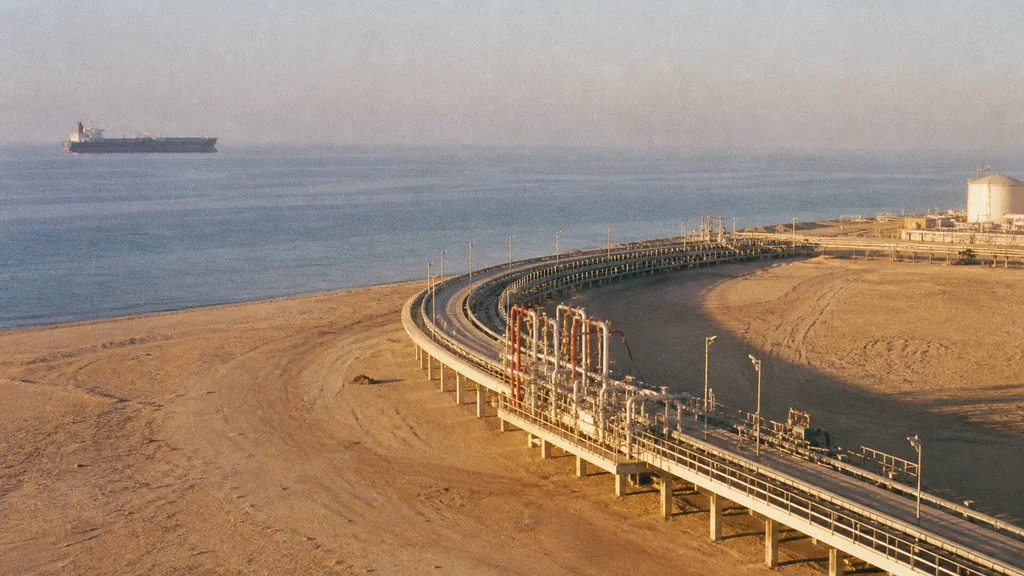
Europe’s new gas route bends toward Egypt’s growing domestic shortage.
Cumadóireacht íomhá · tobriefCyprus has been finding gas offshore for years. What it has not had, until now, is a field that moved from promising discovery to money on the table.
Eni and TotalEnergies have now made that move at Cronos, the first Cypriot offshore gas field to pass beyond exploration and into development. The plan is for the gas to reach European markets as LNG, meaning gas cooled until it shrinks enough to be shipped by tanker, by 2028. But the route to Europe runs through Egypt, and Egypt is no longer the easy export platform it once looked like.
How the gas gets to Europe
Cronos sits about 185 km southwest of Cyprus. Gas from four subsea wells will be sent through a new 105-km pipeline into the Egyptian system linked to Eni's giant Zohr field (TotalEnergies, Ahram Online). From there, existing pipelines take it to the Damietta LNG plant on Egypt's coast, where it is liquefied, loaded onto tankers and sent to a European regasification terminal.
The attraction is straightforward. Egypt already has the liquefaction plants. Cyprus does not. Building a standalone LNG facility on the island would cost roughly twice as much, so the cheaper route is to plug Cypriot gas into Egyptian infrastructure.
Cypriot Energy Minister Michalis Damianos has put the project cost at about $2 billion. He told AP that pipeline construction could begin later in 2026, take up to 18 months, and allow European consumers to receive gas as early as March 2028 (Euronews, ABC/AP).
Egypt needs the gas more than Europe does
That same Egyptian route is also the weak point. Egypt has moved from being a gas exporter to a net importer. Its domestic production fell from about 59 bcm in 2023 to 42 bcm in 2025, a drop the French Treasury and the US Energy Information Administration both link to falling output at Zohr and rising demand at home (French Treasury, EIA).
Egypt's own LNG imports reached a record 9.01 million tonnes in 2025, several times more than Cronos is designed to produce in a year (S&P Global, EnterpriseAM). That matters because Damietta, the plant meant to turn Cronos gas into exportable LNG, sits inside an Egyptian energy system under pressure.
The agreement reflects that reality. A clause allows roughly one-fifth of Cronos output to cover Egyptian needs (ABC/AP). Before Europe gets the full benefit of the project, Egypt has a contractual claim on part of the gas.
A real project, but a small one
The final investment decision matters. It is the point at which companies stop appraising a field and start spending serious capital. Eni, the operator with 50%, and TotalEnergies, also on 50%, are backing a field discovered in 2022, appraised in 2024, and now approved for development with a target plateau of about 2.8 million tonnes per year of LNG (Eni, TotalEnergies). Each company will market half.
For Europe, the volumes are useful but small. The EU imported a record 146 bcm of LNG in 2025, making it the world's largest LNG buyer (European Commission, MondoVisione/ACER). Cronos adds a non-Russian source from the eastern Mediterranean, which is politically useful. But at the disclosed scale, it is not large enough to shift European gas prices in any obvious way. No named European buyer, terminal allocation or long-term sales deal has been announced.
Cyprus gains most politically. Since 2011, it has had offshore discoveries but no producing gas field. For an island still generating most of its electricity from imported oil, getting its own gas into production is a marker in itself, even before any tanker sails for Europe. Cypriot officials called the investment decision "historic" (Cyprus Mail, Politis).
Eni and TotalEnergies get a faster, cheaper route to LNG sales. Egypt keeps its liquefaction plants working and secures the option to use some of the gas at home.
European households should not expect Cronos to bring down bills. The cargoes will land in a global LNG market where Asian demand, shipping costs and terminal access shape the delivered price.
Cronos is funded, sanctioned and real. The question now is whether Egypt's shortage leaves the export route open, or turns it into a pressure valve for Egypt's own energy needs.
How was this article?
Help us get better
Help us get better
Details about this article
- Model:
- claude-opus-4-6
- Generated:
- 8/10/2026, 2:10:29 AM
- Pipeline run:
- eu_pipeline_20260810_005005
- Watermark:
- SynthID (Google's invisible watermark)
- Human review:
- None before publication